

What Is a Cloud Kitchen?
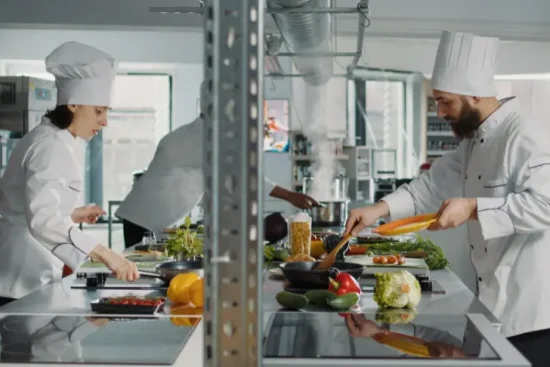
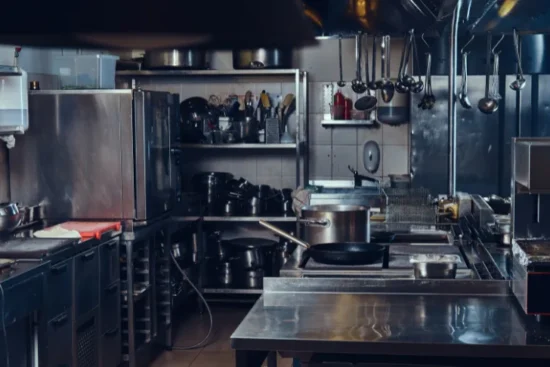
A cloud kitchen — also known as a ghost kitchen, virtual kitchen, or dark kitchen — is a commercial food preparation facility built exclusively for delivery-only meals. Cloud kitchens operate without customer-facing dining areas, relying on online ordering platforms such as Talabat, Deliveroo, Noon Food, Keeta, and Careem for orders.
The cloud kitchen model eliminates front-of-house staff, reduces overhead costs, and allows operators to prepare food in lower-cost locations.
Example: Kitopi, one of Dubai’s leading cloud kitchen operators, manages over 100 virtual restaurant brands across multiple kitchens, showcasing the power of this model in the UAE market.
Is Starting a Cloud Kitchen in Dubai Profitable?
The cloud kitchen model offers low-risk entry and strong profitability in Dubai’s delivery-driven market.
A. Market Size and Growth
According to Virtuzone’s 2025 cloud kitchen analysis, the UAE cloud kitchen market was valued at AED 1.01 billion in 2023 and is projected to reach AED 3.89 billion by 2030 at a CAGR of 25%. More than 400 cloud kitchens operate in the UAE, with the majority in Dubai. UAE foodservice spending also reached USD 8.9 billion in 2025, reinforcing demand for food delivery services.
B. Profit Margins
Cloud kitchens in Dubai achieve profit margins of 15–30%, nearly tripling the single-digit margins common in the traditional restaurant industry. Lower overhead costs (no dining space, fewer staff, no prime-location rent) drive these margins.
“People preferring to dine at home has made co-working kitchens an attractive option for culinary entrepreneurs looking to reduce overhead costs while reaching a broader audience.” — Fred Kawuli, founder of Smacko, Khaleej Times.
Operators who keep their business structure lean enough to pivot menus and respond to market trends separate profitable operations from struggling ones.
C. What Commissions Really Cost
Aggregator platforms in Dubai typically take 15–30% as commission of each order’s value.
On an average order of AED 45, a 30% commission (AED 13.50) plus food cost at 30% (AED 13.50) and packaging at 5% (AED 2.25) leaves a gross contribution of AED 15.75 per order. That contribution must cover rent, salaries, and other fixed costs before any profit remains.
Operators relying solely on aggregators without direct ordering channels like mobile apps or website face persistent margin compression, which is why many successful food delivery businesses invest early in their own online ordering platforms.
Key Benefits of a Cloud Kitchen Business
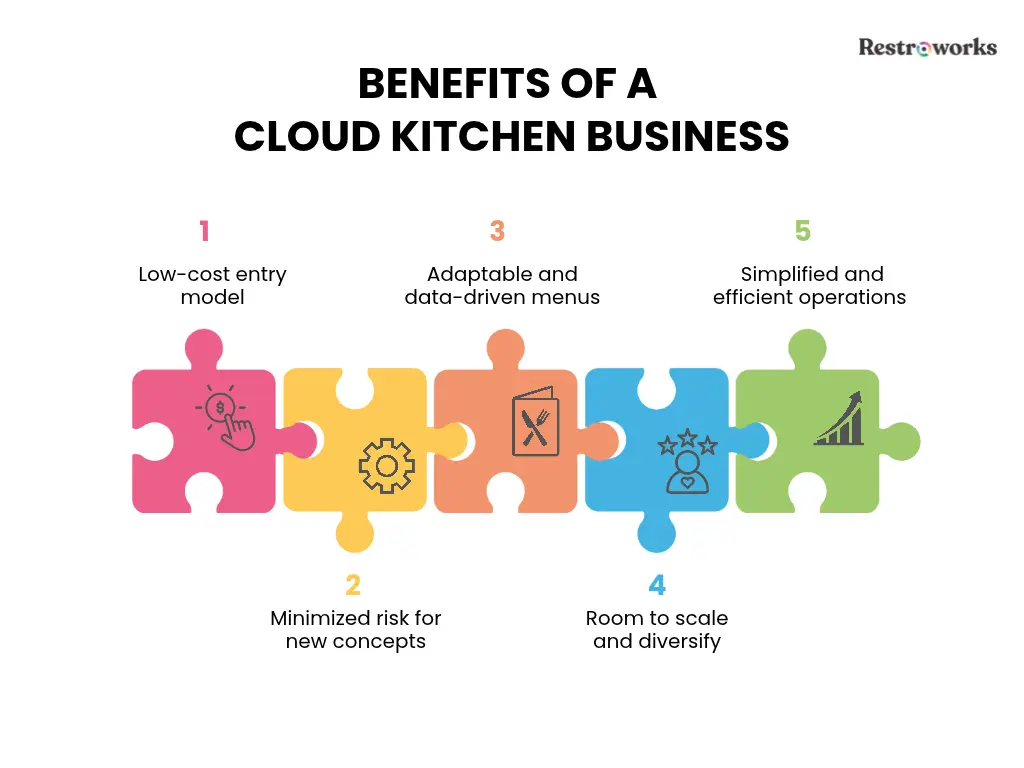
1. Low-Cost Entry Model: Cloud kitchens eliminate the need for expensive interiors, waitstaff, and high-rent dine-in locations, making them ideal for launching a food service business on a budget.
2. Minimized Risk for New Concepts: Entrepreneurs can experiment with niche or innovative food ideas without the high financial risk tied to a traditional restaurant setup.
3. Adaptable and Data-Driven Menus: Menus can be quickly updated based on customer feedback and sales performance, allowing businesses to stay relevant and optimize offerings.
4. Room to Scale and Diversify: Operators can expand rapidly by launching multiple virtual brands from a single kitchen or replicating the model across Dubai and other emirates.
5. Simplified and Efficient Operations: With delivery-focused workflows, online ordering platforms, and centralized systems, cloud kitchens run with streamlined staffing, reduced waste, and faster service.
Licenses Required for a Cloud Kitchen in Dubai
There’s no single “cloud kitchen license” in Dubai. You need a combination of commercial and food safety permits from several authorities, applied for in a specific sequence.
1. Trade License
Issued by the Department of Economy and Tourism (DET) for mainland businesses or by the relevant free zone authority. The trade license specifies your business structure, business activities, and company name. Expect AED 10,000–15,000, depending on jurisdiction and business setup requirements.
2. Food License
Required by Dubai Municipality’s food safety department for any facility that handles, prepares, or stores food. The application includes kitchen layout review, hygiene inspections, and verification that staff hold food safety certifications. Cost: AED 5,000–8,000.
3. HACCP Certification
Hazard Analysis and Critical Control Points certification is required for most cloud kitchen operations in Dubai, ensuring food preparation processes systematically identify and control safety hazards from ingredient storage through final packaging.
Check with Dubai Municipality for the specific requirements that apply to your establishment type.
4. Person in Charge and Food Watch
Every cloud kitchen must designate a certified Person in Charge (PIC) with a valid food handler certification. All kitchen staff require individual food handler cards. You must also register on Dubai Municipality’s Food Watch platform, which enables the food safety department to monitor compliance digitally.
5. Kitchen Layout Approval
Dubai Municipality reviews and approves your kitchen layout plan before operations begin, covering equipment placement, ventilation, waste disposal, and workflow design. Build this into your timeline, as layout approval can add two to four weeks.
6. Insurance, Fire Safety, and Additional Permits
Liability insurance is mandatory. Dubai Civil Defense requires a fire safety NOC before kitchen fit-out begins, covering fire-rated ducting and gas detection with automatic shutoff. The approval process adds four to eight weeks.
Operators running their own delivery fleet need a delivery service permit, and multi-brand operations importing in bulk may require a foodstuff supply license.
INDUSTRY INSIGHT
Mainland vs Free Zone: Which Jurisdiction Suits Your Cloud Kitchen?
Choosing between mainland and free zone is one of the most consequential decisions for your cloud kitchen. Mainland companies, registered through DET, can deliver across all of Dubai and the wider UAE without restriction.
Free zone companies (through authorities such as DMCC, IFZA, or Dubai CommerCity) offer simplified business setup and full foreign ownership, but face a legal constraint: free zone entities generally cannot sell directly to mainland customers unless they obtain a DET license or permit under the Executive Council.
Mainland licenses cost around AED 15,000–AED 25,000 and give unrestricted delivery coverage across all emirates. Since mid-2021, mainland LLCs in most commercial activities allow 100% foreign ownership, removing what was once a key free zone advantage.
Free zones still offer faster company formation and lower initial costs, but if your target audience includes high-demand residential areas outside the free zone, the legal trading restriction directly limits revenue.
Step-by-Step Guide to Starting a Cloud Kitchen in Dubai
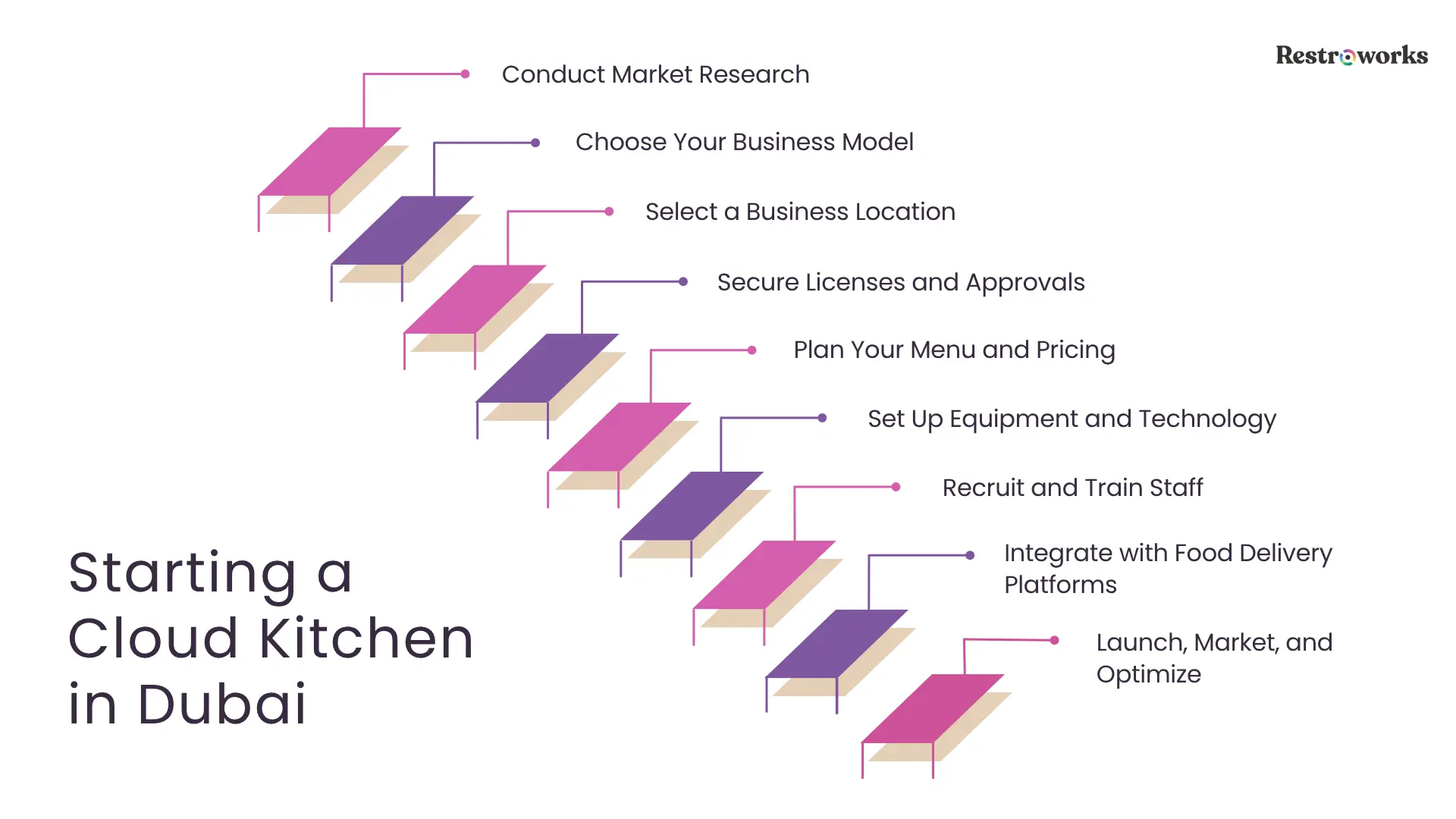
Step 1: Conduct Market Research
Analyze local food delivery trends, top-performing cuisines, and competitor pricing. Identify your target audience and study which food delivery apps dominate in your area. Use market research to spot gaps: underserved cuisines, unmet dietary needs, or time slots competitors ignore.
Step 2: Choose Your Business Model
Three cloud kitchen models dominate Dubai:
- Single-brand: One cuisine, one concept. Simplest to launch but highest failure risk if the concept underperforms
- Multi-brand: Multiple virtual restaurant brands from one kitchen, offering greater resilience and revenue diversity
- Shared or managed kitchen: Lease space from operators such as Kitopi, CloudKitchens, or Kitch at AED 8,000–25,000 per month. This is the lowest-cost option, but with limited control over operations.
A single-brand cloud kitchen runs the risk of poor performance when the operator commits without testing demand. And if your cuisine underperforms on delivery platforms, pivoting requires a full rebrand: new packaging, new listings, new marketing.
Multi-brand operators shift volume to whichever virtual restaurant brand performs best, making this the right business structure for most first-time operators.
Step 3: Select a Business Location
Proximity to high-demand delivery zones matters more than foot traffic. Verify that the property permits commercial cooking and complies with Dubai Municipality zoning for your chosen business location.
Also consider delivery efficiency. A kitchen within a 10–15 minute radius of central areas like Dubai Marina, JLT, or Business Bay receives more orders than one in an industrial zone.
Step 4: Secure Licenses and Approvals
Register with DET or your chosen free zone authority. Reserve a company name complying with UAE regulations, submit your business structure and activity details, and obtain initial approval. Apply for your food license through Dubai Municipality, including kitchen layout submission and staff food safety certification.
Consolidated timeline: The full licensing and approval process takes 10–20 weeks. Trade license processing can take 10-15 days for approval and final licensing. In parallel, you can submit your kitchen layout for Dubai Municipality approval (two to four weeks).
The Civil Defense fire safety NOC must be obtained before fit-out begins and adds another 20-30 days. Build this sequence into your launch plan, as the Civil Defense NOC is a prerequisite for starting kitchen construction.

Step 5: Plan Your Menu and Pricing
It’s a good idea to start with 8–12 dishes, focusing on items that travel well and maintain quality during delivery. Keep food cost between 25% and 35% of the menu price.
This range matters because food cost is the single largest variable expense in a cloud kitchen. Below 25%, consistent quality becomes difficult to deliver, and ingredient shortcuts show up in reviews.
Above 35%, commissions and fixed costs consume remaining revenue. Factor in packaging and aggregator commissions (15–30%) when setting prices.
Packaging compliance: Dubai Municipality’s single-use plastic ban reached its final phase on 1 January 2026, covering plastic plates, cutlery (including chopsticks), and beverage cups and lids, on top of the polystyrene containers, straws, and stirrers already banned in 2025. Delivery kitchens must budget for compliant alternatives such as bagasse, kraft paper, or PLA-lined containers.
Factor this into your packaging cost line, as compliant materials typically cost more than the banned alternatives. Study competitors on delivery platforms and position your menu within your target audience’s spending habits.
Step 6: Set Up Equipment and Technology
Start by purchasing essential commercial kitchen appliances that match your menu requirements. This includes ovens, fryers, chillers, prep tables, and storage units. Equipment should be durable, easy to clean, and energy-efficient to reduce long-term costs.
The right tools not only improve food quality but also ensure compliance with Dubai Municipality’s safety standards. Additionally, invest in technology to better manage and automate your restaurant operations.
This includes installing a cloud-based POS system, the backbone of any cloud kitchen operation. Choose a POS system that integrates with online ordering platforms like Talabat, Noon Food, and Deliveroo. This integration streamlines order processing, provides real-time tracking, and centralizes reporting.
You can also replace paper tickets with a digital kitchen display system to improve order accuracy and kitchen efficiency.
Step 7: Recruit and Train Staff
Hire chefs, kitchen assistants, and a hygiene supervisor. All staff require food safety certification and food handler cards.
Monthly kitchen staff salaries typically range from AED 12,000 to AED 25,000, including chefs and line cooks. Work visas cost AED 3,000–7,000 per employee; basic health insurance runs AED 700–1,500 per employee per year.
Step 8: Integrate with Food Delivery Platforms
Register on online platforms such as Talabat, Deliveroo, Noon Food, Keeta, and Careem. Keeta launched in Dubai in September 2025 and has since expanded across all seven emirates, with its founding vendor program offering zero setup costs.
When integrating with these platforms, focus on the following:
- Negotiate commission rates and visibility terms: Commissions range from 15% to 30%, so plan your pricing accordingly.
- Sync your POS system with delivery: Connect your POS system with aggregator dashboards to streamline order management.
- Develop direct ordering channels: Create your own website or WhatsApp to reduce dependency on delivery services and improve delivery efficiency.
Step 9: Launch, Market, and Optimize
Run pre-launch campaigns on Instagram and TikTok. Partner with food bloggers and influencers. Offer first-time customer discounts, since platforms rank cloud kitchens by review scores and order volume. Monitor delivery times, order accuracy, and customer feedback.
Minimize food wastage through demand forecasting and portion control. As your cloud kitchen matures, explore AI-driven tools for dynamic pricing and predictive ordering based on order data and market trends.
Running Multiple Virtual Brands from One Cloud Kitchen
Operating multiple brands from a single ghost kitchen is the cloud kitchen model’s most powerful scaling lever — one virtual kitchen, one team, one set of kitchen equipment, but several distinct virtual restaurant brands on delivery platforms. A
According to Arabian Gulf Business Insight’s cloud kitchen analysis, Kitopi scaled to 200 brands across five GCC states by standardizing kitchen workflows.
Here’s an example. An operator runs three brands: a burger concept, a healthy bowl line, and a biryani brand from a shared AED 12,000 per month kitchen, and allocates different stations per brand.
If one underperforms, the operator reallocates kitchen time and marketing spend to stronger brands without additional rent or equipment costs. The underperforming brand can be retired or relaunched without disrupting the others.
As Mona Al Sayah, CEO & Co-Founder of Hostmind, mentions in a conversation on Restrocast–
“A lot of brands have the misconception of opening a Cloud Kitchen where we just open any brand, we launch it, and we move forward. And it’s very easy to fall into this cycle. I don’t want to say trap because it’s not always a trap.
It’s very easy to launch a brand on aggregators, right? You set up a license, you pay, you have the money, you launch it within one month, if you are accurate in execution, et cetera. And this is why the average rate of brands opening and closing is 500 concepts a week.”
Cost Breakdown for Starting a Cloud Kitchen in Dubai