
what is the future of dining people discussing

Cloud Kitchen vs Restaurant: Key Differences, Costs & Which Is Better

Home / Blog /
Cloud Kitchen vs Restaurant: Key Differences, Costs & Which Is Better

Read summarized version with

Cloud kitchen vs restaurant – The core difference between the two is that a cloud kitchen prepares food exclusively for delivery, with no dine-in space or customer-facing storefront. On the other hand, a traditional restaurant centers on a physical location where guests dine in. 

In the US, cloud kitchens launch for somewhere between $20,000-$250,000 (shared stations from $20K; independent facilities from $50K), and operators report margins of 8-15% depending on format and direct-order mix. Traditional restaurants require $250,000-$1.5 million and yield 3-9%. Both business models work, and both fail, too, for very different reasons.

The business model you choose determines your margins, your relationship with customers, your brand equity, and your survival odds through the first three years. In fact, with total US restaurant and foodservice sales projected to reach $1.55 trillion in 2026 and online food delivery accounting for a growing share, the decision is no longer theoretical.

Cloud kitchens offer lower overhead costs, speed to market, and direct access to delivery demand. Traditional restaurants offer dine-in revenue, customer dialogue, and compounding brand equity. Understanding the structural reasons each model fails is what separates operators who last from those who close in their first year.

What You’ll Learn

  • Clear definitions and how each model actually works day to day
  • A verified, US-specific cost and profit margin comparison
  • Which model fits which goals, budgets, and experience levels
  • Real examples from US operators, including Brinker International
  • How the hybrid model is reshaping the food industry in 2026
  • Common mistakes that kill both models

Already operating a restaurant and evaluating a format change? The decision framework, hybrid model, and common-mistakes sections later in this article are built for experienced owners.

Why the Restaurant Industry Is at an Inflection Point

The old prescription for restaurant success was simple: 

  1. Good location
  2. Good restaurant design
  3. Good food
  4. Enough repeat business to keep the doors open

That prescription, of course, still works. It just no longer describes what is possible.

A parallel food service economy has developed over the past decade. Before the pandemic, the US restaurant industry was growing 3 to 4 percent per year, while delivery sales were increasing at roughly twice that pace, i.e., at 7 to 8 percent annually. Today, that gap has only widened. Online ordering now accounts for more than a quarter of all restaurant and convenience-store orders nationwide.

COVID-19 hit, and the dining room business went away. The delivery business went on. The dining rooms reopened, but the delivery habits formed during the pandemic stayed. Consumers who discovered third-party ordering between 2020 and 2022 kept ordering that way.

The global cloud kitchen market was valued at $36.9 billion in 2023 and is projected to reach $74.6 billion by 2030, growing at a CAGR (compound annual growth rate) of 10.6%. On top of that, a 2022 Grubhub and Technomic survey found that 41% of independent restaurant operators in the US are running at least one virtual restaurant concept.

This is no longer a story of disruption or competition. Cloud kitchens and traditional restaurants have become allies. Brinker International, in fact, proved it when It’s Just Wings was on track to reach $150 million in annual sales from existing Chili’s kitchens, without a single new lease. How does this kind of alliance work? To understand it, you must know what each model is designed to do in the first place.

What Is a Cloud Kitchen Business Model?

A cloud kitchen is a commercial kitchen that specializes in preparing food for online orders, without a storefront or any customer-facing presence.

The terms cloud kitchen, ghost kitchen, and virtual brand are often used interchangeably, but they describe different things. A cloud kitchen is a delivery-only commercial kitchen facility — the umbrella term for the physical space. A ghost kitchen is a third-party-operated shared facility where multiple operators lease stations and share infrastructure. A virtual brand is a delivery-only restaurant concept that may operate from a cloud kitchen, a ghost kitchen, or an existing restaurant’s kitchen.

A cloud kitchen business removes unnecessary elements from a food business. There are no host staff. There is no customer seating. There are no walk-in customers. It is a very simple business model based on a single principle: take in food orders from food delivery platforms, cook and package the food, and hand it off to delivery drivers.

Cloud kitchens operate under four distinct models – 
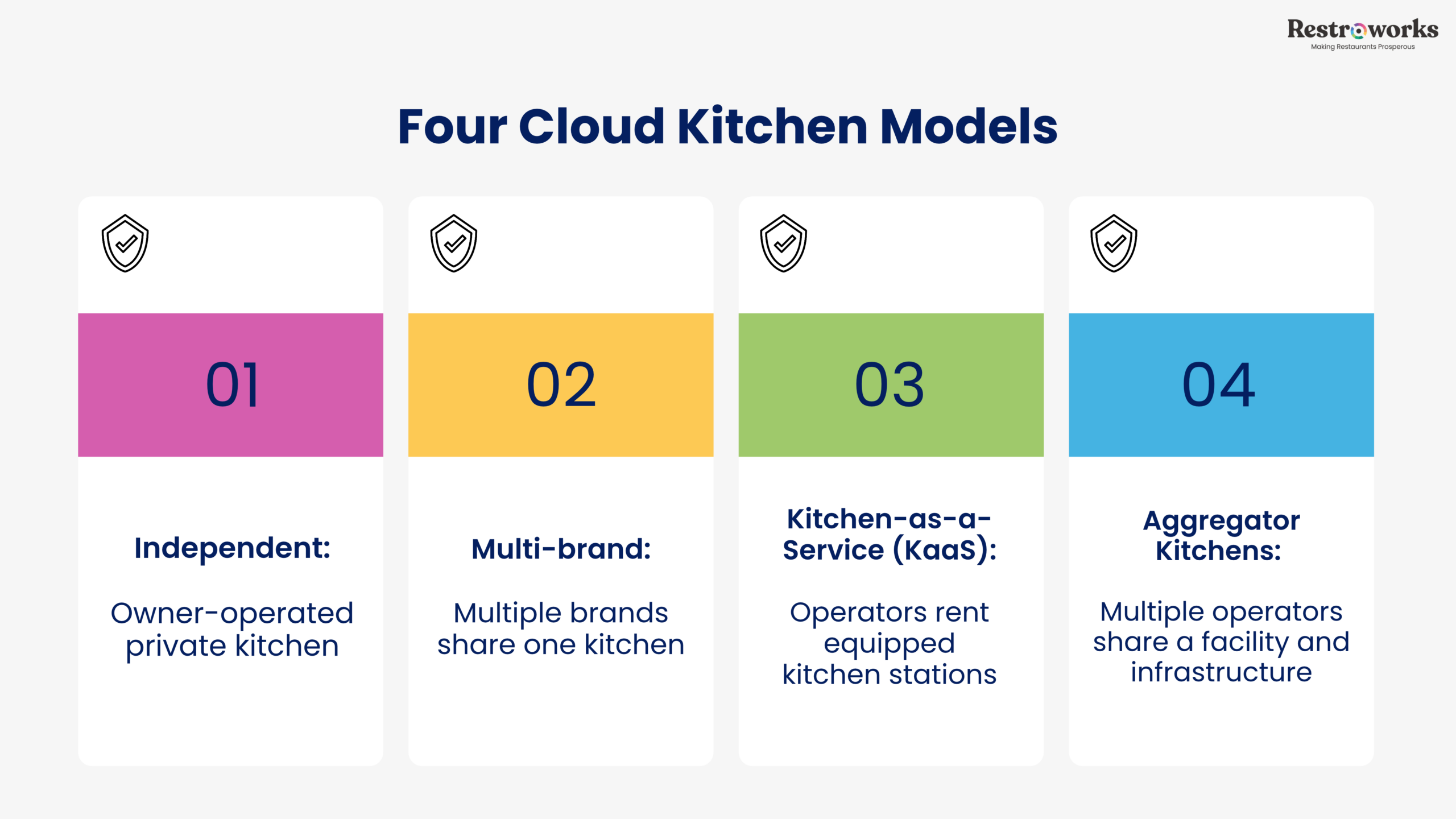
Cloud kitchen vs restaurant - 4 models of cloud kitchens

  1. An independent cloud kitchen is owner-operated from a private facility. 
  2. Multi-brand cloud kitchens operate multiple brands from one space. 
  3. Kitchen-as-a-Service (KaaS) providers lease fully equipped stations to operators. 
  4. Aggregator kitchens bundle multiple independent operators under one roof with shared infrastructure.

For restaurant owners adding a delivery brand, KaaS offers the lowest entry barrier: no second lease, no equipment purchase. In the US, providers like CloudKitchens (operating in Los Angeles, Chicago, Dallas, and other metros) and Kitchen United (which closed its physical locations in late 2023 and pivoted to software) lease fully equipped stations to operators. Industry pricing for turnkey cloud kitchen stations in major US metros typically falls in the $3,500-$6,000 per month range, depending on the market, kitchen size, and included services. Independent kitchens offer more control but require the full capital commitment of a standalone facility.

How a Cloud Kitchen Operates Day to Day

A cloud kitchen’s daily workflow follows five steps:

  1. Online orders arrive through food delivery apps (DoorDash, Uber Eats, Grubhub) and the kitchen’s own direct ordering system.
  2. A digital order management system such as Restroworks cloud kitchen software aggregates orders from multiple delivery platforms into a single queue.
  3. The system routes each order to the correct kitchen station based on brand and cuisine type.
  4. Kitchen staff cook and package the order using delivery-optimized containers.
  5. Delivery drivers collect the packaged order from the ghost kitchen for last-mile fulfillment.

There are no hosts, servers, or dining spaces to maintain. Labor costs are structurally lower. Cloud kitchens can save 30-40% of labor costs as compared to traditional restaurants. A typical cloud kitchen generating $30,000-$50,000 in monthly revenue operates with 3-5 kitchen staff per shift, compared to 8-15 staff (kitchen plus front-of-house) for a similarly sized dine-in operation.

A cloud kitchen can operate multiple brands from the same facility, be it a burger brand, a noodle brand, and a healthy grain bowl brand, all sharing one kitchen. One facility, multiple revenue streams. Ghost kitchens work on a similar principle but typically operate as third-party facilities, offering less control over branding and operations.

Cloud Kitchen: What the Numbers Actually Look Like

Cloud kitchen costs look like:

  • Startup costs: $20,000-$60,000 for a ghost kitchen (the $20,000 entry point reflects shared commissary spaces in markets like Houston, Dallas, and Atlanta where operators lease a station with equipment included); $50,000-$250,000 for an independent facility (based on US shared-kitchen operator pricing and industry benchmarks, 2024)
  • Profit margins (optimized): 8-15% for cloud kitchen operators, depending on format and direct-order mix 
  • Break-even timeline: 6-18 months depending on format and market
  • Monthly revenue potential: $20,000-$60,000 per well-positioned cloud kitchen unit

A ghost kitchen trades the dine-in experience and direct customer interaction to focus solely on delivery, gaining lower overhead costs compared to traditional restaurants, operational efficiency, and the ability to reach delivery customers entirely through online platforms. The trade-off is structural, not fixable with better packaging. Know what you’re giving up before you launch.

What Is a Traditional Restaurant?

A traditional restaurant is a foodservice establishment with a physical location where customers visit, dine, and interact with the brand.

This includes a tremendous range, from fast-casual in New York to full-service in California to fine-dining in Chicago. The National Restaurant Association estimates over one million restaurant locations operate in the US, with projected sales of $1.55 trillion in 2026 and an industry workforce of 15.8 million. What they share is a customer experience beyond food alone: the environment, service quality, ambiance, and direct human interaction are all part of the product.

Traditional restaurants can and do deliver food. They can and do have virtual brands. The business operations, real estate, staffing, and loyalty of traditional restaurants are all based on dine-in customers.

How Traditional Restaurants Operate

The structure centers on visible, customer-facing operations. The customer walks in, gets seated, welcomed, and served. Preparing food is central, but the value does not stop there. It encompasses the entire customer experience, from the dine-in area and service to how customer satisfaction and repeat business are built through customer loyalty.

A typical full-service restaurant operates two distinct labor pools: kitchen staff (line cooks, prep cooks, dishwashers) and front-of-house staff (hosts, servers, bussers, bartenders). Peak service requires coordinating 8-15 employees per shift to deliver a target of 1.5-2.5 table turns. That’s a complex operation, hard to replicate when done well, and the reason labor represents the single largest variable cost at 28-35% of sales.

What Is the Operational Cost Stack of Running a Traditional Restaurant

Opening and running traditional restaurants means carrying operational costs that cloud kitchen operators don’t face:

  • Initial investment: Counter-service restaurants cost $150,000-$500,000; full-service restaurants range from $250,000-$1,500,000 in the US.
  • Restaurant build-out: Nationally, $100 to $800 per square foot depending on market, concept, and the space’s prior use.
  • Staff wages: NYC restaurant workers earn $17-$68/hour across roles, from entry-level kitchen and counter staff at New York City’s minimum wage floor to food service managers at the 90th percentile.
  • Labor as a share of revenue: a median of 36.5% of sales for full-service and 31.7% for limited-service restaurants in 2024, well above the historical average of roughly 33% and 28% respectively.
  • Utilities: $1,000-$2,500 monthly for a smaller, quick-service restaurant.

The point isn’t that these costs are prohibitive; it’s that they’re structural. Every decision a traditional restaurant owner makes about location, dining area design, and staffing carries ongoing operational costs that don’t exist in a cloud kitchen.

Cloud Kitchen vs Restaurant: The Numbers That Matter

Most guides list key differences in startup costs and call it done. The more important comparison is ongoing operational costs, profit margins, and what you’re actually buying with each model.

Model Typical US Startup Cost
Ghost kitchen (shared/commissary) $20,000–$60,000
Cloud kitchen (own facility) $50,000–$250,000
Counter-service restaurant $150,000–$500,000
Full-service restaurant $250,000–$1,500,000

In a high-demand US market such as Los Angeles or New York, it takes 12-18 months and $750,000-$1.5 million to open a full-service restaurant business, according to industry cost benchmarks for high-rent metros. In contrast, it takes only 30-60 days to open a cloud kitchen in the same market.

3-Year Comparative Cash Flow: $100,000 Cloud Kitchen vs $500,000 Counter-Service Restaurant

Metric Cloud Kitchen
Year 1
Cloud Kitchen
Year 2
Cloud Kitchen
Year 3
Restaurant
Year 1
Restaurant
Year 2
Restaurant
Year 3
Initial investment $100,000 – – $500,000 – –
Monthly revenue (avg) $30,000 $42,000 $50,000 $55,000 $75,000 $85,000
Annual revenue $360,000 $504,000 $600,000 $660,000 $900,000 $1,020,000
Food cost (30%) $108,000 $151,200 $180,000 $198,000 $270,000 $306,000
Labor cost $72,000 $100,800 $120,000 $231,000 $315,000 $357,000
Rent and occupancy $42,000 $42,000 $44,000 $96,000 $96,000 $100,000
Platform commissions $79,200 $100,800 $112,000 $29,000 $36,000 $41,000
Other operating costs $30,000 $50,000 $54,000 $86,000 $129,000 $130,000
Net operating income $28,800 $59,200 $90,000 $20,000 $54,000 $86,000
Cumulative cash flow −$71,200 −$12,000 $78,000 −$480,000 −$426,000 −$340,000

Assumptions: Cloud kitchen reaching approximately 15% operating margin by year 3 ($90,000/$600,000 = 15.0%) with growing direct-order share reducing effective commission rate. Counter-service restaurant at 35% labor cost (NRA median for limited-service) reaching approximately 8% operating margin by year 3 ($86,000/$1,020,000 = 8.4%). 

Note: “operating margin” here means revenue minus the operating costs shown; it excludes debt service, depreciation, and taxes, so actual net profit will be lower. Platform commissions are modeled at a 22% blended rate for the cloud kitchen (30% on marketplace orders, reduced by growing direct channel) and 20% on the delivery-only share for the restaurant (delivery at roughly 20% of revenue). Revenue growth assumes metro-area demand density.

These projections illustrate the structural difference in capital recovery timelines: the cloud kitchen reaches positive cumulative cash flow at roughly month 26 (the $71,200 year-1 deficit shrinks to $12,000 by the end of year 2 and is cleared about two months into year 3, at roughly $7,500 per month), while the counter-service restaurant is still $340,000 short of recovering its initial investment at month 36. 

Profit Margin Comparison

Restaurant Type Profit Margin
Full-service restaurant Approximately 3% median pre-tax
Fast casual / QSR 5–9% fast casual; 6–9% QSR net margin
Ghost kitchen (average) 8–15%, depending on format and direct-order mix
Cloud kitchen (optimized) 8–15%

The average US restaurant operates at a net margin of just 3–5% (and that too on good days, says Dr. Anne McBride). The James Beard Foundation’s 2025 Independent Restaurant Industry Report describes that benchmark as under persistent downward pressure, with 50% of independent operators reporting lower profits in 2024. Cloud kitchens with disciplined operations consistently outperform that benchmark. But that advantage disappears fast when delivery platform fees aren’t managed well.

The Commission Problem Nobody Talks About

Third-party delivery apps — the same platforms that provide cloud kitchens their entire customer base — charge 15–30% commission per order.

A worked example makes the margin math clear: on a $30 delivery order at 25% commission, the operator keeps $22.50. Subtract food cost at 30% of the menu price ($9.00), packaging ($1.50), and allocated labor ($4.50), and the operator nets $7.50 — a 25% margin before rent, utilities, and marketing. Raise the commission to 30% and net drops to $6.00 (20%). On a direct order with no commission, net jumps to $15.00 (50% before fixed costs).

Pauline Ibrahim, F&B CEO and guest on Restrocast, discussed this structural problem: how delivery commissions, food costs, rent, and labor combine to destroy the profitability of cloud kitchens that aren’t finely tuning each line item.

Key Differences: Cloud Kitchen vs Restaurant

Factor Cloud Kitchen Traditional Restaurant
Physical dining space None Required
Dine-in space No Yes
Customer interaction Digital/delivery only In-person, multi-sensory
Front of house staff Not required Essential
Startup costs (US) $20,000-$250,000 $250,000-$1.5M
Profit margins Operators report 8–15% 3–9% (varies by type)
Customer loyalty Harder to build Built through experience
Brand recognition Platform-dependent Location and experience-driven
Scalability Fast, capital-light Slower, capital-intensive
Time to launch 30–60 days 12–18 months
Revenue streams Delivery, direct orders Dine-in service, takeaway, delivery services

In short: Cloud kitchens trade dining-room costs for delivery-platform dependency, launching at $20K-$250K with operators reporting 8-15% margins depending on format and direct-order share. Traditional restaurants invest $250K-$1.5M for in-person brand equity at 3-9% margins. Neither model is inherently superior. The right choice depends on your capital, timeline, and whether your concept needs a physical space to deliver its full value.

The Customer Experience Gap That Doesn’t Close

The product of the cloud kitchen is convenience. The product of traditional restaurants is an experience. They are different products. They cannot be made different through improved packaging.

The product of your cloud kitchen, delivered through the apps, is something that you can control: the quality and appearance of the food. However, you cannot control the delivery driver, the bag’s temperature, or the 25 minutes it takes to get there. The entire customer experience is contained within the food.

The product of traditional restaurants is not just the food. It is the dining area. It is the interaction with the server. It is the ambiance. It is the relationship that is built over time through exceptional customer service. Your customers come back because of how they feel. They don’t come back because of what they ate. That is the difference.

Joseph Unger, current President and COO of GOSH Enterprises, leading non-traditional restaurant groups at REEF Technology, shared his perspective on this: “The opportunity with ghost kitchens is real. The challenge is ensuring the format works with the concept, because without a physical space, it’s not always easy. Not all concepts translate.”

The discipline is knowing which category your concept falls into before you spend the money.

The financial gap mirrors the experience gap. Bloom Intelligence’s 2025 guest-retention data, drawn from platform analytics across full-service and quick-service locations, shows that only 25% of first-time restaurant guests return within 90 days.

Among guests who do come back, the value gap is stark. Loyal diners carry a projected five-year lifetime value of $1,490 at roughly 8.5 orders, nearly three times the $555 from guests who churn after 4.2 orders.

Cloud kitchen operators closing the retention gap use five tactics to build loyal customers without a dining room: 

  1. Handwritten thank-you notes or branded inserts in every delivery bag.
  2. A direct ordering channel with a first-order discount to capture the customer off-platform.
  3. SMS or email follow-up within 24 hours of a first order.
  4. A simple loyalty program (every 10th order free) tied to the direct channel. 
  5. Consistent packaging and presentation that builds visual brand recognition across orders.

For restaurant owners adding a virtual brand, the retention math shifts. If existing dine-in guests order from your new delivery brand, the relationship is already built. That audience bypasses the cold-start problem that makes standalone cloud kitchen customer acquisition expensive.

Choosing the Right Model: A Framework

Use this decision matrix to score each factor on a 1–5 scale for your situation. A total above 25 leans toward a cloud kitchen; below 15 leans toward a traditional restaurant; between 15 and 25 suggests a hybrid approach.

Decision Factor Cloud Kitchen Favored (4–5) Either Model (3) Restaurant Favored (1–2) Your Score
Available capital Under $150K $150K-$500K Over $500K ___
Time to first revenue Under 90 days needed 3-12 months 12+ months acceptable ___
Brand experience goal Delivery convenience Mixed channels In-person dining experience ___
Customer relationship Transactional, volume-based Growing repeat base Long-term loyalty, regulars ___
Market validation Untested concept or cuisine Some local data Proven concept, relocating ___
Scaling ambition 10+ locations in 3 years 2-5 locations Single flagship ___
Delivery infrastructure Strong platform presence in zone Moderate delivery demand Weak delivery, strong foot traffic ___
Total ___ /35

If Budget Is the Primary Constraint

The cloud kitchen is the logical place to begin. The cost differential between a shared cloud kitchen ($20K-$60K) and a counter-service restaurant ($150K-$500K) ranges from $90,000 to $480,000, depending on the facility, equipment, and build-out requirements.

US shared kitchen providers like CloudKitchens and locally operated commissaries in most major metros offer turnkey stations where an operator’s total launch budget breaks down roughly as follows: 

First and last month’s rent plus deposit ($7,000-$14,000)

Smallwares and packaging setup ($2,500-$5,000)

Initial food inventory ($3,000-$5,000)

Platform onboarding and photography ($1,500-$3,000)

Permits and insurance ($2,000-$3,000)

Total comes to $16,000-$30,000 for a shared-kitchen launch. Cloud kitchens let first-time food entrepreneurs focus solely on testing a new concept with minimal investment.

If Brand Building Is the Primary Goal

Traditional restaurants, when done correctly, provide a sense of place that a cloud kitchen struggles to match. People associate with a location — they celebrate there, they become regulars at a specific table. That structural customer loyalty is difficult to build as a delivery profile.

A cloud kitchen can establish a strong virtual brand. MrBeast Burger demonstrated this at scale: launched in late 2020 as a delivery-only brand through a licensing deal with Virtual Dining Concepts, opening at roughly 300 existing restaurant kitchens and eventually expanding to more than 1,700 US locations. It was on track to surpass $100 million in cumulative revenue by mid-2022, leveraging the creator’s digital audience rather than physical locations.

The model proved that brand-building through digital channels alone is possible at massive scale and then demonstrated the risk. Quality-control challenges across hundreds of partner kitchens led to widespread customer complaints about food quality. In July 2023, MrBeast sued Virtual Dining Concepts to shut down the operation, alleging the brand was producing “disgusting” and “inedible” food that was damaging his reputation. The lesson is that building a virtual brand requires more, not less, operational discipline because the customer experience must be consistent without the feedback loop of in-person service, and that licensing a brand across hundreds of kitchens without centralized quality control is a structural vulnerability.

For operators without an existing audience, building customer loyalty in a delivery-only format requires greater focus on digital marketing, direct ordering channels, and the quality of the digital experience to establish direct relationships with customers. It is possible; it just takes longer and is more intentional.

If Speed to Market Is Critical

Cloud kitchen. No ambiguity. A commissary-based cloud kitchen can be launched in Dallas, Houston, Los Angeles, and other markets in as little as 30 to 60 days to accept its first delivery order. Traditional restaurants take 12 to 18 months in these same markets.

A realistic 45-day cloud kitchen launch timeline looks like this: weeks 1–2 (sign lease, apply for permits, order smallwares and packaging), weeks 3–4 (finalize menu, set up POS and delivery platform accounts, photograph menu items, hire 2–3 kitchen staff), weeks 5–6 (soft launch on one platform, test order flow and delivery packaging, adjust menu based on early feedback), week 7 (go live on all platforms, activate marketing spend).

If You’re Scaling to 25-100+ Locations

This is where the two concepts diverge most.

Cloud kitchens that operate multiple brands can scale into new locations without spending money on new physical infrastructure. You’re not building dining spaces. You’re leasing kitchens and plugging into the food delivery ecosystem. This is a capital-efficient way to expand into new locations.

For brick-and-mortar restaurants, the cost of entry and exit is much slower and much costlier. But every restaurant creates its own brand equity, which compounds over time.

While most examples in this guide are US-based, the scaling principle is best illustrated by a GCC operator whose volume thresholds translate directly. Mr. Mubarak Jaffar is Co-Founder and CEO of KLC Virtual Restaurants, one of the most scaled cloud kitchen operations in the GCC, with more than 80 virtual brands across cloud kitchens in Kuwait, the UAE, and Qatar (KPMG Kuwait F&B Report, 2024). On Restrocast, he shared the basic rule for scaling: “A single kitchen location must need more than 500 orders a day to be viable. Below that, business economics doesn’t work.” 

US operators in high-density metros like New York and Los Angeles apply the same demand-density test; though the threshold varies by market, the principle is identical. His approach to scaling reflects that discipline: one kitchen per demand zone, standardized menu and packaging, and every brand created based on a validated need, not opinion.

EXPERT INSIGHT

“Build multiple brands and capture a cuisine, as opposed to having one brand to capture a cuisine.” 

– Mubarak Jaffar, Co-Founder & CEO, KLC Virtual Restaurants.

For operators managing 25-100+ locations, that kind of systematic, data-led approach is the difference between a scalable food business and an operationally chaotic one.

If You’re Planning an Exit

Traditional restaurants with established locations sell at a median of 1.85 times seller’s discretionary earnings, according to BizBuySell data from 8,692 completed US transactions between 2021 and 2025. Equipment, leasehold improvements, and liquor licenses add floor value. Cloud kitchens command lower multiples unless they own proprietary brands with proven direct-order channels.

For operators adding a virtual brand, the hybrid approach can lift total valuation — the dine-in operation provides the asset base while the delivery brand demonstrates growth and revenue diversification.

The Hybrid Model: Where Smart Operators Are Landing

The cloud kitchen vs restaurant debate is becoming less binary. The most interesting operators in 2026 aren’t choosing one model; they’re using both.

Hybrid configurations typically take one of three forms: 

  1. A dine-in restaurant that launches delivery-only virtual brands from its existing kitchen (the Brinker model below).
  2. A cloud kitchen operator that opens a small pickup-and-takeout counter to build local brand presence without a full dining room.
  3. A multi-unit operator that runs some locations as dine-in and others as delivery-only, matching format to each neighborhood’s demand profile.

The Brinker International Playbook

In June 2020, Brinker International, the Dallas-based parent company of Chili’s, announced the launch of It’s Just Wings, a delivery-only virtual brand created entirely within existing Chili’s and Maggiano’s kitchens, with delivery offered exclusively through the DoorDash network.

No new leases, no new dining rooms, no new kitchen staff — simply leveraging existing infrastructure to build a new restaurant business revenue stream.

It’s Just Wings was on track to reach $150 million in annual sales in its first year, pacing at roughly $3 million per week. In its first month, 70% of sales came from customers who had not previously ordered from Chili’s.

As then-CEO Wyman Roberts put it, “it’s not overbuilt, maybe it’s just underutilized.”

The story didn’t end there. By 2023, diner demand for virtual brands had weakened as pandemic-era dining restrictions faded. Under new CEO Kevin Hochman (who succeeded Roberts in June 2022), Brinker “graduated” It’s Just Wings into the real world, adding it prominently to Chili’s bar and dining room menus, giving the brand the marketing power and foot traffic of the core chain. Brinker also discontinued its Maggiano’s Italian Classics virtual brand as part of an effort to simplify operations. The pivot made the hybrid argument stronger, not weaker: the virtual brand ultimately fed the dine-in menu, proving that cloud kitchen concepts and traditional restaurants can strengthen each other.

IHOP and Applebee’s followed with their own delivery-only virtual brands operating from existing kitchen infrastructure. Applebee’s Cosmic Wings and similar efforts were eventually folded or wound down as demand for standalone virtual brands cooled, further reinforcing the hybrid integration model over pure virtual-brand expansion.

What Happened After the Hype: The 2023–2025 Shakeout

The ghost kitchen sector’s pandemic-era momentum did not last. As diners returned to restaurants and delivery growth plateaued, several high-profile operators pulled back or shut down entirely:

  • Kitchen United, which had raised approximately $175 million in funding and operated virtual commissary locations inside select Kroger supermarkets, closed all its physical locations in late 2023 and pivoted to a software-only model.
  • Brinker International discontinued its Maggiano’s Italian Classics virtual brand and moved It’s Just Wings onto Chili’s in-store menus rather than keeping it delivery-only.
  • Applebee’s wound down Cosmic Wings; its dedicated website now redirects to the main Applebee’s site.
  • Wendy’s, once bullish on virtual brands, reversed course and pulled back from the model.

The shakeout did not kill the cloud kitchen concept. It corrected the market. Operators who survived shared common traits: disciplined unit economics, direct ordering channels that reduced platform dependency, and tight quality control. The lesson for anyone entering the space in 2026 is that a cloud kitchen business is viable, but the pandemic-era assumption that any delivery-only brand would find demand has been thoroughly disproven.

Cloud Kitchens as Proof-of-Concept Platforms

The reverse hybrid works just as well. Instead of the initial investment of half a million dollars into a physical space, a lease, and a full staff, you test first in a virtual kitchen or ghost kitchen. Build a delivery presence through a ghost kitchen. Determine what sells, what gets returned, and which cuisines draw online orders in your target area. Build working capital for a fraction of the initial investment a restaurant business buildout would cost.

Most restaurants that fail do not fail because the food was bad. They fail because the operator committed to a concept, location, and cost model without enough data to support any of those decisions. A cloud kitchen or ghost kitchen mitigates that risk.

A widely cited Cornell Hotel and Restaurant Administration Quarterly study that tracked 2,439 restaurant permits in a major US metro found that 26% closed or changed ownership in year one and roughly 60% within three years. Bureau of Labor Statistics data shows restaurant survival rates broadly mirror other small businesses over a five-year window.

Figure out what works and what does not, with minimal capital exposed. Then build the restaurant business — not as a gamble, but as a validated next step.

Common Mistakes That Kill Both Models
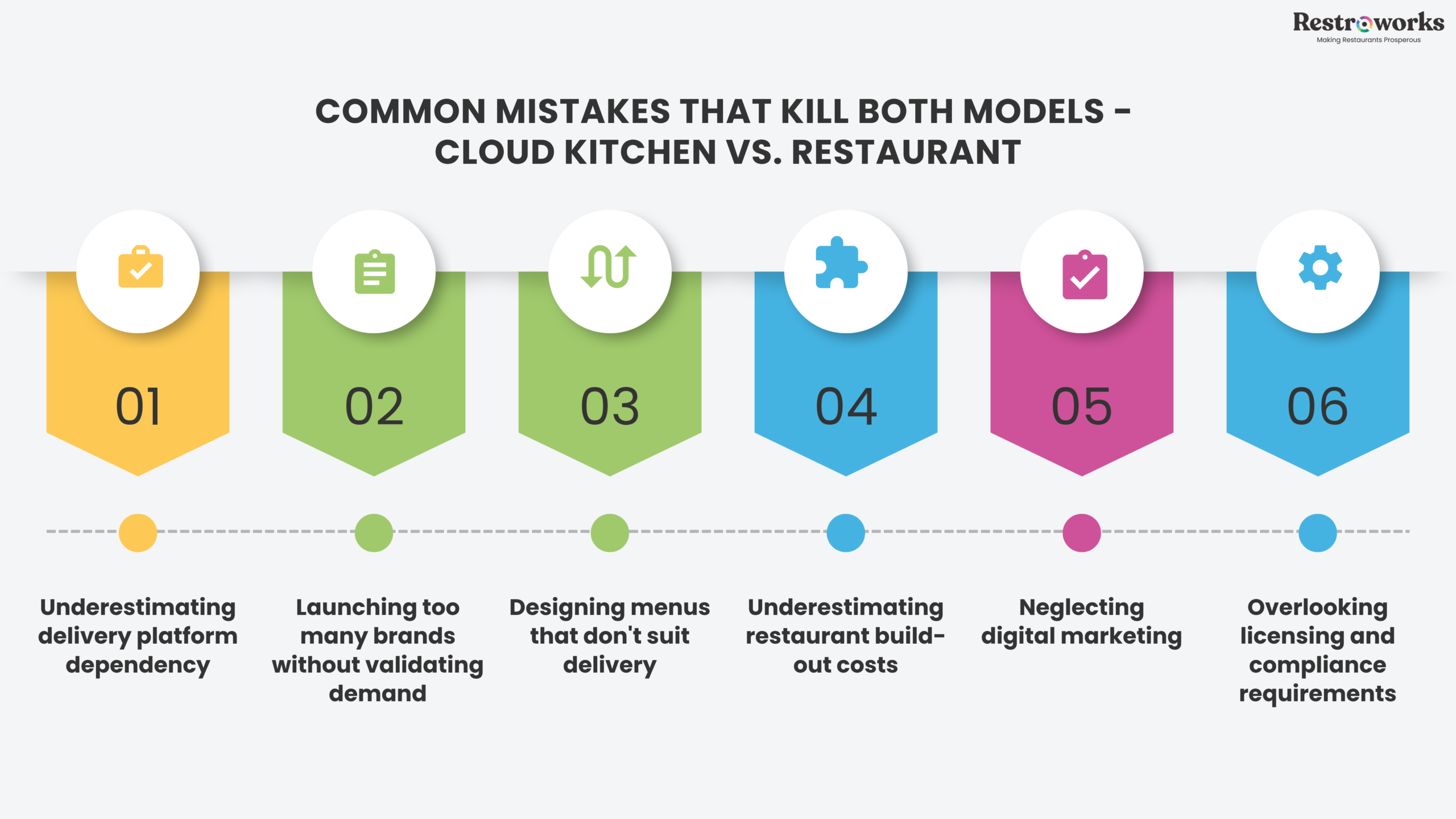
Cloud kitchen vs restaurant - common mistakes both make

Whether you’re building a cloud kitchen or a traditional restaurant, these failure patterns are common. The common thread: each mistake is a structural problem that compounds over time, not a one-time error that can be corrected after launch.

Underestimating dependency on delivery platforms — margin ceiling locked at 70–85%

When commissions run 15–30%, only 70–85% of each order’s list price reaches the kitchen — setting a hard ceiling on achievable margins before food, labor, and rent are paid. A cloud kitchen that earns 90% of its income through third-party delivery platforms has effectively locked itself inside that ceiling. The operators building durable food businesses are creating their own direct channels (websites, apps, and loyalty programs) in addition to the platforms.

Talkin Tacos is a specialty taco restaurant in South Florida that was losing over $20,000 per month in delivery app commissions. They have since built their own direct ordering platform and now earn $120,000 monthly in direct online sales.

Third-party delivery platforms own the customer data: order history, preferences, contact information. If the platform changes its algorithm, raises fees, or suspends your listing, you lose those customers overnight. Direct ordering channels are a data ownership strategy, not just a margin play.

Launching too many virtual brands without validating demand — complexity kills execution

The idea of launching multiple restaurant brands does not translate into more revenue. Without validated demand, too many brands add complexity, increase food waste, and compromise execution quality across every brand. The KLC approach (launching each brand to fill a validated cuisine gap) is the discipline to learn from.

Before launching a second brand, validate demand in five steps: 

  1. Analyze delivery platform search data in your zone for underserved cuisines
  2. Check competitor density. If more than 15 listings already serve that cuisine within your delivery radius, the market is likely saturated
  3. Test with a limited menu of 8–12 items for 30 days before building a full brand
  4. Set a minimum order threshold (100+ orders per week) to justify the added complexity
  5. Confirm that adding the brand does not increase ticket times for your primary brand by more than 2–3 minutes.

In saturated delivery markets like Manhattan, Los Angeles, and Chicago, hundreds of ghost kitchen brands compete for the same zones. Without paid promotion or platform-preferred placement, orders may not materialize regardless of food quality.

Designing menus for dine-in, not for delivery — 25 minutes changes everything

Food that looks great on a plate does not automatically translate to food quality after 25 minutes in a delivery bag. Food preparation and menu engineering for delivery are distinct disciplines in the food industry. The food must travel well, maintain food quality within acceptable temperature ranges, and arrive in a condition that justifies the price paid. Cloud kitchen operators with menus engineered for delivery will outperform those without.

Under FDA Food Code 2022, Section 3-501.16, the safe holding threshold is 135°F. That temperature constraint eliminates many traditional plating techniques and requires delivery-specific packaging and menu engineering.

Neglecting the total cost of a physical dining space — build-out overruns sink year one

Restaurant build-out costs in the US range from $100 to $800 per square foot depending on the space’s condition, concept complexity, and market. A 2,000-square-foot casual dining space in a second-generation location might cost $200,000-$400,000 to build out; the same footprint as a ground-up fine-dining concept can exceed $1 million.

Back-of-house construction (commercial kitchen equipment, hood and fire suppression systems, grease traps, walk-in coolers) typically accounts for 35–45% of total build-out spending, with the balance going to dining-area finishes, furniture, signage, and ADA-compliant restrooms. Owners of traditional restaurants often over-invest in front-of-house aesthetics before the kitchen is dialed in. A beautiful dining area draws first-time customers, but consistent food quality and service execution are what bring them back; those are built in the back of house, not the dining room.

Neglecting digital marketing for cloud kitchens — invisible means zero orders

A cloud kitchen without effective digital marketing strategies is essentially invisible. Unlike traditional restaurants that benefit from foot traffic and signage, cloud kitchens exist only inside delivery apps, and organic placement depends entirely on the platform’s algorithm.

The two primary paid channels are DoorDash Sponsored Listings, which use a pay-per-order model where merchants set a bid and daily budget (DoorDash reports an average return of $6 for every $1 spent, based on a study of 15,700 merchants), and Uber Eats Sponsored Listings, which use a cost-per-click model where restaurants set their own CPC bids and weekly budgets. Most cloud kitchen operators allocate $500-$1,500 per month per brand across platform ads, Google local campaigns, and social media. Without that spend, a new cloud kitchen brand in a competitive zone like Manhattan or Los Angeles may see fewer than five orders per day regardless of food quality.

Overlooking licensing and compliance differences — permits vary by state and city

Cloud kitchens in the US require a food service establishment permit, a business license, and health department approval — the same core permits as any restaurant. The difference is zoning. Many commercial zones that permit dine-in restaurants restrict or prohibit delivery-only operations. Some states require a separate commissary kitchen license for operations without a public-facing storefront.

Costs and requirements vary significantly by state and city. In California, food facility permit fees vary by county and establishment type. San Diego County, for example, charges annual restaurant permit fees ranging from $842 to $2,087, depending on employee count. Food handler card requirements and costs also vary: Riverside County charges $28 for its certificate, while San Bernardino County charges $22 for its county-specific card. 

In New York City, a standard food service establishment permit costs $280 annually, plus $25 for establishments manufacturing frozen desserts. At least one supervising manager must hold a Food Protection Certificate and be on-site during operations; the in-person course and certificate cost $114, while the online course is free with a $24 exam fee. Businesses conducting activities covered by New York State’s Article 20-C food-processing rules may also need a separate license, generally costing $400 for two years, with reduced fees or exemptions available to eligible operators.

Operators adding a delivery brand often assume their existing permits cover the new operation. A delivery-only concept at a different address typically requires its own permits, inspections, and liability coverage. Most US landlords and commissary operators require cloud kitchen tenants to carry $1 million-$2 million in general liability insurance.

When Neither Model Is the Right Answer

Not all food concepts are suited for delivery-only models. If your restaurant business model relies on ambiance, service theatre, or experiences that require the patron to be physically present, then a traditional restaurant model with a proper dine-in space is non-negotiable. There are no cloud kitchens that offer this. Food entrepreneurs learn the hard way when they try to force experience-dependent concepts into delivery-only models.

If your menu economics cannot sustain 15–30% delivery fees, then the issue isn’t the model. Is it your menu pricing or your food costs? Fix these first.

Consumer behavior in the food industry has shifted permanently towards the convenience of delivery, driven by emerging food trends that aren’t going back. However, not all dining experiences have shifted. It’s the entrepreneurs who understand the nuances of these differences who build food businesses with staying power.


Practical Implementation Checklist

Before launching a cloud kitchen: pressure-test before you spend a dime

  • Validate demand for your cuisine in your target delivery zone using platform data
  • Engineer your menu specifically for delivery, not adapted from dine-in restaurants
  • Model unit economics with 15–30% delivery platform commissions included
  • Plan your direct ordering channel from day one, not as an afterthought
  • Choose a location within 3–5 miles of dense residential or office demand
  • Build a digital marketing strategy before launch; the algorithm is your storefront
  • Standardize food preparation workflows to maintain consistent service quality under order volume pressure

Before opening a traditional restaurant: budget $250,000-$1.5 million and target 28–32% food cost

  • Confirm your concept genuinely requires in-person dining to deliver its core customer experience
  • Budget realistically: restaurant startups in the US typically cost $150,000-$500,000 for counter-service and $250,000-$1,500,000 for full-service concepts, including build-out, equipment, permits, and working capital
  • Target food cost at 28–32% of revenue. Take it above 35% and most full-service concepts cannot sustain the labor and occupancy costs that come with a physical location
  • Stress-test your staffing model across the kitchen and front of house, budgeting labor at 28–35% of revenue
  • Model whether projected margins support the full startup costs at your chosen price point
  • Consider adding a cloud kitchen or virtual brand to offset operational costs and extend reach into the delivery-only market
  • Calculate what happens to your profit margins if delivery grows to 30% or more of revenue

The decision is not about which business model is better. It is about which business model is better suited to what you want to create.

Cloud kitchens give you speed, flexibility, lower operational costs, and access to the delivery economy. The trade-off is platform dependency, fewer customer touchpoints, and harder-to-build loyalty.

Brick-and-mortar restaurants give you a location customers associate with real experiences but at five to ten times the startup cost, longer timelines to profitability, and operational complexity that demands elite execution every shift.

Both models work. Both fail when the fundamentals are missing. The operators who build restaurant businesses with staying power, in either model, share the same discipline: consistent operations, precise portioning, a clear understanding of how customers arrive, and a deliberate plan for keeping them.

The model is the framework. The food, the operations, and the customer relationships inside any restaurant business are what determine whether it lasts.

KEY TAKEAWAYS

  • Cloud kitchens offer lower startup costs ($20K-$250K vs $250K-$1.5M), faster market entry (30–60 days vs 12–18 months), and operators report higher potential margins (8-15% vs 3–9%), while traditional restaurants excel at building customer loyalty and brand experiences.
  • The most successful food businesses are increasingly adopting hybrid models that combine dine-in operations with delivery-only virtual brands. Operators who add a virtual brand to an existing kitchen can generate incremental revenue at near-zero marginal occupancy cost.
  • Delivery platform commissions (15–30%) can erode cloud kitchen profits to single digits without a direct ordering strategy.
  • The global cloud kitchen market is projected to reach $74.6 billion by 2030, making delivery infrastructure a long-term structural requirement for both models, not a temporary trend.
  • Choosing the right model depends on your goal: prioritize cloud kitchens for speed and scalability, traditional restaurants for experience-driven brand building, and hybrid configurations when you need both.

Frequently Asked Questions

1. What are the disadvantages of Cloud Kitchens?

High reliance on food delivery apps, high commission fees (15–30%), lack of brand visibility, no direct customer interaction to build loyalty, and intense competition are some of the disadvantages of cloud kitchens.

2. What is the average monthly cost for a cloud kitchen?

In the US, rent for a private, fully-equipped cloud kitchen unit typically ranges from $3,500 to $6,000 per month depending on the market, kitchen size, and included services, excluding food costs, staff, and marketing.

3. What is the difference between a cloud kitchen and a restaurant?

A cloud kitchen operates from a delivery-only facility with no dine-in space, lower startup costs ($20K-$250K), and operators report higher margins (8-15%). A traditional restaurant requires a customer-facing location, costs $250K-$1.5M to open, and yields 3–9% net margins. The full comparison table and cash flow breakdown are covered in the sections above.

4. Which is better for beginners, a cloud kitchen or a restaurant?

Cloud kitchens are generally better for beginners due to lower initial investment ($20K-$250K vs $250K-$1.5M), faster setup (30–60 days vs 12–18 months), quicker break-even timelines (6–18 months depending on format and market), and reduced financial risk compared to traditional restaurants.

5. Is a cloud kitchen legal in the USA?

Cloud kitchens are legal in the US and operate under the same food safety regulations as traditional restaurants. Every cloud kitchen requires a food service establishment permit, a business license, and health department certification. The key variable is local zoning: not all commercial zones permit delivery-only food operations, and some municipalities require a separate commissary kitchen license. Check your county’s zoning code and health department requirements before signing a lease.

6. What skills do you need to run a cloud kitchen?

Running a cloud kitchen requires proficiency in food safety and consistency, digital marketing, inventory management, logistics and supply chain optimization, and managing online platforms and POS systems. A unified platform such as Restroworks consolidates inventory tracking, recipe costing, and multi-platform order management into a single system, reducing the number of tools an operator needs to learn.

7. How long does it take to set up a cloud kitchen vs. a restaurant?

A commissary-based cloud kitchen can be operational in as little as 30–60 days using existing shared-kitchen infrastructure, whereas traditional restaurants often take 12–18 months or longer due to construction and permitting.

8. How do cloud kitchens handle customer complaints without face-to-face service?

Complaints are handled digitally through food delivery app dashboards (e.g., DoorDash, Uber Eats), social media channels, or immediate phone follow-ups, prioritizing quick replacements or refunds to maintain online ratings.

Newsletter subscription banner

Talk to a restaurant expert today and learn how Restroworks can help your business.

Request Demo >

Share

Discover More Insights to Power Your Journey

Ice Cream Shop Failure Rate: What the Data Says and Why It Matters

The very thought of opening an ice cream shop feels like scoops, sprinkles, pink-all-around, cloud…and a hundred other words that…

Cloud Kitchen UK License: Complete Guide to Requirements & Compliance

Launching a cloud kitchen is often considered faster and simpler than opening a traditional restaurant. That perception is partly true:…

How to Start Cloud Kitchen in Dubai: A Complete Guide [Updated 2026]

Dubai’s culinary landscape has evolved significantly in recent years, with digital transformation and shifting consumer preferences redefining food consumption, making…

Cloud Kitchen License Cost in Dubai: Fees, Requirements & Setup Guide for 2026

A cloud kitchen license cost in Dubai ranges from AED 17,000 to AED 27,500 for a mainland setup, covering the…

Cloud Kitchen: Complete Guide to Start and Run a Successful Delivery Business

Less than a decade ago, opening a restaurant meant investing in a high-rent retail space and hiring a full front-of-house…

Cloud Kitchen vs Restaurant: Key Differences, Costs & Which Is Better

Cloud kitchen vs restaurant - The core difference between the two is that a cloud kitchen prepares food exclusively for…

Join. Learn. Grow.

Sign up to receive the latest hospitality insights and stories straight to your inbox

Streamline your operations with Restroworks