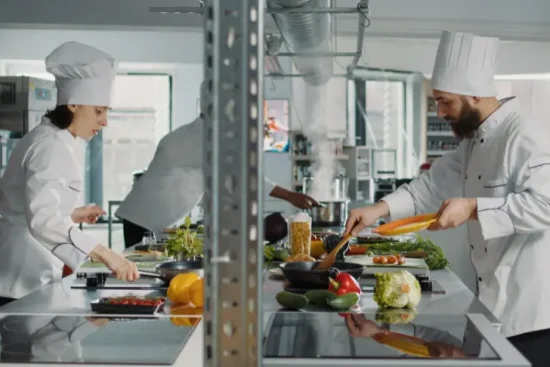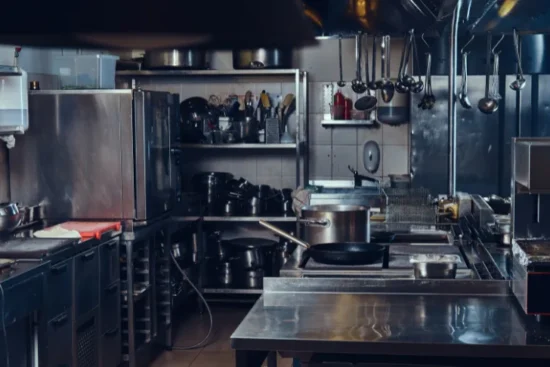
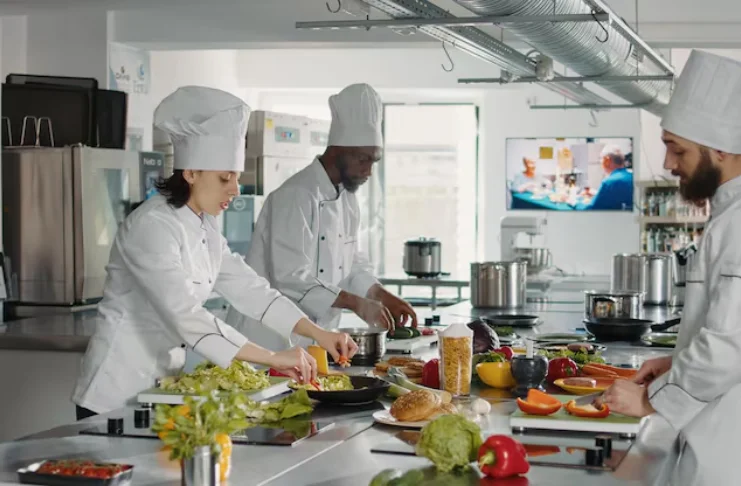

A ghost kitchen is a delivery-only commercial kitchen with no storefront, dining room, or walk-in traffic. Multiple virtual restaurant brands typically operate from the same shared facility, managed by a third-party operator. Orders arrive through delivery apps, are prepared in dedicated stations, and handed off to drivers. The model is also called a dark kitchen or virtual kitchen.
For a first-time entrepreneur, this means you can choose to rent space in a shared commercial kitchen or a dedicated unit inside a ghost kitchen facility. The operator manages the infrastructure. “Ghost” refers to the customer’s perspective: they order from what looks like a standalone restaurant, but no customer-facing storefront exists.
A ghost kitchen is not the same as a virtual restaurant. A virtual restaurant is the brand: the menu, the name, the delivery-app listing. A ghost kitchen is the physical space where that food is prepared. One facility can house four or more virtual restaurants simultaneously.
Before signing a ghost kitchen lease, verify five things: the facility holds a current health department permit for your food category, the lease includes shared-area maintenance and pest control, the operator’s insurance covers tenant operations, the contract specifies which equipment is included and who maintains it, and exit terms allow you to leave within 60–90 days if the concept fails.
Ghost kitchen tenants also carry risks they do not directly control. Verify that the operator’s insurance covers tenant liability, not just facility liability. Brand reputation is exposed when another tenant’s health violation or pest issue affects the facility’s delivery ratings.
How Ghost Kitchens Actually Operate
Picture a commercial kitchen in Chicago or Los Angeles with five virtual restaurant brands running simultaneously. One station prepares burgers, another handles Thai noodles, a third assembles sushi rolls. Every order goes out to drivers heading to different parts of the city. No customer knows the food comes from the same building.
That is the efficiency argument: one kitchen, multiple revenue streams.
The pressure point arrives Friday at 7:30 PM when all five brands surge at once: five menus, five prep times, five order volumes competing for the same space. Quality under that pressure is difficult. Consistency across all five brands is harder.
Mubarak Jaffar, Co-Founder and CEO of KLC Virtual Restaurants, which has successfully scaled up a multi-brand delivery business in Kuwait and the GCC, walked us through this in detail in an episode of Restrocast, a podcast hosted by Ashish Tulsian, CEO of Restroworks.
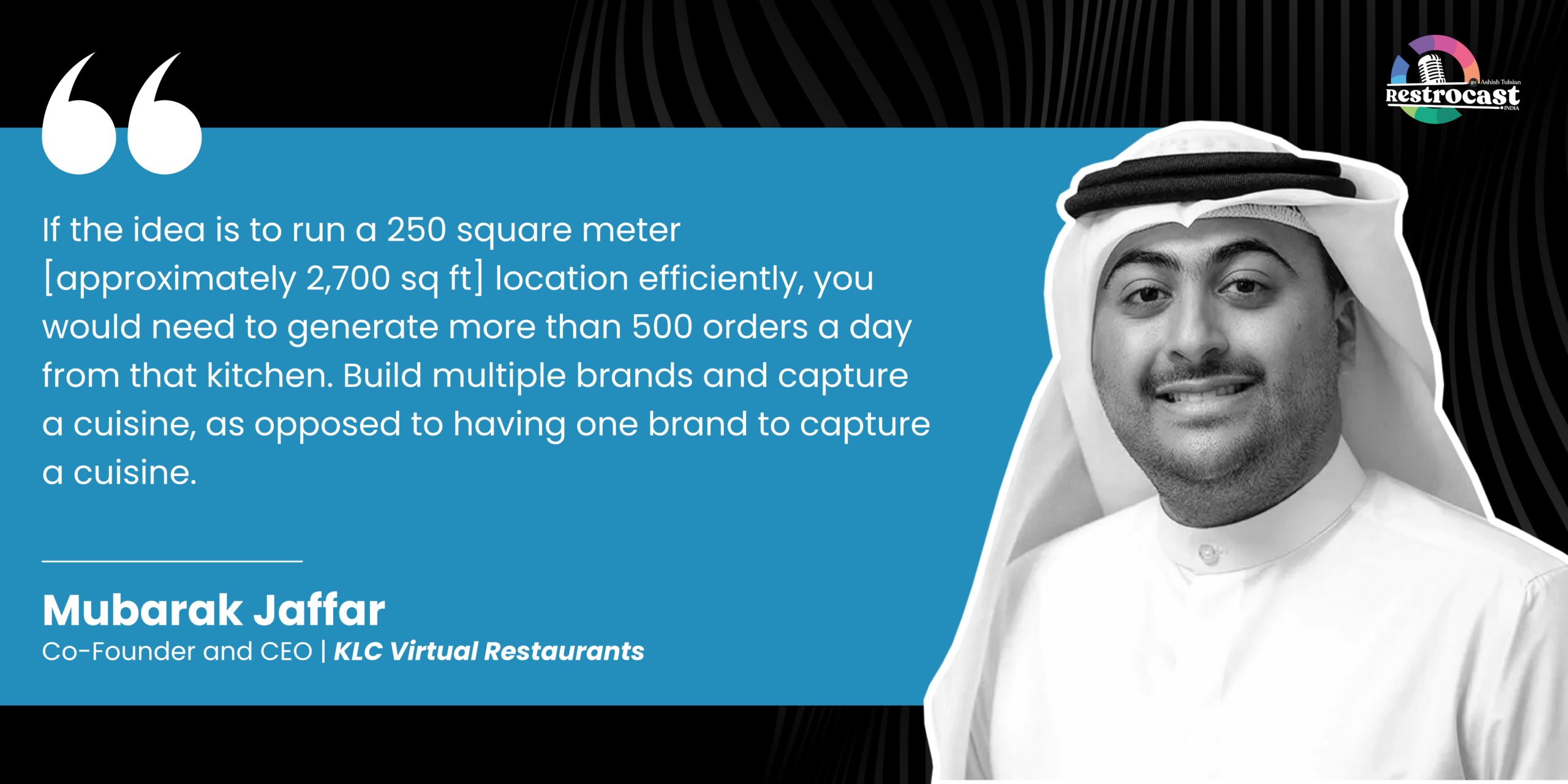
If a ghost kitchen cannot hit that order density, its shared-infrastructure economics collapse. The rent stays fixed while revenue falls short.
Where Ghost Kitchens Genuinely Work
Ghost kitchens work best when the goal is speed, low capital risk, or incremental revenue alongside an existing restaurant:
- Testing new virtual restaurant brands before committing to a full buildout
- Entering new US cities without signing leases on physical locations
- Adding delivery revenue streams alongside an existing full-service restaurant
Niko Lambrou in Atlanta launched three virtual brands from a single ghost kitchen pod, shifting from an 80-hour week at a 24-hour diner to roughly 10-15 hours of oversight. That is the ghost kitchen value proposition at work: test a concept, measure demand, scale or kill it without a lease commitment.
The cost of launching a ghost kitchen in the US runs between $20,000 and $60,000, compared with $750,000 to $1.5 million for a traditional restaurant in a high-demand market like New York City or Los Angeles.
What Is a Cloud Kitchen?
A cloud kitchen is a delivery-focused commercial kitchen that the operator owns or leases independently. Unlike a ghost kitchen, a cloud kitchen can house a single brand, run multiple brands under one roof, share space with other food businesses, or operate as an aggregator-managed facility. The defining feature is operational control: the operator decides the menu, the technology stack, and the brand identity.
Ownership control means you choose delivery partners, set packaging standards, and switch platforms without renegotiating a facility contract. In practice, that looks like shifting 30-40% of your orders from Uber Eats at 20–30% (tier-wise) commission to a direct ordering channel at 5–10% processing cost, a margin swing of roughly $2.25-$3.75 per order on a $15 ticket. When the goal is building a recognizable brand rather than testing a concept, that flexibility is the structural difference.
Cloud kitchen operators carry a heavier operational load. Physical buildout alone takes 8-12 weeks for a cloud kitchen versus 2–4 weeks for a ghost kitchen pod, and total time to launch, including permitting, licensing, and inspections, typically runs 3–6 months for a cloud kitchen versus 30–60 days for a ghost kitchen. Staffing runs 3–5 people per shift versus 1-2 in a managed facility. The trade-off is day-to-day control: switching packaging suppliers same-day, adjusting menus without facility approval, and negotiating directly with delivery platforms.
The Four Main Cloud Kitchen Formats
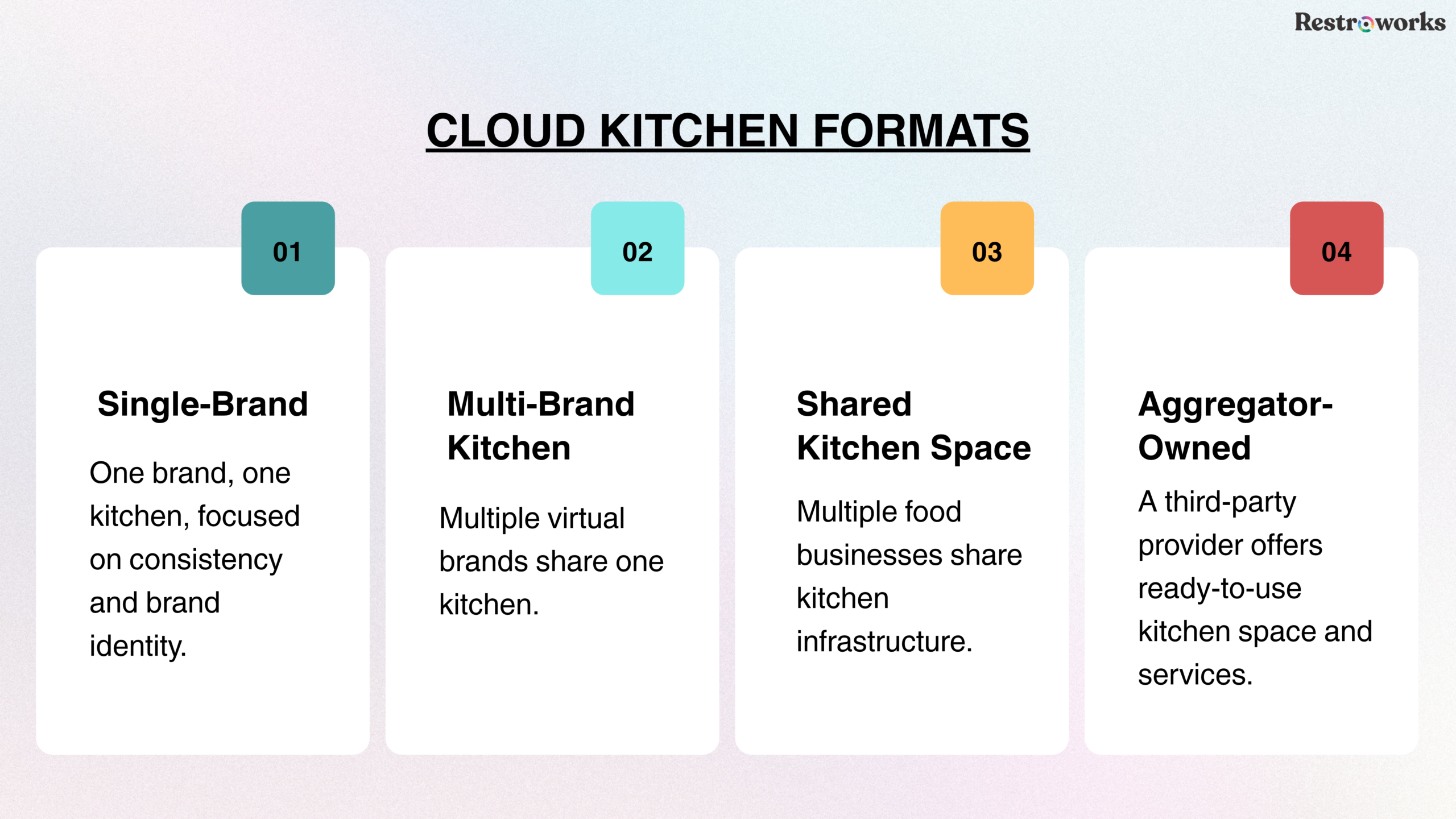
- Single-Brand Cloud Kitchen: One brand, one kitchen, focused on food quality and consistency. Setup starts around $50,000 with monthly rent of $3,500-$7,000 depending on city and square footage. The strongest model for building a real restaurant brand identity.
- Multi-Brand Kitchen: Multiple virtual brands under the same kitchen infrastructure, coordinated through a centralized cloud kitchen management system. Setup costs $60,000-$100,000+ given the additional stations and equipment, with rent of $5,000-$10,000 per month. Diversifies revenue and allows different cuisine types without separate locations.
- Shared Kitchen Spaces: Multiple food businesses share infrastructure costs. Also called a commissary kitchen, this format reduces individual risk with entry costs of $2,000-$10,000 and monthly rent of $1,500-$4,000 per station. Let entrepreneurs test demand before investing in a dedicated facility.
- Aggregator-Owned Kitchens: Companies such as CloudKitchens offer pre-built kitchen spaces with integrated delivery solutions at $3,500-$6,000 per month for a turnkey pod. You get existing infrastructure without heavy investment while maintaining more control than a ghost kitchen tenancy.
The KLC Model: What a Cloud Kitchen Done Right Looks Like
KLC Virtual Restaurants built multiple virtual brands across a network of cloud kitchens in the GCC region. The strategy: name brands for search-based discoverability, build based on existing demand data, and retire underperformers without changing the kitchen. That demand-led approach is the cloud kitchen model working as intended.
At a larger scale, according to Inc42 (2025), India-based Rebel Foods operates over 450 cloud kitchens across 75+ cities with more than 45 virtual brands, making it the world’s largest internet restaurant company. Rebel Foods owns the kitchen infrastructure, builds data-driven brands, and scales through cloud kitchen networks rather than franchise agreements.
For a US operator, Rebel Foods illustrates the end state of the cloud kitchen model: own the kitchen, the brands, and the technology, and your margin is not capped by a facility operator’s rent or a platform’s commission. Their 45+ brands launch and retire based on order data, and that brand agility is the structural advantage cloud kitchens hold over ghost kitchen tenancies.
Technology and Software Requirements
Both models depend on technology to manage orders, coordinate delivery platforms, and track performance. A cloud kitchen typically requires a centralized kitchen management system, integrated POS (point-of-sale), multi-platform order aggregation, inventory tracking, and delivery logistics software. Ghost kitchen tenants use the facility operator’s stack, which limits customization but reduces setup complexity.
The technology choice is a hidden cost. Ghost kitchen tenants pay less upfront but inherit someone else’s systems. If the facility’s POS does not integrate with your preferred delivery app, you are stuck.
Cloud kitchen operators choose their own stack but must budget $500-$2,000 per month for software covering order management, analytics, and inventory. Plus, if you want dedicated kitchen management platforms: POS subscriptions start at $60-$70 per month and scale to $200+ with add-ons, while order aggregation tools run $100-$150 per month.
Cloud kitchen operators use data analytics for menu optimization, tracking which items travel well, which price points maximize order value, and which brands underperform in specific zones. Customer data ownership is another trade-off: ghost kitchen tenants share data with the facility operator and platforms, while cloud kitchen operators retain their data and build direct ordering channels. A platform like Restroworks consolidates POS, kitchen management, inventory, and digital ordering into one system, reducing the integration burden for operators managing multiple brands.
Listen: Restrocast: Cloud Kitchen Operations and Technology
Licensing and Compliance
Cloud kitchens and ghost kitchens must meet the same food safety and health regulations as traditional restaurants. US operators typically need a business license, food handler certifications, fire safety compliance, zoning permits, a tax identification number, and a sales tax license.
Zoning laws vary by city, and this is where first-time operators get caught. Some municipalities restrict delivery-only kitchens in residential zones, and a growing number require specific permits for multi-brand operations from a single address. In 2020, some ghost kitchens in Los Angeles required Conditional Use Permits for specific activities, while broader zoning rules for delivery-only facilities remained unresolved. The issue continued through 2025, when the City Council proposed a dedicated land-use definition for ghost kitchens. Check current requirements with your city’s planning department before committing to a location, as ghost kitchen zoning rules are evolving in many US cities.
Ghost kitchen tenants typically inherit the facility’s permits. Cloud kitchen operators must secure their own. Budget four to eight weeks and $2,000-$5,000 for licensing before launch. Confirm that your lease permits delivery-brand operations, verify the building’s ventilation meets multi-brand output requirements, and ensure your liability insurance covers delivery from the premises.
Cloud Kitchen vs Ghost Kitchen: Key Differences
These are 2025–2026 industry estimates; actual costs depend on your city, kitchen size, and brand count. Verify current pricing with local operators or your regional Small Business Development Center (SBDC) before committing capital.
Ghost kitchens are optimized for speed. Cloud kitchens are optimized for control.
Choosing Between Cloud Kitchen vs Ghost Kitchen
Answer these five questions before choosing a model:
- What is your available capital? Under $60,000 points to a ghost kitchen pod. Above $100,000 opens standalone cloud kitchen options.
- How fast do you need to launch? Ghost kitchens can be operational in 30–60 days. Cloud kitchens typically take 3–6 months for buildout and permitting.
- Do you want to own the customer relationship? Ghost kitchens share customer data with the facility and platform. Cloud kitchens let you build direct ordering channels and retain that data.
- Is this a test or a long-term brand? Testing a concept favors the low-commitment ghost kitchen. Building a brand you intend to scale favors cloud kitchen ownership.
- Do you have an existing kitchen with off-peak capacity? If yes, a virtual brand run from your current space carries no additional base rent if the space is already leased.
Before committing to either model: tour two to three facilities in your target delivery radius, request P&L templates from current tenants, calculate your breakeven order volume at your planned average ticket, and talk to at least one operator currently running each model.
If Speed and Low Risk Are Your Priority
Go with a ghost kitchen. You can launch a new virtual restaurant brand in weeks, test the market, and shut down concepts that are not working without losing six figures. CloudKitchens operates turnkey pods at $2,000-$6,000 per month with equipment included, a realistic entry point if you have under $100,000 in capital and need to be operational within 30–60 days.
The operators who succeeded in ghost kitchens, Kristen noted, were often those with an existing restaurant using it to offload demand they couldn’t handle on-premise, not operators launching blind into an untested market. Brinker’s It’s Just Wings worked because Chili’s already had the kitchen infrastructure, the menu knowledge, and the DoorDash relationship. The virtual brand captured demand that already existed. By contrast, REEF Technology scaled to thousands of locations before profitability challenges forced restructuring, illustrating what happens when infrastructure expansion outpaces actual order demand.
If Brand Building and Long-Term Margins Are Your Priority
The stronger foundation is the cloud kitchen. A commissary or shared kitchen lets you own equipment and control layout. Commissary stations run $1,500-$4,000 per month versus $2,000-$6,000 for a turnkey ghost kitchen pod. The comparison table’s broader cloud kitchen rent range ($3,500-$10,000) includes multi-brand and single-brand formats that carry higher costs. The additional investment buys something a ghost kitchen cannot easily provide: identity.
When you own the operation, you own everything: food quality, packaging, customer experience, and the delivery partner relationship. That control compounds. A cloud kitchen operator paying $4,000 per month in commissary rent who shifts 30% of orders to direct ordering saves $2-$4 per order in platform commissions. At 50 orders per day, that shift adds $1,000-$2,000 per month in retained margin, enough to cover the rent difference between a shared pod and an independent lease within the first year.
When to Use Your Existing Kitchen
A growing number of operators run a hybrid model: dine-in paired with a separate delivery-only operation. This keeps delivery-optimized menus out of a kitchen designed for plated service and prevents delivery volume from overwhelming dine-in at peak.
For existing restaurant owners with off-peak capacity, running a virtual brand from your current kitchen during weekday lunches (11 AM–2 PM) or late evenings (8 PM–close) carries no additional base rent if the space is already leased. Most POS and delivery platforms allow order throttling, capping incoming delivery orders at 10–15 per hour during dine-in peaks to prevent kitchen overload. The risk is operational chaos when a Friday night dine-in surge collides with delivery volume you did not throttle. For first-time entrepreneurs, the hybrid model is typically Phase 2, after establishing dine-in operations.
The Budget and Cost Reality
Ghost kitchen entry costs run $20,000-$60,000. Cloud kitchen infrastructure costs $50,000-$250,000 or more, depending on build-out versus lease. Both avoid traditional restaurant expenses: dine-in space, high-end locations, front-of-house staff, and decor.
Both models also create costs that traditional owners underestimate. Delivery apps charge 15–30% commission per order, packaging adds $0.50-$2.00 per order, and your margin is capped by the platform.
Delivery platform economics extend beyond the headline commission. Delivery radius caps at five to seven miles in urban areas, defining your addressable market. A single-platform deal keeps operations simple but limits your customer base; multi-platform presence (Uber Eats, DoorDash, Grubhub) increases reach but multiplies commission costs and order-stream complexity. Before signing a platform agreement, confirm exclusivity clauses, commission tiers at volume thresholds, and whether the platform can adjust rates mid-contract.
Here is what a $15 delivery order actually yields after every cost layer:
These margins assume disciplined operations. The real math is tighter: 30% food cost plus 25% delivery fees plus 15–20% labor plus 10–15% rent leaves 10–20% margin before packaging, software, and marketing, and only when every line hits its target. Most operators underestimate customer acquisition cost, which further compresses the number.
“Not all revenue is good revenue. If I were a restaurant owner, I’d be asking: how much do I actually make on an average delivery order after all of my costs and the third-party fees?” – Victoria Lord, Partner, McKinsey & Company
That question comes before any discussion of which kitchen type to use.
Note: The cloud kitchen margin range of 10–18% is based on limited published data. Independent third-party confirmation of this specific range is not widely available.
Real-World Examples: How US Operators Validated Both Models
In June 2020, Brinker International launched It’s Just Wings as a delivery-only virtual brand, cooking out of existing Chili’s and Maggiano’s kitchens via DoorDash. No new leases, no new space, no new staff.
According to FSR Magazine, 2020, the brand reached a $150 million annual revenue run rate within months, and 70% of first-month sales came from customers who had never ordered from Chili’s. The launch investment was described as “small” relative to traditional restaurant expansion; the entire operation ran through roughly 1,000 existing kitchens with no new equipment or real estate. By the end of fiscal 2021, It’s Just Wings had grown to a $170 million business. In August 2023, Brinker “graduated” the brand by integrating it into Chili’s bar and dining room menus, a sign that a virtual brand built on existing infrastructure can eventually earn a permanent place on the physical menu.
In Columbus, Ohio, Nick Penzone used a CloudKitchens pod to revive his family’s Florentine restaurant (originally opened in 1945) without committing to a brick-and-mortar lease. According to CloudKitchens, 2025, setup investment started at approximately $30,000 for a 200-square-foot pod, with enterprise-partner kitchens averaging $1.2 million in annual sales.
In Atlanta, operator Niko Lambrou launched three virtual brands (Larry’s Late Night Eats, Cheesesteak City, and Hell Yeah Hamburgers) from a single CloudKitchens facility, cutting his working hours from 80 per week at a 24-hour diner to roughly 10–15 hours.
ClusterTruck in Indianapolis took a different path: own the kitchen, own the delivery drivers, skip third-party platforms entirely. According to Startland News, 2018, ClusterTruck’s Indianapolis kitchen handled nearly 400,000 deliveries per year with 68 drivers, delivering food within five to eight minutes of completion. By controlling the full chain (kitchen, technology, and last-mile logistics), ClusterTruck eliminated the 15–30% platform commission that caps margins for most ghost kitchen operators.
The company expanded to Kansas City, Cleveland, Columbus, and Denver, with each new market opening as a single central kitchen serving a defined delivery radius. However, some locations have since closed: the Fishers, Indiana kitchen shut down after less than two years of operation. ClusterTruck’s trajectory shows that even full-chain control does not guarantee every market sustains the order density a central-kitchen model requires.
Sweetgreen’s Outpost program, which places pickup stations in office buildings for employees to collect pre-ordered meals without delivery fees, expanded to over 550 locations by 2024. While not a ghost kitchen model, Outpost illustrates how established brands can extend delivery reach through alternative formats without committing to full restaurant buildouts.
MrBeast Burger scaled to over 1,700 locations and $100 million in cumulative revenue by 2022 by operating out of existing restaurant kitchens through Virtual Dining Concepts (VDC). But in August 2023, MrBeast sued VDC, alleging the company prioritized rapid expansion over food quality, with customers describing orders as “disgusting” and “inedible.” The case is the strongest US example of what happens when a virtual brand scales across a shared, third-party kitchen network without quality controls at every site. The lesson: a demand engine gets you to 1,700 locations, but without operational standards enforced at every kitchen, the brand erodes faster than it was built.
On the infrastructure side, REEF Technology converted urban parking spaces into modular kitchen hubs, scaling to thousands of locations across North America at its peak. REEF’s trajectory is instructive: rapid scale, then profitability challenges and restructuring. Even well-funded operators struggle with unit economics. Ghost kitchen tenants should verify facility stability before signing a lease. Joseph Unger, President and COO of GOSH Enterprises with experience at REEF Technology during the ghost kitchen boom, discussed these risks on the Restrocast podcast.
Common Mistakes That Actually Kill These Businesses
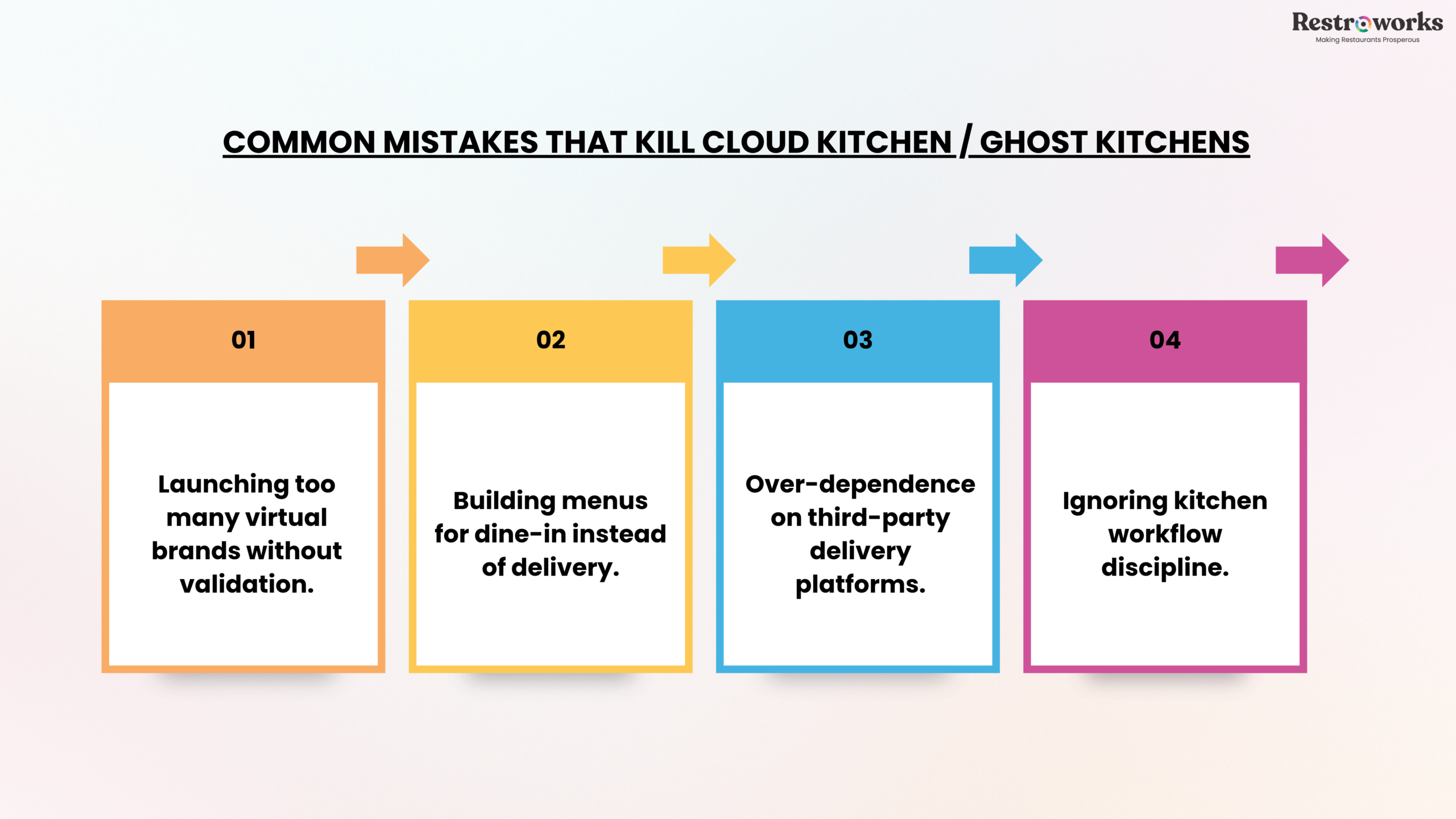
- Launching too many virtual brands without validation. More brands do not mean more revenue. Without demand validation, each brand adds complexity, waste, and inconsistency. KLC’s approach, filling gaps in cuisines already validated, is the model.
- Building menus for dine-in instead of delivery. Food that looks good on a plate does not look good in a bag after 25 minutes. Menu engineering for delivery is fundamentally different, and operators who ignore this pay in ratings and lost repeat customers.
- Over-dependence on third-party delivery platforms. If 15–30% of every order goes to a platform, the business is margin-capped from day one. Successful operators develop direct ordering channels.
- Ignoring kitchen workflow discipline. Inefficiency in a delivery kitchen is exponential: it grows with every order that goes out the door late or incorrectly prepared.
Ghost kitchen failures tend to be occupancy-dependent: when facility occupancy drops below 70%, the shared-infrastructure economics break and the operator raises rents or closes locations. Cloud kitchen failures are volume-dependent: when order volume does not cover the higher fixed costs of an independent operation, the margin advantage disappears.
When Neither Model Is the Answer
Not all food concepts are suited for delivery-only operations.
If your business depends on ambiance, visible preparation, or the customer being physically present (custom pizzas assembled to order, poke bowls built in front of you, tasting menus), a physical restaurant is not optional. No cloud kitchen or ghost kitchen replaces that experience.
Tertiary markets with populations under 200,000 present a different problem. Delivery platform penetration is weak, and customers often will not pay $6-$8 delivery fees. Ghost kitchen economics collapse without sufficient order density.
If your menu economics cannot survive 15–30% delivery commissions and still maintain profitable margins, the problem is your menu, not your kitchen type. Fix that first.
Food trucks offer a third path with lower setup costs and geographic flexibility. For entrepreneurs testing a concept before committing to a fixed kitchen, a food truck can serve as proof of concept.