

Business License and Registration
Before anything else, your business needs a legal personality. Most business owners opt for an LLC, but a sole proprietorship or partnership is also acceptable. Register your food business name at the local level, and if you operate under a different name, you will need to file a DBA.
You will also need an Employer Identification Number from the IRS, which is free. It is necessary for hiring, for opening a business bank account, and for tax purposes. Without it, you cannot operate as an employer. Apply for it before you sign a commissary lease or start platform onboarding, since the delivery platforms request it at signup and most banks require it to open the business account.
Food Service License and Building Health Permits
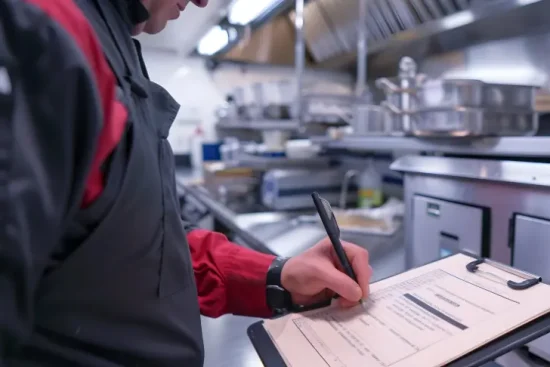
This is your most critical requirement. A health department permit confirms your cloud kitchen complies with the hygiene standards set by your local health authority, and it is issued only after your kitchen has been inspected and passes.
- Cost: $100 to $1,000
- Mandatory before cloud kitchen operations begin
- Requires an inspection, and a re-inspection fee if you fail
Inspectors fail cloud kitchens on the same handful of items: inadequate handwashing stations, missing or uncalibrated thermometers, improper cold-holding temperatures and pest-control gaps. A failure means a re-inspection, which usually costs you a further one to several weeks plus a fee, so it pays to get the permit right the first time.
Food Handler and Food Manager Certifications
Your staff need food safety training and certification, depending on state and local requirements. Food handler training typically costs around $10–$15 per employee, with certificates commonly valid for three years.
Many jurisdictions also require at least one supervisor/person in charge (PIC) to hold a separate food protection manager certification, which a food handler card does not replace. These are two different credentials, and assuming one covers the other is a common and expensive mistake. Most states require the manager exam to be proctored, though online proctoring by webcam is usually allowed.
This certification is valid for five years, after which the manager must renew or recertify according to local requirements. The cost varies by provider, but nationally accredited CFPM exams can start at around $25 for the exam only and increase when training courses, study materials, or proctoring are included.
Local Municipality Requirements
Beyond state food safety standards, your local municipality imposes operational requirements a first-timer rarely budgets for: a grease interceptor sized to your cookline, a scheduled commercial hood-cleaning cadence, a contract with a licensed commercial waste hauler and documented pest-control service. The municipality also controls zoning and signage. These are precisely the records a health or fire inspector asks to see, so keep the paperwork on file.
Fire Safety and Building Permits

Your kitchen has to be inspected by the fire department, which checks fire suppression systems, ventilation compliance and emergency exits. The fees, of course, vary by jurisdiction and project scope. For example, Honolulu lists a $100 initial inspection fee for commercial cooking fire-extinguishing systems, while Montgomery County, Maryland, charges $102.74 for a fire-code compliance permit plus $102.74 per fire-protection system.
The permit is not the real expense, though. Any cookline producing grease-laden vapor needs a Type I hood with an automatic wet-chemical suppression system, and code requires a licensed technician to service it periodically. Steam-only equipment can use a cheaper Type II hood, but inspectors do not negotiate the line: if grease can rise off the appliance, it is Type I. In a way, a complete installed commercial kitchen hood system can cost you roughly $15,000 to $50,000, though high-end configurations can easily exceed $100,000.
Plus, exterior signage may require a separate sign permit. Its cost ranges from $25 to $300 in Quincy, Illinois, while West Lafayette, Indiana, charges $100 plus inspection fees for a permanent sign.
Zoning and Use Permits
Cloud kitchens must comply with local zoning laws, which usually require a zoning or conditional-use permit for commercial food use. Commercial food production is typically restricted to commercially or light-industrially zoned parcels, with permit costs and processing times that vary widely by city.
Most residential cloud kitchen setups are restricted. Cottage food laws allow limited home production but cap annual sales and permitted products, which is why they do not suit a delivery-first business. If you are considering a home-based setup, check those limits before anything else. Missing these licensing requirements can trigger fines or closure.
Liquor or Alcohol Permit, If You Serve Alcohol

This one is often missed. A delivery-only brand adding alcohol needs a liquor permit, and the rules are strictly state-specific. Some states bar alcohol delivery entirely and allow off-site sale only if the customer collects in person, while others permit delivery of sealed, original-container beverages.
California, for example, allows certain restaurants to sell alcohol to-go but requires the customer to pick up qualifying drinks in person; the state’s expanded alcohol-to-go rules expressly prohibit delivery of those beverages. In Texas, on the other hand, qualifying businesses can deliver alcohol with food orders, subject to license-specific requirements around the type of alcohol, packaging, and delivery.
Virginia also permits alcohol delivery. Here, businesses using third-party delivery services may need a third-party delivery license, which costs $2,500 annually for businesses with 25 or fewer delivery employees and $7,500 for those with more than 25.
Check your state’s alcohol beverage control authority before you add a single drink to the menu.
Shared Facility and Commissary Kitchen Licensing
Working from a shared or commissary kitchen does not lessen your licensing requirements. It adds a layer. You must satisfy both the master permit for the facility and your own individual food licenses.
The hidden danger is that if another tenant in the facility fails an inspection, your food business can be shut down temporarily through no fault of your own. Before you sign:
- Check the facility’s inspection record
- Check the insurance requirements
- Confirm whether you need to carry your own liability insurance

Adding a Virtual Brand to an Existing Restaurant
If you already run a licensed restaurant, launching a delivery-only brand from your existing kitchen is the fastest route in. But “I am already licensed” is not the same as “the new brand is covered.”
- What carries over: your health department permit, fire suppression and staff certifications attach to the kitchen and its operators, so a second brand cooked in the same space under the same processes generally rides those permits.
- What the new brand needs: its own DBA or assumed-name registration, and separate onboarding to each delivery platform with its own menu and documentation. Platforms treat every storefront as a distinct listing.
- When a new permit is triggered: if the brand adds a process your original permit never covered, such as a new allergen program or packaged retail items, you may need a permit amendment. Adding alcohol reopens the state rules above.
- The trap to check first: confirm your certificate of occupancy and lease actually permit multi-brand use. Some authorize a single operating name.
Third-Party Delivery Platform Requirements
Partnering with a third-party food delivery service connects your cloud kitchen to a much larger customer base. Platforms such as DoorDash, Uber Eats and Grubhub require more than a basic license. Setting up your delivery integration properly is what keeps orders flowing once you are approved.
What they require:
- Business license
- Health permit
- Food safety certifications
- Insurance
Approval takes two to four weeks, but here is the catch: applying before all your permits are complete will freeze your application and you start again from zero. Rejection over incomplete paperwork can lock you out of the revenue channel for 30 to 90 days.
Step-by-Step Cloud Kitchen License Application Process
Obtaining the necessary licenses is crucial for operating legally. Run them in parallel wherever possible, and take them in this order:
- Form your business entity and get your EIN.
- Find your commercial kitchen space, confirming the zoning is correct before you sign.
- Submit your health permit application.
- Schedule your fire safety inspection at the same time as the step above.
- Get your staff food handler certificates and a manager certification.
- Get your sales tax permit, which is usually free.
- Obtain your certificate of occupancy, if required.
- Onboard with the online food delivery platforms. This step comes last, never first.
The core total is the sum of every row above it, excluding the two conditional permits at the bottom, which apply only if you are renovating or displaying exterior signage.
Hidden Costs Most Operators Miss
- Resubmissions due to incomplete applications
- Temporary kitchen rental at $2,000 to $5,000 per month while you wait
- Cross-state certification issues
- Platform rejection, which blocks revenue for 30 to 90 days
Licensing can cost as much as $3,000 to $8,000 per month in pre-revenue burn, because rent and prep costs run while approvals clear.
Common License Rejections and How to Avoid Them
- Incomplete documentation: assemble your kitchen layout plans, equipment lists and pest-control contracts before you apply, not during.
- Zoning issues: applying in a location that is not zoned for commercial food preparation. Understand local zoning law before signing a lease.
- Poor kitchen layout plans: inspectors examine food storage separation, cross-contamination workflow and handwashing placement. Have these drawn up professionally.
- Poor hygiene setup: no handwashing stations means a failed inspection and a delayed launch.
- Sequential rather than parallel applications: apply for your platform listings alongside local permits and fire safety, not after.
- Residence against business address: using a home address while operating from a commercial kitchen creates zoning conflicts that cost you time and money.
Multi-Location Licensing Strategy
Scaling across cities compounds the complexity:
- Licenses are non-transferable
- Each state requires separate applications
- Some states do not honor out-of-state certifications
The independent cloud kitchen market is expected to reach 56% market share in 2026, which means multi-location operations are the norm rather than the exception.
Anton Soulier, CEO of Taster, stated: “We doubled the size of the food service business in six months” by partnering with existing restaurants instead of building his own. That approach removes license complexity by using facilities that are already compliant. |
How to Ensure Compliance in Ongoing Operations and License Renewals
Licensing is usually renewed annually. Failure to meet deadlines can lead to fines, suspension of operations, or removal of your listing from the delivery platforms.
Build a renewal plan:
- Create a renewal calendar
- Schedule reminders 60 days ahead of each deadline
- Assign ownership of every license to a named person
That keeps your virtual kitchen inspection-ready at all times rather than scrambling when a notice arrives.
Real-World Case Study: Cloud Kitchen Licensing in Action
The case of Happy Holdings shows how the delivery-only model works in the United States. Founders Wesley Li and Ana Moreno entered the restaurant industry in 2021 without a traditional restaurant background. They started with a single ghost-kitchen unit and built multiple delivery-first concepts around it. By 2024, Happy Holdings had grown to three kitchen spaces and three virtual brands, generating about $215,000 in monthly revenue.
Since then, the company has continued expanding. Happy Holdings’ current website reports 10 locations, up from one in 2022, and says it is targeting more than 30 locations in the next 12 months. It also describes an internal technology stack that tracks kitchen performance, labor, capacity, and operations across locations.
The important part for a new operator here is that a ghost kitchen does not sit outside the normal food-service regulatory system simply because customers never enter the premises. In New York City, for example, every food business needs a Health Department permit, and food-service establishments must renew that permit annually. As of 2026, the city’s food-service establishment permit costs $280 per year. Shared commissary facilities can require a separate non-retail food establishment permit, which costs $200 per year.
For a delivery-only operator, the exact permit structure depends on how the kitchen is set up, who owns and operates the facility, and whether the business is preparing food for direct sale or operating as a shared commissary.
Cloud Kitchen Licensing Challenges Nobody Talks About
- Shared kitchen liability exposure: a violation by another tenant in your facility can directly affect your own permit. This is not hypothetical.
- Platform against regulator conflicts: platform documentation requirements and local food safety regulations sometimes contradict each other, and you have to satisfy both.
- Documentation duplication: every location carries its own paperwork, and the sets rarely match, which becomes a real administrative load as you scale.
Omar Shihab, founder of BOCA Dubai, said on Restrocast:

A cloud kitchen has its own legal compliance requirements. Treating it as a secondary operation within a wider hospitality business is how those requirements get missed.
Franchising expert David Bloom captured the same tangle on Restrocast: “There’s the brand, the franchisee, the kitchen operator… each potentially requiring compliance.”
Why Getting Licensing Right Matters in the Food Delivery Industry
This is not only about avoiding non-compliance. It is about not losing revenue.
If your food business fails to meet the licensing standards these platforms require, you lose access to the revenue channel for up to 30 to 90 days. Combined with rent and prep costs that keep running, that is the $3,000 to $8,000 a month of pre-revenue burn described above.
INDUSTRY INSIGHT