Launching a cloud kitchen is often considered faster and simpler than opening a traditional restaurant. That perception is partly true: there is no storefront, no dining room, and no front-of-house team to hire, but it misses a critical detail. There is no single “cloud kitchen licence” in the UK. Cloud kitchens need the same food business registration, hygiene compliance, and premises approvals as any other food operation. A cloud kitchen is still a regulated food business, subject to the same scrutiny around food safety, hygiene, and premises standards as any restaurant.
What You Will Learn
- The registrations, licences, and food safety requirements for legally operating a cloud kitchen in the UK.
- How food hygiene ratings, delivery platform policies, and local council inspections affect your ability to launch and operate.
- The differences between cloud kitchens, ghost kitchens, and virtual kitchens, including their registration obligations.
- The costs of setting up a shared or private kitchen, including insurance, equipment, and ongoing operating expenses.
- How business structure, tax registration, planning permission, and food safety procedures affect long-term compliance and growth.
- A step-by-step process for preparing your premises, registering your business, and onboarding with delivery platforms.
Do You Need a Licence to Run a Cloud Kitchen in the UK?
There is no single licence that authorises a cloud kitchen. Instead, you need a combination of registrations and approvals: mandatory food business registration with your local council (free, at least 28 days before trading), premises that meet food hygiene and safety standards under EC 852/2004, appropriate staff training, and—depending on your model—a premises licence for alcohol, a waste carrier registration, and planning permission for change of use.
Delivery platforms enforce compliance independently. Deliveroo and Uber Eats require a minimum Food Hygiene Rating of 2 before listing a kitchen, while Just Eat requires a rating of 3 for new partners. A kitchen that falls below these thresholds risks suspension or removal from the platform entirely. This guide breaks down the key cloud kitchen UK licence requirements, registrations, and compliance obligations you must address before starting your business. If you already operate a restaurant and want to add delivery-only brands, the Cloud Kitchen vs Ghost Kitchen section below explains what changes in your compliance requirements.
Quick Start: Three Steps to Begin This Week
- Register your food business at least 28 days before trading through your local authority via GOV.UK (or Food Standards Scotland in Scotland).
- Book Level 2 Food Safety and Hygiene training through an accredited provider such as Highfield Qualifications or the CIEH.
- Contact your council’s environmental health team to confirm registration requirements for your kitchen type and any virtual brands you plan to operate.
What are the Benefits of Starting a Cloud Kitchen in the UK?
The cloud kitchen model continues to attract UK operators because it offers operational flexibility and lower financial exposure compared to traditional restaurant formats. The UK food delivery market reached £14.3 billion in 2025 and is projected to exceed £15.8 billion by 2028, according to Lumina Intelligence. This continued growth underpins the cloud kitchen business model, as more consumers shift to ordering meals through food delivery platforms and delivery apps for regular meals. For food entrepreneurs assessing the market, cloud kitchens offer a route into the food industry with lower overhead costs than traditional restaurants.
Growth is not evenly distributed. Urban areas with high population density and strong delivery infrastructure, including London, Manchester, Birmingham and Leeds, account for the largest share of online food orders. Market trends show potential customers increasingly expect fast food delivery, with same-day and under-one-hour windows becoming the norm across major UK cities.
For a first-time cloud kitchen operator, this means location selection matters even without a storefront. Proximity to delivery zones with high order density directly affects driver availability, delivery times, and customer satisfaction ratings on platforms. Conducting market research on your target market before committing to a location helps match your food concept to local customer preferences.
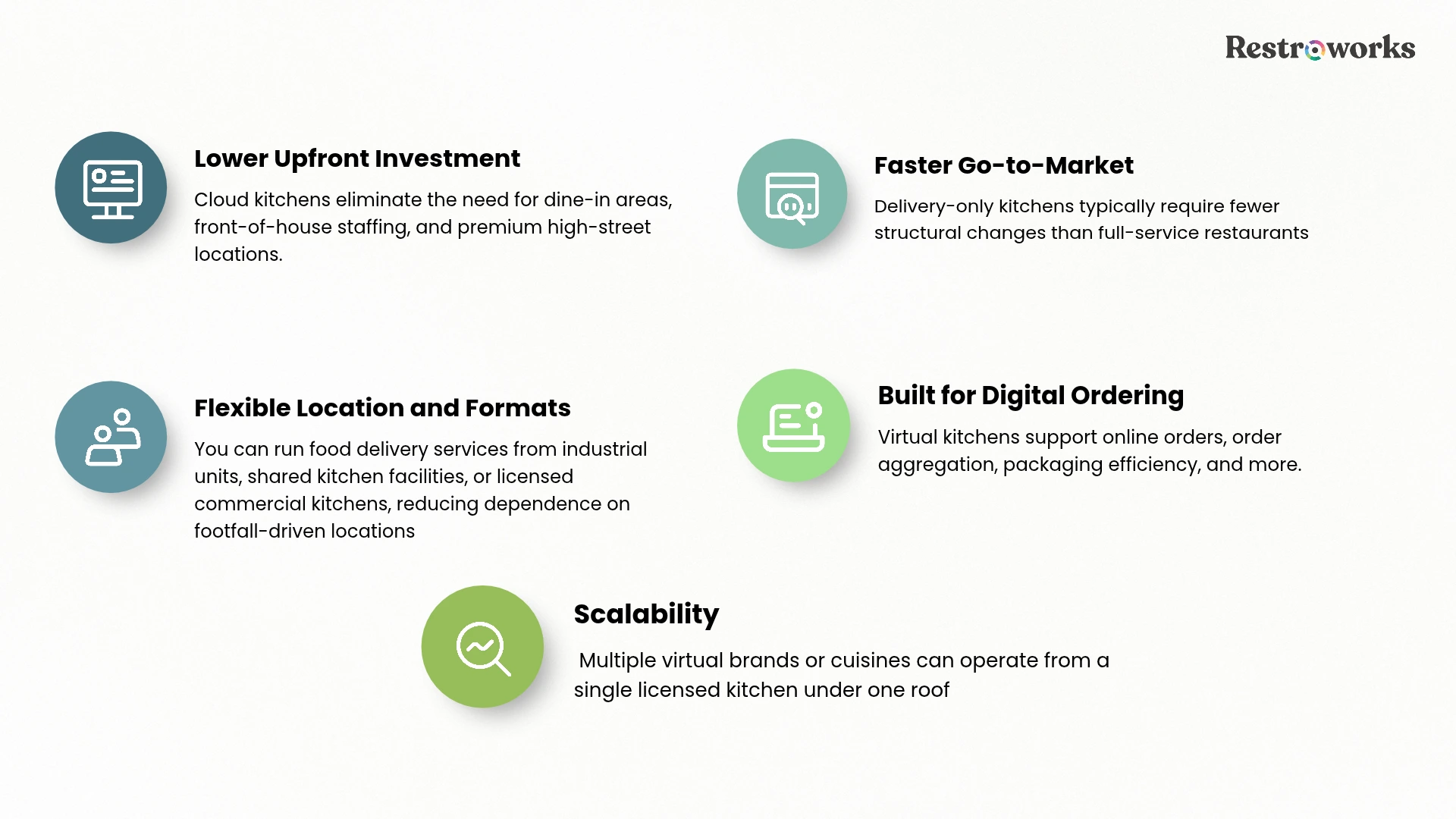
Below are the major benefits of starting a cloud kitchen business-
- Lower Upfront Investment: Cloud kitchens eliminate the need for dine-in areas, front-of-house staffing, and premium high-street locations. This significantly reduces overhead costs and capital expenditure, making market entry more viable in UK cities with high commercial rents.
- Flexible Location and Formats: You can run food delivery services from industrial units, shared kitchen facilities, or licensed commercial kitchens, reducing dependence on footfall-driven locations. This flexibility gives cloud kitchen operators lower operating costs and more control over their target audience.
- Faster Go-to-Market: Delivery-only kitchens typically require fewer structural changes than full-service restaurants, supporting faster concept testing and iteration.
- Built for Digital Ordering: Virtual kitchens support online orders, order aggregation, packaging efficiency, and delivery coordination from the outset, making it easier to track performance, gain valuable insights from online platforms, and refine menus based on consumer preferences.
- Scalability: Multiple virtual brands or cuisines can operate from a single licensed kitchen under one roof, improving cooking equipment utilisation and cost efficiency. This model lets a cloud kitchen business test new food concepts without the capital expenditure of a separate premises for each brand.
Cloud Kitchen vs Ghost Kitchen vs Virtual Kitchen
Cloud kitchens and ghost kitchens are often used interchangeably in the UK, but they describe slightly different models. A cloud kitchen is a delivery-only kitchen built from the outset for online food orders, with no dine-in option.
A ghost kitchen typically refers to an existing restaurant kitchen repurposed to serve virtual restaurants and delivery-only brands alongside its main operation. The distinction matters for compliance. A purpose-built cloud kitchen needs registration as a new food business.
A ghost kitchen operating from an existing restaurant premises may already hold the food business registration and hygiene rating, but each separate virtual brand operating from that kitchen may still need its own registration with the local authority, depending on council interpretation.
For example, Westminster Council says that if you operate from more than one location, you will have to register each premises with the local authority where they are situated. Camden’s information is unverified, and no sources can be found. Contact your council’s environmental health team before launch to confirm what applies in your area. Virtual restaurants and delivery-only restaurants fall under the same regulatory framework regardless of which term is used.
If you are starting from scratch, the cloud kitchen model is what applies; if you are adding delivery brands to an existing restaurant, ghost kitchen is the more accurate term. In both cases, the underlying compliance and food safety obligations are the same.
However, the delivery-only model carries risks worth understanding before committing. Platform dependency means commission rates of 20–35% directly reduce margins, and even established restaurant chains face the same pressure on food delivery commissions. A poor food hygiene rating reduces your brand’s visibility on platforms or removes you entirely. And if you operate from a shared kitchen, another operator’s compliance failure during an inspection can disrupt your operations too. Building a direct ordering channel through your own marketing channels early helps reduce platform dependence and improve customer retention over time.
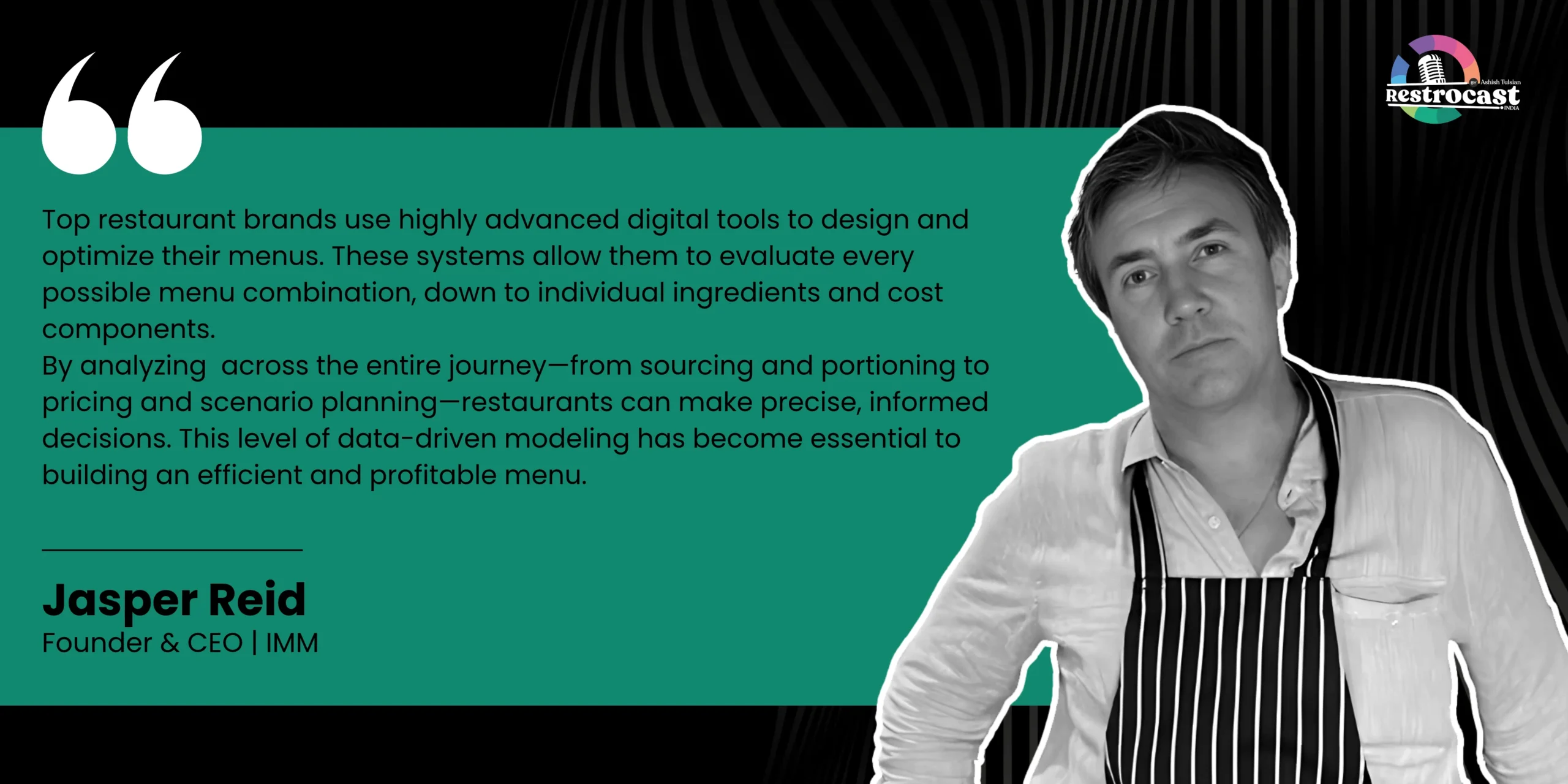
Jasper Reid, Founder & CEO of IMM, came on the Restrocast podcast with Ashish Tulsian and talked about how, in this digital age, utilising digital tools can help scale brands and allow them to make informed decisions.
What are the Mandatory Registration Requirements for Cloud Kitchens in the UK?
Before you can launch a cloud kitchen business model in the UK, it must be registered as a food business with the relevant local authority. This requirement applies regardless of whether the kitchen serves customers on-site or operates entirely through online delivery services.
What Registration Legally Means
Registering your cloud kitchen formally notifies the local council that food is being prepared, handled, and sold from a specific premises. Under UK food law, registration is mandatory if your business is involved in cooking, preparing food, storing, handling, selling, or distributing food. In England, Wales, and Northern Ireland, register through your local authority’s environmental health team via GOV.UK. In Scotland, register through your local council via Food Standards Scotland.
For cloud kitchens, this applies even when:
- Online orders are taken exclusively through online platforms or delivery apps
- The kitchen operates from a shared or rented commercial space
- There is no customer-facing or dine-in area
When Registration Must Be Completed
Registration must be completed at least 28 days before you start trading. There is no fee for food business registration. However, failure to register or late registration can result in enforcement action under Regulation (EC) No 852/2004, Article 6 (the duty to register) and the Food Safety and Hygiene (England) Regulations 2013 (with equivalent regulations in Wales, Scotland, and Northern Ireland), which carry penalties of an unlimited fine and up to two years’ imprisonment on indictment. Councils actively pursue operators who trade without registering. Recent enforcement cases have resulted in fines of several thousand pounds plus costs, particularly where the operator also lacked a food safety management system.
Before starting the registration form, prepare the following documentation: your business name and trading name, the full premises address where food will be prepared, the type of food activities you will carry out (cooking, reheating, packaging), and your proposed trading start date. The GOV.UK registration form asks for these details, along with the name and contact details of the food business operator. After submission, councils typically acknowledge your registration and schedule your first inspection within the 28-day window.
Begin the registration process as soon as you have confirmed a premises address, since the form requires a specific location. Some insurers flag businesses that begin trading before food business registration is complete, which can complicate or invalidate your cover.
Devolved Regulation Across the UK
Food safety regulations apply across the UK, but enforcement sits with different bodies depending on location. In England and Wales, the Food Standards Agency (FSA) sets the framework, while local councils carry out inspections. In Scotland, Food Standards Scotland oversees food safety policy and enforcement. In Northern Ireland, the FSA retains direct responsibility. Registration and inspection processes are broadly similar, but local authority practices can vary.
The practical difference for a first-time cloud kitchen operator starting a cloud kitchen business in the UK is in inspection scoring. England, Wales, and Northern Ireland use the Food Hygiene Rating Scheme (FHRS) with a 0–5 scale. Scotland uses the Food Hygiene Information Scheme (FHIS), which gives a pass or improvement-required result rather than a numeric score. Display of the rating is mandatory in Wales and Northern Ireland. If you plan to operate across borders or open a second site in a different nation, expect to deal with a different local authority and potentially a different rating system.
Registration in Shared Kitchen Facilities
Operating from a shared kitchen facility does not transfer the host kitchen’s food business registration or food hygiene rating to your business. Each operator in a shared cloud kitchen space must hold their own food business registration with the local authority. You are individually responsible for food safety compliance, even if you share kitchen infrastructure, but you risk losing ratings. Others’ standards in that space, even if your setup is spotless, can affect your hygiene rating.
The shared kitchen provider holds their own registration, but your food business is a separate legal entity and the local authority inspects your operation independently. Shared kitchens simplify premises compliance because the ventilation, drainage, and surfaces are already in place, but food handling, allergen management, and temperature control remain your responsibility.
What are the Cloud Kitchen UK License Requirements?
Cloud kitchen operations in the UK carry a number of essential licences and permits related to food preparation, food handling, employee safety, and premises.
| Licence / Registration | Required When | Issuing Body | Cost | Typical Processing Time |
|---|---|---|---|---|
| Food business registration | Always | Local council | Free | Submit at least 28 days before trading |
| Food Hygiene Rating | Following registration and inspection | Local authority / EHO | Free | Inspection timing varies |
| Employer’s liability insurance | If you employ staff | Private insurer | £4/month | Same day to 1 week |
| Public liability insurance | Commonly required by delivery platforms | Private insurer | Less than £50/year for small businesses | Same day to 1 week |
| Premises licence (alcohol / late-night refreshment) | If selling alcohol or operating between 11 pm and 5 am, where applicable | Local licensing authority | From £100 | 4–8 weeks |
| Waste carrier registration | If you transport waste covered by registration requirements | Environment Agency or relevant national regulator | Free for qualifying lower-tier registration / £191 for upper-tier registration | 1–5 working days |
| Fire risk assessment | Required for applicable premises under fire safety law | Responsible person; competent assessor where needed | £150–£900 | 1–2 weeks |
Food Hygiene Rating and Platform Requirements
Delivery platforms and food aggregators impose their own compliance requirements beyond local authority registration. Deliveroo, Uber Eats, and Just Eat each require cloud kitchen operators to hold a valid food business registration, provide evidence of insurance, and maintain a minimum food hygiene rating, typically 2 or above on the FHRS scale, before accepting them as partners.
Deliveroo requires a minimum FHRS of 2. Uber Eats also requires 2 or above. Just Eat generally requires a rating of 3 for new restaurant partners, though delivery-only and residential-kitchen applicants may face stricter requirements. Just Eat’s onboarding policy has historically required these operators to have been inspected and rated 3 or above before listing. Confirm the current requirements directly with each platform during your application, as these policies are updated periodically. The FSA-backed Food Safety Charter commits major platforms to listing only registered food businesses that meet a minimum hygiene standard. Factor in an onboarding timeline of 2–4 weeks per platform. Have all documentation ready before applying, including registration confirmation, insurance certificates, and your hygiene rating.
If your rating drops below the platform’s minimum threshold, expect suspension from that platform’s listings until the score is restored. You have the right to request a re-inspection from your local authority at any time after addressing the issues identified in your last report. Councils typically schedule re-visits within three months of a request. Be aware that many English councils charge a fee for a requested re-rating visit, and Wales has a statutory re-inspection fee; check with your local authority before requesting one. Deliveroo gives operators 21 days from notification of a rating drop to appeal before the listing is affected.
Food Safety and Hygiene Training
Food safety compliance is demonstrated through training and supervision rather than a government-issued licence. Under Regulation (EC) No 852/2004, Annex II, Chapter XII , food business operators must ensure that food handlers are supervised, instructed, and trained in food hygiene matters appropriate to their role. There is no legal requirement to hold a certificate, but the Level 2 Award in Food Safety and Hygiene for Catering is the industry-expected standard and the benchmark most environmental health officers look for during inspections. It covers personal hygiene, safe food handling, cross-contamination prevention, allergen awareness, and temperature management.
Insurance
Employer’s liability insurance is legally required if you employ staff, with a statutory minimum cover of £5 million. Premiums for a small cloud kitchen typically range from £40 to £150 per year for employer’s liability and £50 to £300 per year for public liability, depending on turnover and headcount. Delivery platforms typically require public liability cover before onboarding, so check each platform’s current onboarding requirements for minimum cover levels, as these vary and are updated periodically. Many landlords and shared kitchen operators also require evidence of both policies before allowing access to the premises.
Fire Safety
Commercial kitchen premises must comply with fire safety legislation: the Regulatory Reform (Fire Safety) Order 2005 in England and Wales, the Fire (Scotland) Act 2005 in Scotland, and the Fire and Rescue Services (Northern Ireland) Order 2006 in Northern Ireland. The responsible person (usually the operator or landlord) must carry out a fire risk assessment covering ventilation, emergency exits, suppression systems, alarms, and extinguishers. Cloud kitchens carry specific risks from deep fryers, high-temperature cooking equipment, and grease-laden extraction ducting that require appropriate suppression systems. A professional fire risk assessment typically costs £150 to £900 depending on premises size, and compliance is assessed separately from food hygiene inspections.
Waste Carrier Licence
All food businesses must use a licensed commercial waste carrier for food and packaging waste. If you only carry waste your own business produces, you qualify as a lower-tier carrier and registration with the Environment Agency is free. If you carry other businesses’ waste, upper-tier registration costs £191. In Scotland, register with SEPA; in Wales, with Natural Resources Wales (NRW); in Northern Ireland, with the Northern Ireland Environment Agency (NIEA). Under the Environment Act 2021 and the Simpler Recycling regulations, food businesses in England with 10 or more employees must separate food waste from general waste for collection from 31 March 2025, with micro-businesses (fewer than 10 employees) following from 31 March 2027.
Alcohol Licensing
If your cloud kitchen delivers alcohol alongside food in England and Wales, you need a premises licence under the Licensing Act 2003. In Scotland, the equivalent is a premises licence under the Licensing (Scotland) Act 2005. In Northern Ireland, licences are governed by the Licensing and Registration of Clubs (Amendment) Act 2011. This is separate from food business registration and requires an application to the local licensing authority, a designated premises supervisor (DPS) who holds a personal licence, and public consultation, which can take 4 to 8 weeks. Fees start from £100 based on rateable value. Late-night refreshment (between 11 pm and 5 am) also requires a premises licence. Most operators launch food-only first and add alcohol later once the operation is established.
Common Inspection Failures
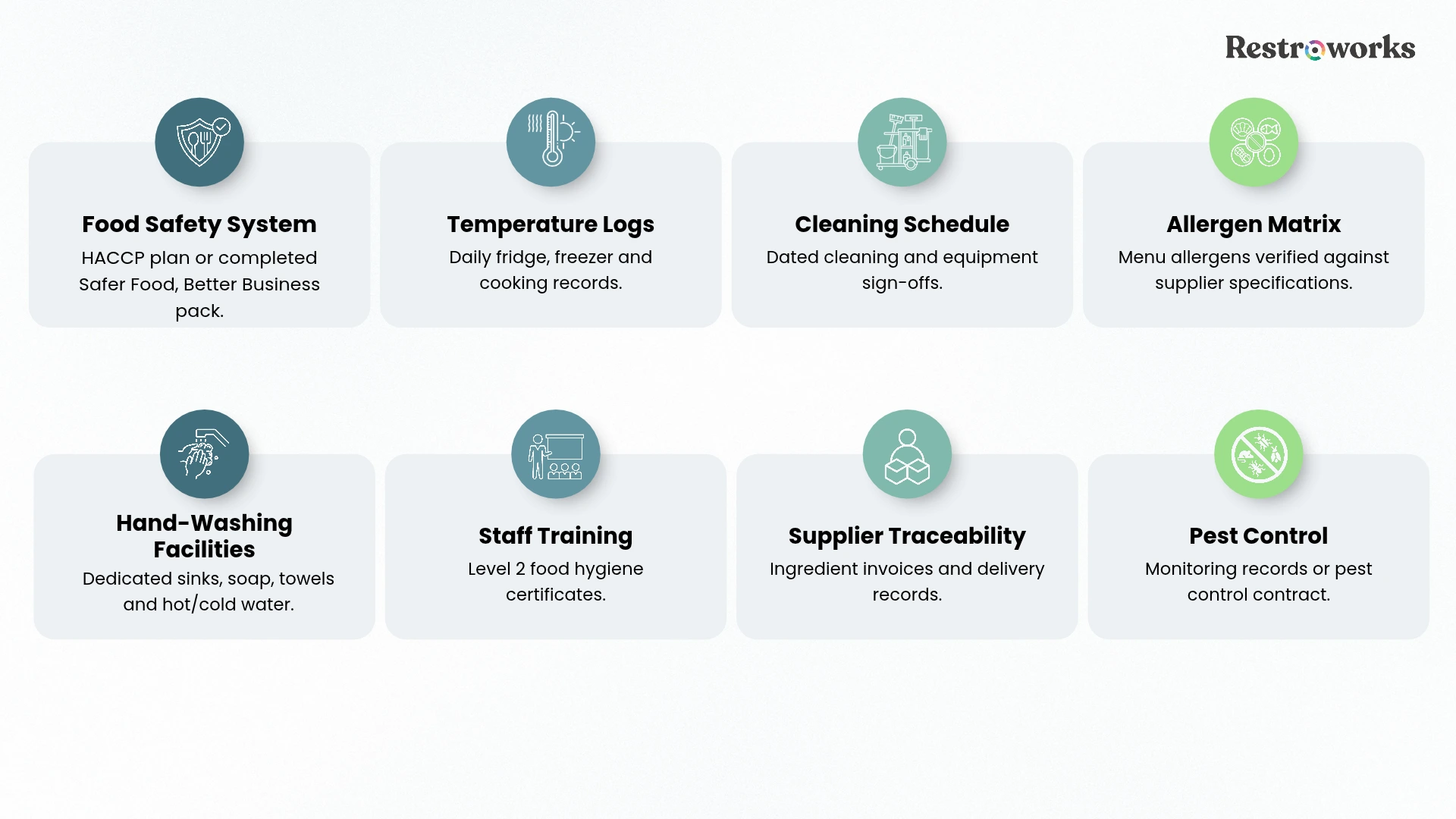
Environmental health officers commonly flag cloud kitchens for inadequate hand-washing facilities, poor temperature records, missing cleaning schedules, and insufficient separation between raw and cooked food storage. Other frequent issues include blocked fire exits, missing allergen documentation, and absent or outdated food safety management systems. Addressing these before your first inspection avoids delays to your launch.
Most preventable inspection failures come from missing documentation rather than infrastructure problems. Use the following pre-inspection compliance checklist to verify readiness before your first EHO visit:
- HACCP-based food safety management system or FSA’s Safer Food, Better Business pack, completed and dated
- Temperature logs for fridges, freezers, and cooking (begin recording from the day equipment is installed; daily sign-off; inspectors want to see a consistent logging habit rather than a specific number of months)
- Cleaning schedule covering all surfaces, equipment, and extraction, with dated sign-off records
- Allergen matrix for every menu item, cross-referenced to supplier specifications
- Hand-wash facilities stocked and accessible (soap, paper towels, hot and cold water), separate from food prep sinks
- Staff food hygiene training certificates on file (Level 2 minimum)
- Supplier traceability records, invoices or delivery notes showing source for all ingredients
- Pest control contract or evidence of pest monitoring
Councils typically inspect within 28 days of registration, so prepare these before you register rather than after.
Allergen Information for Delivery Orders
Cloud kitchens selling food at a distance must comply with the FSA’s allergen guidance for food sold online or by phone. Under the Food Information Regulations 2014, allergen information must be available to the customer at two points: before the order is placed (on the menu, app listing, or website) and again when the food is delivered (on labelling, a sticker, or an enclosed allergen sheet). This is a legal requirement for all distance-selling food businesses, not a platform policy. Failure to provide accurate allergen information at both stages is a common enforcement target and a serious food safety risk.
Approval for Supplying Other Businesses
If your cloud kitchen supplies meat, fish, dairy, or egg products to other food businesses (rather than directly to consumers), you may need food business approval from your local authority rather than registration alone. Approval involves a more detailed inspection of your premises and processes. Most single-brand, direct-to-consumer cloud kitchens need registration only, but multi-brand enterprise operators supplying satellite kitchens or other outlets should check whether approval applies.
INDUSTRY INSIGHT
Cloud kitchens are no longer a fringe operating model in the UK. A University of Sheffield study funded by the NIHR estimated over 750 dark kitchens operating in the UK as of 2020. This study indicates that more needs to be done to ensure that the inevitable growth of dark kitchens is accompanied by effective food safety measures. The operating model of dark kitchens poses different challenges due to shared kitchen spaces, multiple trading names, and sporadic operational times,” according to the researchers.
What are the Business Structure, Tax, and Regulatory Formalities?
Your legal structure, tax registrations, and rate relief eligibility directly affect liability, take-home profit, and how easily you can scale to multiple sites or brands.
Choosing the Right Business Structure
Cloud kitchen operators in the UK typically operate under one of three structures, each with different tax and liability implications.
- Sole Trader: Simplest structure with minimal setup requirements; owner personally liable for debts and obligations; often suitable for small or test-stage cloud kitchen food concepts.
- Partnership: Two or more individuals share ownership and responsibility; liability is shared unless structured as a limited partnership.
- Limited Company: A limited company is a separate legal entity from its owners, registered through Companies House for a £100 digital incorporation fee (since 1 February 2026) with a £50 annual confirmation statement. Corporation tax applies at 19% on profits up to £50,000 (small profits rate), with marginal relief for profits between £50,000 and £250,000, and a main rate of 25% above £250,000. Most new cloud kitchens fall within the small profits band. A limited company offers greater protection against personal liability and is commonly preferred for scalable or multi-brand cloud kitchen operations.
The liability difference is not theoretical. A sole trader whose customer suffers food poisoning faces personal liability for damages because there is no corporate veil separating the individual from the business.
If you are testing a single food concept with limited volume, sole trader status keeps setup simple. If you plan to scale, take on staff, or operate multiple brands, a limited company structure provides the protection most operators need.
Many UK cloud kitchen guides recommend choosing a structure early, as changing later can create tax and administrative complexity. Switching from sole trader to limited company after you begin trading, for example, requires re-registering with HMRC, updating insurance policies, and notifying your local authority.
Business Rates and Rate Relief
Cloud kitchens operating from commercial premises are subject to business rates, calculated based on the rateable value of the property. Small cloud kitchen operators may qualify for Small Business Rate Relief (SBRR) if the rateable value falls below £15,000, with full relief available for properties valued under £12,000 in England.
Between £12,000 and £15,000, relief is tapered. Above £15,000, the standard small business multiplier of 43.2p per £1 of rateable value applies for non-retail properties with a rateable value under
(2026–27). Qualifying retail, hospitality, and leisure (RHL) properties pay a lower multiplier of 38.2p, check with your local authority whether your cloud kitchen qualifies, as classification depends on how the Valuation Office categorises the premises. Scotland, Wales, and Northern Ireland set their own thresholds and multipliers. Shared kitchen operators typically include business rates in their rental charges; confirm this before signing. Check the Valuation Office Agency for the rateable value of any premises you are considering.
HMRC Registration and Financial Records
Register with HMRC based on your chosen structure: Self Assessment for sole traders (register by 5 October after your first trading year; a late tax return carries a £100 penalty, with further penalties for continued delay, while failing to register altogether is penalised as a percentage of the unpaid tax), Corporation Tax for limited companies (register within three months of starting to trade).
Register for VAT once turnover exceeds £90,000 in any rolling 12-month period. Under Making Tax Digital, VAT-registered businesses must keep digital records and submit returns through compatible software. Open a separate business bank account and maintain records of orders, supplier invoices, payroll, and food safety logs.
What are the Premises and Kitchen Setup Requirements?
For cloud kitchens in the UK, compliance is determined largely by the physical condition and layout of the kitchen premises. Local authorities assess whether your kitchen is structurally suitable for safe food preparation, storage, and handling, and non-compliant fit-out is the most expensive problem to fix after signing a lease.
Core Physical Requirements
Regulation (EC) No 852/2004, Annex II , food business premises must meet specific structural and hygiene standards. Kitchen spaces must be designed and maintained for hygiene and contamination control: cleanable surfaces throughout (floors, walls, ceilings, and work surfaces must be smooth, non-absorbent, and easy to clean), adequate ventilation, lighting, and drainage, and dedicated hand-washing facilities with hot and cold water separate from food preparation sinks.
All equipment and cooking equipment must be commercial-grade and maintained to food safety standards. Internal layout must provide clear separation between food preparation, cooking, storage, and packaging areas, with raw and cooked food stored separately.
Planning Permission and Change of Use
Before signing a lease for a cloud kitchen premises, check whether the property requires planning permission for change of use. Under the Town and Country Planning (Use Classes) Order, delivery-only kitchens most closely align with Use Class E(g)(iii) (any industrial process that can be carried out in a residential area without causing detriment to amenity). However, there is no settled use class for dark kitchens, and council interpretation varies significantly. If the premises were previously used for a different purpose, such as storage or light industrial, a change of use application may be needed.
Use Class E, introduced in 2020, merged several previous use classes into a single flexible class. A unit already in Class E may not require a planning application to operate as a cloud kitchen, but this depends on the local planning authority’s view of whether a delivery-only kitchen fits within E. Industrial units in Use Class B2 or B8 sit outside Class E and typically need a formal change of use application, which can take 8–13 weeks.
Planning interpretation varies by council. Camden, for example, has taken enforcement action against a dark kitchen operator, treating the use as sui generis (a use class of its own) rather than E. Other councils have accepted E(g)(iii) for similar operations. Check with the local planning authority before committing to a lease, assumptions about Use Class E do not hold universally, and proceeding without confirmation risks enforcement action after fit-out.
Running a Cloud Kitchen from Home
Running a cloud kitchen from home is possible for small-scale operations, but the kitchen must meet the same food safety regulations as any commercial premises. Your local authority will inspect the home kitchen for hygiene standards, storage, and separation from domestic use. Planning permission may also be required depending on scale.
A home kitchen that cannot demonstrate clear separation between domestic and commercial use will fail an environmental health inspection. Most residential properties lack commercial extraction, separate hand-washing facilities, and adequate cold storage, all of which officers assess. If the operation generates regular deliveries, waste, or noise, neighbours can raise planning objections. Starting from home keeps costs minimal for a first-time operator testing a food concept, but expect to move to a commercial or shared kitchen space as order volumes grow. The transition requires a new food business registration at the new address.
Noise and Leasing Considerations
Commercial kitchen extraction fans, refrigeration units, and delivery vehicle movements generate noise that councils may regulate. Local authorities assess noise impact using the approach set out in BS 4142 (the standard for rating industrial and commercial sound), which compares the sound from the kitchen against the existing background level rather than applying a fixed decibel threshold. If your premises are near residential property, expect noise conditions attached to any planning consent.
Some landlord insurance policies exclude commercial cooking activities. Confirm that your landlord’s building insurance covers food preparation use before signing a lease. Discovering an exclusion after fit-out is an expensive problem to resolve.
What Does a Cloud Kitchen Cost in the UK?
Starting a cloud kitchen in the UK typically costs between £5,000 and £55,000, depending on whether you choose a shared kitchen or a private setup. For a detailed breakdown, see the Restroworks guide to cloud kitchen costs. Shared cloud kitchens cost around £5,000 to £10,000 to get started, while setting up a private kitchen ranges from £20,000 to £55,000 or more, including kitchen equipment and fit-out.
A shared kitchen in a facility like Karma Kitchen comes with equipment, extraction, and compliance already in place. Potential customers can be served from day one because your spend covers only a deposit, initial stock, and packaging. A private unit means paying for fit-out from scratch: commercial ventilation and extraction alone costs £3,000–£5,000 for a small takeaway or café-style operation, according to Zigaflow, 2026, with larger restaurant-grade systems running £12,000–£30,000. Monthly running costs add £2,000–£5,000 for rent, utilities, insurance, and waste collection, before delivery platform commissions.
| Cost Category | Shared Kitchen | Private Kitchen |
|---|---|---|
| Initial setup | £5,000–£10,000 | £20,000–£55,000+ |
| Monthly rent | £500–£2,000 | £1,500–£5,000 |
| Kitchen equipment | Included | £5,000–£15,000 |
| Ventilation / extraction | Included | £3,000–£12,000 |
| Food business registration | Free | Free |
| Insurance (annual, all policies combined) | £500–£1,500 | £1,000–£3,000 |
| Typical timeline to launch | 6–12 weeks | 3–6 months |
Costs depend on the premises, location, fit-out, equipment, and contract. Shared-kitchen packages differ, so equipment and ventilation may not always be included. The launch timelines are estimates, not official processing periods.
Platform Commissions and Profit Margins
Delivery platforms such as Deliveroo, Uber Eats, and Just Eat charge commission rates between 15% and 35% per order. The exact rate depends on the platform, your negotiated terms, and whether you use their marketing or logistics services. These commissions are a core operating cost for any cloud kitchen business.
A basic listing on Just Eat with self-delivery sits at the lower end (around 15%), while a full-service arrangement on Deliveroo or Uber Eats, where the platform handles food delivery services, marketing placement, and customer satisfaction management, pushes toward 30–35%. Most first-time operators start with full-service to avoid hiring their own drivers, then negotiate or add self-delivery as volume grows.
Industry estimates suggest cloud kitchen profit margins can reach 15% to 25% under favourable conditions, compared with many traditional restaurants where margins often fall below 10%. The absence of front-of-house staff, dining area costs, and high-street rent contributes to this advantage, though delivery platform commissions partially offset it.
That 15–25% range assumes stable order volume and controlled food costs. Margins compress if average order values drop below £12–£15 or food waste runs above 5–8%. Tracking your food cost percentage (ideally 28–35% of revenue) and your cost per order across each platform gives you the clearest view of where margin is being made or lost.
What are the Operational and Ongoing Compliance Requirements?
Compliance for a cloud kitchen in the UK does not end once the kitchen is set up and registered. Day-to-day operations are subject to ongoing oversight, and regulators expect food safety, hygiene, and operational controls to be consistently maintained.
Cloud kitchens are expected to operate using defined procedures that show how food safety risks are controlled during peak hours and normal service alike. Efficient operations depend on documented standard operating procedures for food handling, cooking, cleaning, storage, waste disposal, and staff hygiene. Regulators expect an FSA-aligned, HACCP-based food safety management system such as Safer Food, Better Business. Maintain temperature records, cleaning logs with sign-off, waste disposal records, staff training records, and supplier traceability documentation for allergens. Cloud kitchen management platforms can help centralise these operational records across locations.
For a deeper look at kitchen technology and setup considerations, see the Restroworks cloud kitchen guide.
EXPERT INSIGHT
Joe Tyler, Launch Manager at Kitchen Ventures, described a common early-stage problem: “The main problem we had was that we didn’t have all our compliance records and documents in one easily accessible place” (Trail App, 2023)
That gap shows up at the worst time: during an unannounced EHO visit or a platform audit. Operators who centralise compliance records from day one report faster platform onboarding, higher food hygiene ratings, and a simpler path to opening additional sites. Businesses that achieve a high rating at first inspection avoid the re-inspection process, which can add several weeks to the launch timeline if the initial score falls below platform thresholds. A strong compliance record from your first kitchen becomes the template for every site that follows.
How to Start a Cloud Kitchen in the UK?
Starting a cloud kitchen in the UK involves more than securing a kitchen space and listing on online delivery services. Here is the step-by-step process to follow:
- Define your cloud kitchen business model and menu: Decide whether you will operate a single brand, multiple food brands, or a shared-kitchen model. Conduct market research to identify your target audience and understand industry trends in your area. Analyse customer preferences and local demand before finalising your menu. Your cuisine type and production volume influence kitchen layout, equipment needs, allergen controls, and inspection risk. A restaurant management platform can help you plan menu engineering and cost control from the outset.
- Choose a compliant kitchen location: Secure a commercial kitchen, industrial unit, or shared dark kitchen space in your target market permitted for food use. Confirm the lease allows commercial food preparation and that the premises meet hygiene, fire safety, and ventilation requirements.
- Register your food business with the local council: Submit your registration at least 28 days before trading (see the Registration section above for full details). Each kitchen location requires its own registration.
- Set up food safety systems and staff training: Implement a food safety management system based on HACCP principles or the FSA’s Safer Food, Better Business framework. Ensure food handlers complete appropriate training.
- Prepare the kitchen for inspection readiness: Finalise kitchen layout, cleaning schedules, temperature controls, waste handling, and pest control. Have documentation ready before the council inspects.
- Complete business, tax, and insurance registrations: Register with HMRC, set up a business bank account, and obtain employer’s liability and public liability insurance.
- Apply to delivery platforms and confirm additional licences: Submit onboarding applications to Deliveroo, Uber Eats, and Just Eat, the major online platforms and delivery apps, with your registration confirmation, insurance certificates, and hygiene rating. Apply for a premises licence if delivering alcohol. Your initial focus should be on efficient food delivery and building loyal customers rather than listing on every platform at once.
When starting a cloud kitchen in the UK, operators can typically move from concept to first orders within 6 to 12 weeks when using a shared kitchen facility. A private kitchen build-out takes longer, usually 3 to 6 months, due to fit-out work, planning approvals, and the 28-day food business registration window.
Shared kitchen operators such as Karma Kitchen offer managed onboarding that can significantly compress the launch timeline compared with a private build-out. A private build-out includes change of use applications (8–13 weeks), fit-out, fire safety sign-off, and EHO inspection, though the 28-day registration period runs concurrently with fit-out.
Taster, founded by Anton Soulier, raised $37 million and scaled to over 40 cities by operating multiple delivery-only food brands from hub kitchens — each with its own registration and brand identity, sharing a single licensed premises. The model demonstrates how one compliant kitchen can support several virtual brands without duplicating real estate or infrastructure.
Following these steps in order helps ensure your cloud kitchen is legally compliant, inspection-ready, and able to scale without regulatory setbacks. Cloud kitchens that skip or reorder steps—particularly registering after trading begins or signing a lease before confirming use class—create the compliance gaps that delay launches and trigger enforcement.
Conclusion
Opening a cloud kitchen in the UK requires the same level of regulatory discipline as any established food business. By understanding which approvals are mandatory, which depend on your operating model, and how inspections are applied in practice, you can build a cloud kitchen that is not only efficient but also resilient in the face of regulatory checks. Cloud kitchens that launch with every compliance requirement addressed from day one avoid the enforcement delays and platform suspensions that set back unprepared operators.
Before you take your first order, confirm every item on this launch-readiness checklist:
- Food business registration submitted to the local council (at least 28 days before trading)
- Kitchen premises meet EC 852/2004 structural and hygiene standards
- HACCP-based food safety management system documented and dated
- All food handlers trained to at least Level 2 Food Safety and Hygiene standard (or supervised by someone who is)
- Employer’s liability (£5M minimum) and public liability insurance in place
- Fire risk assessment completed and documented
- Waste carrier arrangements confirmed with licensed carrier
- HMRC registration completed (Self Assessment or Corporation Tax)
- Allergen matrices prepared for every menu item
- Delivery platform applications submitted with registration confirmation, insurance certificates, and hygiene rating
FSA data shows that 97% of food businesses in England, Wales, and Northern Ireland hold a rating of 3 or above. Completing this checklist before your first EHO inspection gives you the strongest foundation for achieving a high rating on the first attempt and avoiding the re-inspection delays that push launch timelines back by weeks.
KEY TAKEAWAYS
- You can legally operate a cloud kitchen in the UK by meeting food safety, premises, and registration requirements.
- Food business registration with the local council is mandatory and free, but must be completed at least 28 days before trading.
- Kitchen layout, cleaning systems, and food safety processes directly affect inspection outcomes and your Food Hygiene Rating.
- Food handlers must be supervised and trained in food hygiene appropriate to their role; a formal licence is not required, but Level 2 training is the expected standard.
- Business structure and HMRC registration influence tax, liability, and growth decisions.
- Licensing needs change as you add alcohol, late-night trading, or new locations.
- Most operators move from concept to first orders in 6 to 12 weeks using a shared kitchen, or 3 to 6 months for a private build-out.
Frequently Asked Questions
1. Can I open a cloud kitchen in the UK?
You can open a cloud kitchen in the UK, provided you register your food business with the local authority, meet food safety and hygiene regulations, and operate from premises approved for food preparation. Additional licenses may be required depending on alcohol sales, late-night trading, or premises use.
2. Are ghost kitchens legal in the UK?
Yes. Ghost kitchens are legal in the UK and regulated the same way as other food businesses. They must be registered with the local council, comply with food safety laws, pass hygiene inspections, and meet premises and fire safety requirements. The terms ghost kitchen, dark kitchen, virtual kitchen, and cloud kitchen all describe delivery-only kitchen models and virtual restaurants that fall under the same regulatory framework. Cloud kitchens, regardless of the label used, face identical compliance obligations.
3. Do I need a licence to sell food from home in the UK?
You do not need a separate licence, but you must register as a food business with your local council before selling food from home. Your home kitchen must meet the same food safety standards as a commercial premises and will be inspected by an environmental health officer for hygiene, storage, and separation from domestic use.
4. Do you need a licence to sell coffee in the UK?
Selling coffee does not require a specific licence, but you must register as a food business with the local council. Additional permissions may be needed if you sell alcohol, operate late at night, or trade from public spaces.
5. How can I sell homemade food legally in the UK?
Register as a food business with your local council at least 28 days before you start selling. Your kitchen must meet food safety standards, and you need a documented food safety management system. Complete Level 2 food safety training, maintain allergen records for every product, and ensure your kitchen can pass an environmental health inspection.
6. Do I need to register my home kitchen with the council?
Yes. Any premises where food is prepared for sale—including a domestic kitchen—must be registered with the local authority. Registration is free and must be completed at least 28 days before you begin trading. The council will then schedule an inspection to assess your kitchen against food safety standards.
7. How much does it cost to register a food business with the local council?
Food business registration is free across the UK. There is no fee to register with your local council, regardless of whether you operate from a commercial premises, shared kitchen, or home kitchen.
8. What are the food hygiene requirements for selling food from home in the UK?
Your home kitchen must have separate hand-washing facilities, adequate refrigeration, cleanable surfaces, and clear separation between domestic and commercial food activities. You need a food safety management system (such as the FSA’s Safer Food, Better Business), allergen documentation, and temperature monitoring records. An environmental health officer will inspect these during your first visit.
9. What do I need to start a cloud kitchen?
You need a food business registration with your local council, a kitchen premises that meets food safety standards, a food safety management system, food hygiene training for all handlers, employer’s and public liability insurance, and HMRC registration for your chosen business structure. You will also need to meet each delivery platform’s onboarding requirements, including a minimum food hygiene rating.
10. How much does it cost to start a cloud kitchen in the UK?
Starting costs range from £8,000 to £120,000 for a shared kitchen setup to £20,000–£55,000 or more for a private kitchen, depending on fit-out, equipment, and ventilation requirements. Monthly running costs typically add £2,000–£5,000 for rent, utilities, insurance, and waste collection, before delivery platform commissions of 15–35% per order.
11. Do I need planning permission for a cloud kitchen?
It depends on the property’s existing use class. Premises already classified under Use Class E (commercial, business, and service) may not require a planning application. Units in Use Class B2 (general industrial) or B8 (storage and distribution) typically need a formal change of use application, which can take 8–13 weeks. Check with the local planning authority before committing to a lease, as interpretation varies by council.