

Wouldn’t it be a lot easier to run a restaurant if your only expenses were food, labor, staff, and rent?
But of course, you already know that’s not how it works.
Once you account for these, then comes the longer list of other small expenses. There’s the electricity bill, payment processing fees, equipment repairs, software subscriptions, delivery commissions, and so much more. It’s never-ending.
These are your restaurant operating costs, and they play a huge role in determining how much money you actually get to keep. In fact, the average U.S. restaurant retains just 3-5% of its sales as net profit, which means every expense matters.
The good news? Once you know where your money is going, it’s much easier to budget, price your menu right, and keep restaurant costs from getting out of hand. Let’s explore the different types of restaurant operating costs, how to calculate them, and a few practical ways to reduce them.
What you will learn
- The difference between fixed costs and variable costs for a restaurant
- The key operating costs in a restaurant
- Strategies to control restaurant costs for better profitability
Understanding Restaurant Operating Costs
Restaurant operating costs are all the expenses that keep your business running from one day to the next. That includes the obvious ones, like food, labor, rent, and utilities, as well as dozens of smaller expenses like maintenance, delivery platform commissions, tech costs, and so on.
And those costs add up fast.
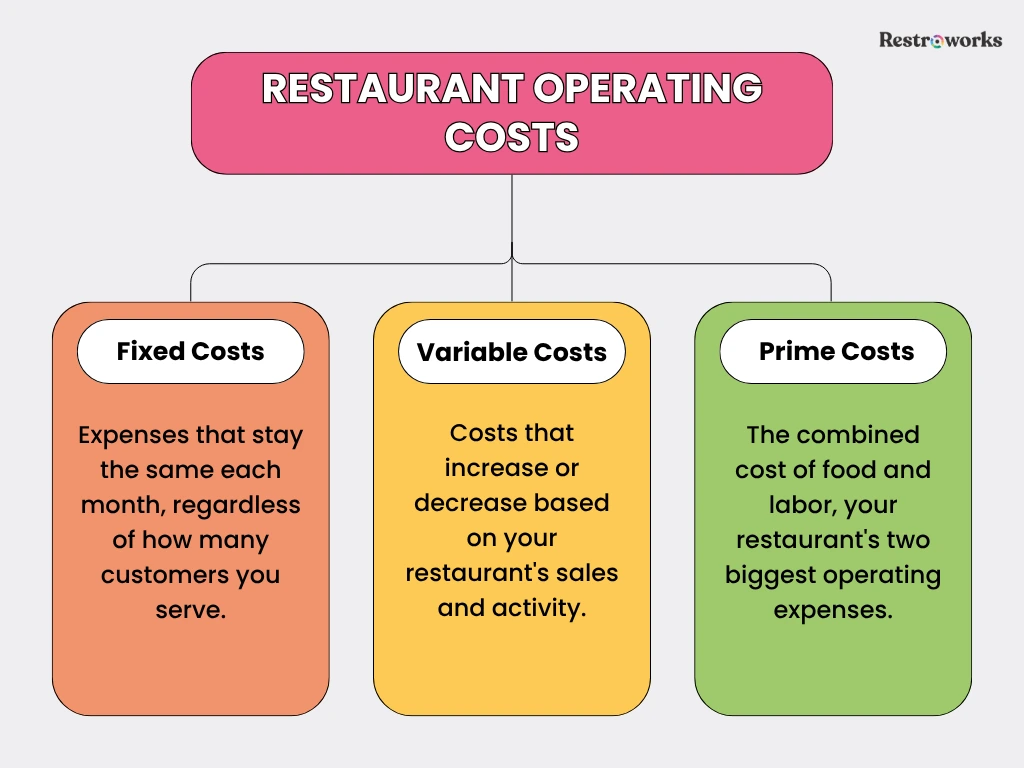
On average, restaurants spend around 85% of their revenue on operating expenses, leaving only a small portion behind as profit. So, when margins are already tight, it’s important to know exactly where your money is going. The first step is understanding the major categories of restaurant operating costs, which are-
A. Fixed Costs
Fixed costs are the expenses you have to pay, regardless of the revenue. Rent, insurance, licenses, and salaried employee wages fall into this category because they stay mostly the same from month to month.
The upside is that these costs are predictable. You know what bills are coming and can budget for them in advance. The downside? You’ll still have to pay for them, even when things are slow.
For example, if you’re running a fine-dining restaurant in a prime downtown location, your rent stays the same whether you serve 300 guests this week or 150.
B. Variable Costs
Variable costs, on the other hand, fluctuate with your restaurant’s activity. Basically, the more customers you serve, the more you’ll spend on ingredients, hourly workers, packaging, and other day-to-day expenses.
Unlike fixed costs, you have a little more flexibility with these expenses. Say your sales are slow, so you can also cut down on inventory purchasing, staffing hours, or marketing spend based on demand.
Then there are the semi-variable costs, such as utilities. You’ll usually pay a minimum monthly charge for services like electricity and water, and the bill will increase as you use more.
C. Prime Costs
If there’s one number every restaurant owner should keep an eye on, it’s prime cost.
Prime cost combines your two biggest expenses: food costs and labor costs, and accounts for more than half of your total sales. Which makes it worth considering the industry benchmarks and keeping your prime costs within-
- 55% and 60% of sales if you have a quick-service restaurant
- 60% to 65% if it’s a full-service restaurant
Why do these benchmarks matter, though? If food and labor consume 75% of your revenue, you’re left with only 25% to cover rent, utilities, insurance, technology, marketing, maintenance, and everything else.
Clearly, once the prime costs go above this range, it may get difficult for you to cover the rest of your operating expenses and still generate profits.
Prime cost is one of the most useful restaurant KPIs to understand performance. With regular tracking, you can identify rising costs early and make better decisions about pricing, staffing, and inventory management to cut down on your prime costs.
How to Calculate Prime Costs?
Prime Cost = Food Costs + Labor Costs
To understand how much of your revenue is being consumed by these expenses, you can also calculate the prime cost percentage-
Prime Cost % = (Food Costs + Labor Costs) ÷ Total Sales × 100
Say your monthly food costs are $25,000, labor costs are $35,000, and monthly sales are $100,000; your prime cost would be =
= ($25,000 + $35,000) ÷ 100,000 × 100 = 60%.
What are the Key Restaurant Operating Costs?
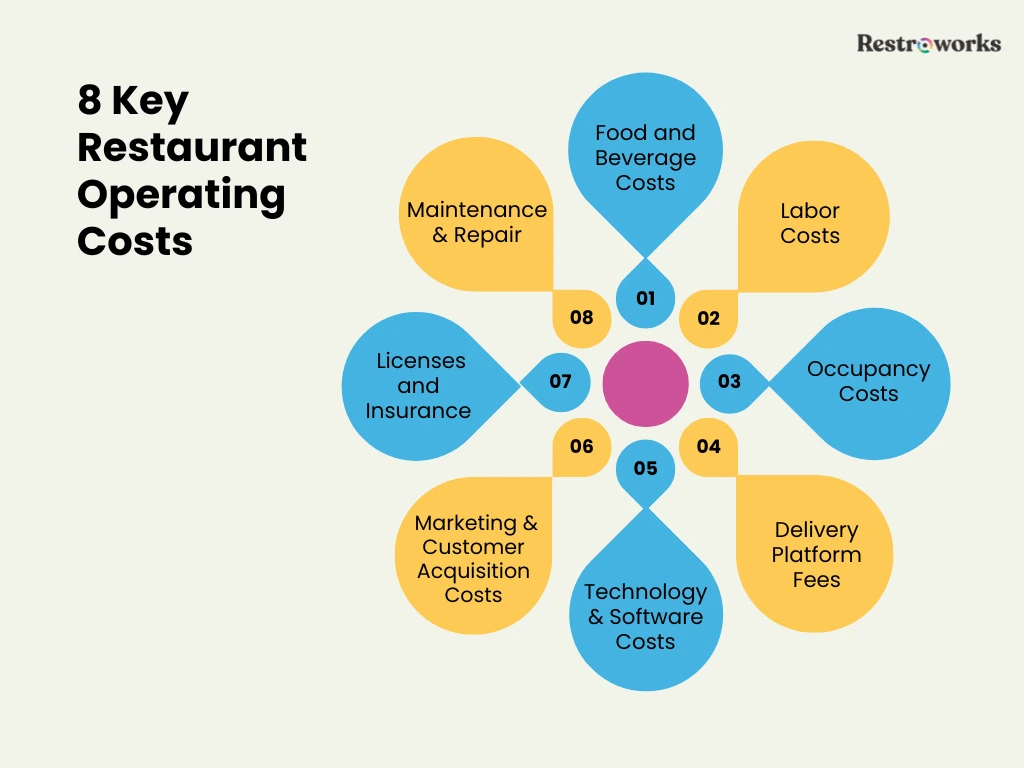
Let’s dive into the restaurant operating costs breakdown for your business-
1. Food Costs (28-32% of Revenue)
Food and beverage costs, also known as Cost of Goods Sold (COGS), include the ingredients, beverages, and other items you purchase to prepare your menu items. For most restaurants, these costs account for 28-32% of revenue, making them one of the biggest expenses you’ll deal with.
But the exact food cost percentage depends on your concept, menu pricing, supplier costs, and how efficiently your kitchen uses ingredients. For instance, full-service restaurants have average food costs of 32.4%.
Your food costs include all expenses associated with ingredients and beverages used in service, including-
- Raw ingredients
- Beverages, including both alcoholic and non-alcoholic offerings.
- Condiments, dressings, and specialty ingredients.
- Waste from spoilage, overproduction, or inconsistent portioning.
To calculate your food costs, use this formula-
Food Cost percentage = (Cost of Goods Sold ÷ Food Sales) × 100
How to Control Food Cost Percentage
- Standardize recipes and portions: Standardize your recipes with accurate ingredient quantities and portion sizes, so you know your inventory usage and costs.
- Count inventory regularly: Frequent inventory checks help you identify waste, over-ordering, and stock variances.
- Menu engineering: Which menu items bring you the most profit? Regularly review your menu, find out your bestselling items, or re-evaluate your pricing.
- Reduce food waste: Track spoilage and overproduction to understand where you’re losing costs on ingredients.
- Compare supplier pricing: Ingredient costs change frequently, so it’s worth reviewing vendor pricing instead of automatically reordering from the same supplier.
2. Labor Costs (28-35% of Revenue)
You can cut back on inventory purchases during a slow week. Staffing? Not so much.
Labor costs include your staff expenses, such as wages, salaries, overtime, payroll taxes, employee benefits, and proper training. In general, total labor costs account for 28-35% of your revenue, making it the second largest operating expense after food costs.
Now, the thing about labor costs is that managing them is tricky. It can quickly add up if you’re not managing it smartly, for instance-
- Scheduling more staff than you need
- Frequent overtime hours
- High employee turnover
- Long training periods for new hires
- Last-minute shift changes and call-outs
You can calculate labor cost percentage using the formula-
Labor Cost percentage = (Total Labor Costs ÷ Total Revenue) × 100

How to Control Labor Cost Percentage
- Schedule around demand: You don’t need to have the same number of employees for every shift. Use historical sales data to align your staffing levels with expected customer traffic.
- Cross-train employees: Offer comprehensive training to your employees across multiple roles. This gives you more flexibility during busy and slow periods.
- Reduce employee turnover: Hiring and training new employees takes time and money. Build a strong culture of trust and transparency to retain your existing employees.
EXPERT OPINION
3. Occupancy Costs
Occupancy costs include the expenses related to your restaurant location and everyday operations, such as-
- Rent or lease payments
- Utilities like electricity and water
- Property taxes
- Repairs and maintenance
- Waste collection services
- Insurance
The challenge is that most of these expenses are difficult to reduce quickly. If ingredient prices rise, you can adjust portions or negotiate with suppliers. If labor costs increase, you can revisit schedules. But rent doesn’t work that way.
That’s why it’s important to consider your occupancy costs before you sign that lease.
How to Control Occupancy Costs
- Think carefully before signing a lease: Rent is one of the few expenses you’ll be committed to, no matter what happens. So before you sign that lease, make sure you are okay with the terms and costs involved.
- Negotiate terms: Talk to your landlord to secure favorable terms, such as fixed rent increases, caps on CAM charges, or rent-free periods for renovations.
- Monitor utility usage: Higher-than-usual utility bills can point to operational inefficiencies. It may be due to equipment problems, leaks, or waste, which makes it important to track your usage regularly.
- Invest in efficient equipment: One of the best ways to save money on utility bills is to invest in energy-saving equipment, LED lighting, and programmable HVAC systems to make the most of your equipment.
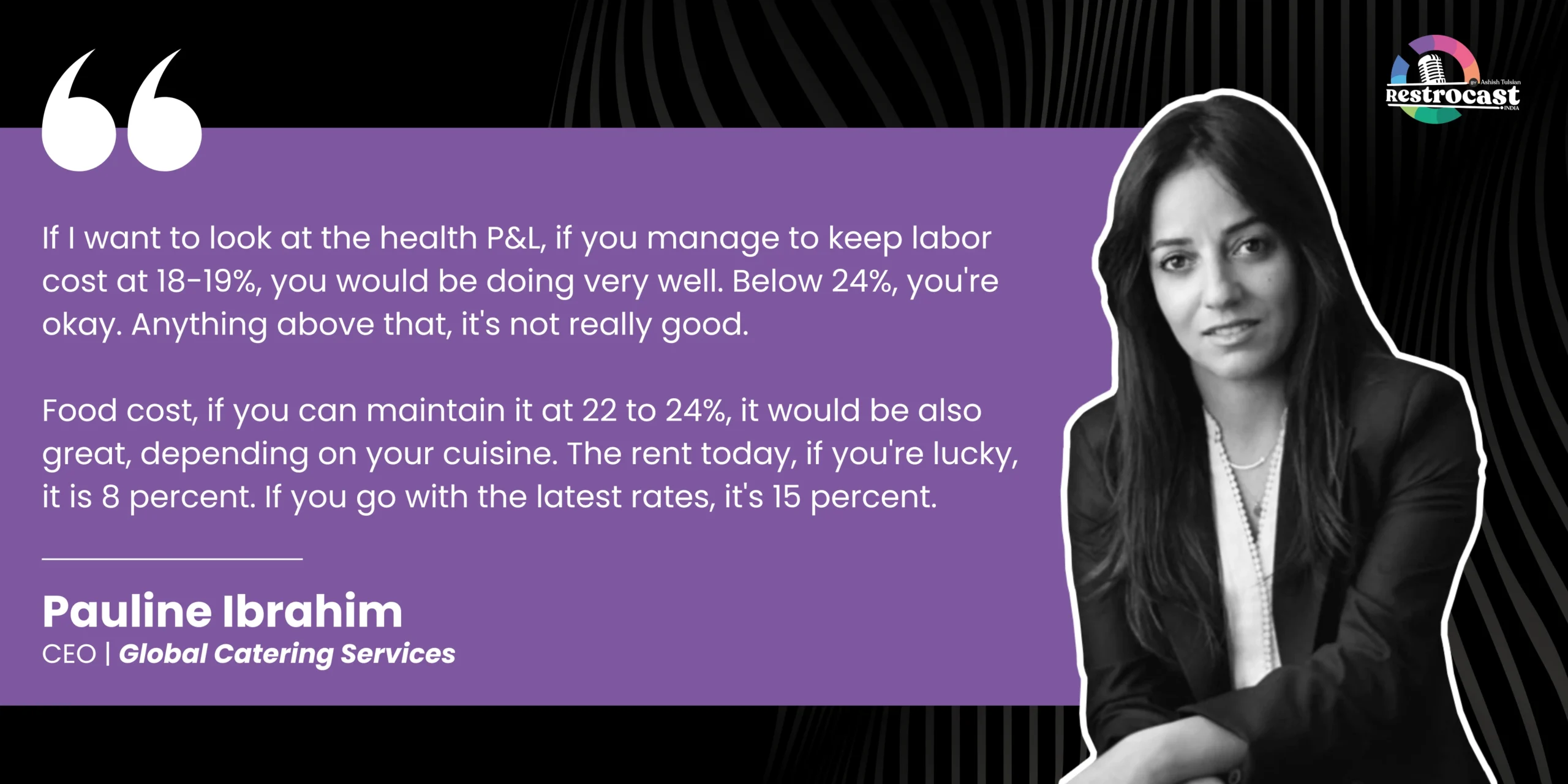
While every restaurant operation has its own cost structure, most operators keep a close eye on food, labor, and rent because these three expenses usually consume the largest share of revenue. Pauline Ibrahim, CEO of Global Catering Services, shared a simple benchmark for how these major restaurant costs typically stack up-
4. Third-Party Delivery Platform Fees
Being on third-party delivery platforms is a great idea for your restaurants.
It helps you boost your presence, reach more customers, and add another revenue channel, but it also adds another operating cost. All major food apps, Uber Eats, DoorDash, and Grubhub, charge you commissions, order processing fees, marketing fees, and other charges on every order.
Now, if your delivery sales are high, it may be easy to overlook these costs. But, at the same time, a high volume of delivery orders may not always mean higher profits, as commission rates are high; as Pauline Ibrahim notes, “If you have high dependency on delivery, the delivery costs would be 15 percent or 16 percent of your sales.”
How to Manage Delivery Platform Fees?
- Review commission rates regularly: As your delivery volume grows, don’t ignore your commission rate. Consider it as a percentage of delivery sales to see how it’s actually impacting profits.
- Encourage direct ordering: Sure, third-party delivery apps are perfect for reaching new people, but the costs aren’t always worth it. Instead, focus on building an intuitive website or app with direct ordering services to minimize third-party commissions.
- Review delivery menu prices: Like many other restaurants, if you also have separate pricing for delivery apps, review it too.
- Track profit per order: Receiving a high number of delivery orders is great, but is it generating enough revenue for you? Determine how much money you’re actually keeping after commissions, discounts, and other fees.
5. Technology and Software Costs
For a restaurant, there’s no doing without technology. And for good reason. It streamlines your operations, simplifies management, and ensures a smooth customer experience.
But what was once limited to a basic cash register now includes POS systems, online ordering platforms, inventory management software, payroll tools, loyalty programs, and accounting software. You have dozens of subscriptions, and their combined cost can become huge as your technology stack grows.
The value of these tools comes from saving time, reducing manual work, and improving visibility into restaurant performance. But paying for multiple systems with overlapping features does not make a lot of sense financially.
How to Control Technology Costs?
- Audit subscriptions regularly: Once you’ve subscribed to a software tool, don’t forget about it. Vendors may increase base pricing or add costs for additional features you may not know about.
- Look for overlapping systems: Surprisingly, many restaurants end up investing in multiple tech tools that perform similar functions. Consolidate your overlapping tools to simplify restaurant operations and reduce operating costs.
- Measure the return on each tool: Every subscription should either save time, reduce costs, improve visibility, or generate revenue; if it doesn’t, review why you have it again.
6. Marketing and Customer Acquisition Costs

Whatever you spend to attract new customers and encourage repeat visits is your marketing expenses. Given how competitive the restaurant industry is today, marketing has become an unavoidable cost to get in front of potential customers.
The good thing is that, unlike rent or insurance, marketing spend is highly flexible. You can decide to spend more during slower periods, launch seasonal campaigns, or reduce spending when demand is already strong. At the very least, you’ll be spending on-
- Digital advertising
- Social media campaigns
- Email marketing
- Loyalty programs
- Influencer partnerships
- Promotional events
How to Control Marketing Costs
- Track metrics: Likes, views, and clicks on social media will get your restaurant in front of the right people, but they don’t pay the bills. The real measure of your marketing success is the channels that actually lead to orders, reservations, or repeat visits.
- Invest in customer retention: Acquiring a new customer costs more than keeping an existing one, about 5-10 times more, to be precise. Strategies like loyalty programs, email campaigns, and personalized offers are useful for engaging your customers and keeping them coming back.
- A/B test ideas before increasing budgets: Consider starting with a small budget or A/B testing your campaigns before going big. It’s safer this way for a new restaurant and also allows you to see what will work for your audience.
- Build channels you own: Email lists, loyalty programs, and direct communication channels give you a way to reach customers without paying for every interaction.
- Review marketing performance regularly: Customer behavior changes, platforms change, and marketing trends change. What worked six months ago may not be the best use of your budget today, so keep reviewing and revising.
7. Licenses and Insurance
Before you can serve your first customer, there are a few costs you simply can’t avoid.
Licensing is one of them. Depending on your location and restaurant format, you’ll need various licenses, permits, and insurance policies to operate legally and protect the business from financial risk. While these expenses are not as big as food or labor costs, they’re still an important part of your operating budget. These will include-
- Business licenses
- Food safety and health permits
- Liquor licenses
- Fire and safety permits
- General liability insurance
- Workers’ compensation insurance
- Property insurance
How to Control License and Insurance Costs
- Stay ahead of renewal deadlines: Missing a permit renewal or insurance payment can create unnecessary penalties and administrative headaches. A simple tracking system can prevent costly oversights.
- Review insurance policies regularly: As your restaurant grows, expands, or changes operations, your insurance needs may change as well. Review your insurance coverage periodically to ensure you’re paying for protection you actually need.
- Compare providers occasionally: Many operators renew the same policy year after year without checking alternatives. A quick online search comparing the top insurance providers can sometimes help unlock better rates or more suitable coverage for your restaurant.
8. Maintenance and Repair
Restaurant equipment works hard every day. Multiple appliances like ovens, refrigerators, dishwashers, HVAC systems, and kitchen appliances keep running all day, every day.
And then eventually, things wear out.
This makes maintenance and repair costs another cost center for you, covering expenses required to keep your restaurant operating safely and efficiently. This includes some planned expenses, such as equipment servicing, and other unexpected ones for repair and replacement.
So your maintenance costs will include-
- Equipment servicing
- Emergency repairs
- HVAC maintenance
- Plumbing and electrical work
- Kitchen equipment replacement parts
- Building repairs
Ignoring maintenance may save money in the short term, but it will most definitely lead to bigger repair bills later.
How to Control Maintenance Costs
- Don’t postpone small repairs: Minor issues won’t stay minor for too long. The moment you see a leaking pipe, the oven making a weird noise, or a faulty refrigerator door, it can turn into a much larger expense if ignored.
- Follow a preventive maintenance schedule: Regular servicing keeps equipment running efficiently and reduces the chances of unexpected breakdowns during busy service periods.
- Train employees on proper equipment use: A lot of equipment issues often arise from misuse rather than equipment failure. Offer comprehensive training to ensure proper use and extend the life of expensive assets.
- Set aside funds for emergencies: Having a maintenance budget in place makes unexpected breakdowns easier to handle without disrupting cash flow.
Hidden Operating Costs in Restaurants
You account for food, labor, marketing, rent, utilities — you know, the basics. But the story doesn’t end here. You’re yet to account for various recurring hidden costs that usually catch you by surprise.
Here are some of the most common hidden operating costs restaurants encounter-
1. Credit Card Processing Fees
Every card transaction comes with a fee. When card payments make up the majority of your sales, those charges can add up quickly over the course of a month. The cost becomes even higher for restaurants with high transaction volumes and lower profit margins.
2. Pest Control Services
Regular pest inspections and treatments are part of operating a food business. While these services may not be too expensive on their own, skipping them can lead to health code violations, failed inspections, and far more costly problems later.
3. Licenses and Permit Renewals
Restaurant licensing costs are not limited to one-time approval. Business licenses, health permits, liquor licenses, and other regulatory requirements renew annually. Because they aren’t monthly expenses, they’re easy to forget until renewal notices arrive.
4. Music Licensing Fees
Playing music in your dining room, bar, or waiting area also requires licensing agreements, depending on how the music is used. You may not even think about these fees until they appear as part of a compliance review.
5. Waste Removal
Everyday trash collection, recycling services, and grease disposal also feature fixed costs that you need to account for in your operating expense budget.
Factors Affecting Your Restaurant Operating Costs
Restaurant operating costs can vary widely from one business to another. Many restaurant owners go into business with a clear understanding of the initial investment required for it.
But the challenge comes later, when day-to-day operating costs start piling up from different directions. As Kamran Khan, CEO of Arabian Entertainment Co. Ltd., puts it-

Here are some of the biggest factors that influence what you’ll spend each month-
A. Location
Where you open your restaurant affects almost every expense that follows.
A prime downtown location may bring more foot traffic, but it usually comes with higher rent, higher hourly wages, and of course, higher total operating costs. Plus, it also affects-
- Utility costs
- Property taxes
- Insurance premiums
- Delivery costs
- Local labor rates
In other words, the same restaurant concept can have very different operating costs simply because it’s located in a different area.
B. Restaurant Format
A fine-dining restaurant and a fast-casual restaurant don’t spend money the same way.
Fine-dining concepts often need highly skilled chefs, extensive staffing, premium ingredients, and higher décor expenses. Those choices can increase both labor expenses and food cost percentages.
Fast-casual and quick-service restaurants can operate with smaller teams and simpler menus, helping keep some expenses lower. At the same time, they also rely on serving a higher volume of customers to maintain a profitable restaurant.
C. Menu Complexity
A larger menu will sound good on paper because you can offer more choices to customers that way. But what you may forget is that it also creates more work behind the scenes.
More menu items just means more ingredients to purchase, store, track, and manage. That can increase food waste, inventory costs, and kitchen complexity.
While simpler menus are easier to execute consistently because you’re relying on fewer ingredients and less storage space. So, when evaluating your restaurant costs, your menu is one of the first places worth looking.
D. Supply Chain
The ingredients on your menu are only part of the equation. Where those ingredients come from matters too.
If you rely on imported products, you may deal with more shipping delays, supplier shortages, and price fluctuations. If you source locally, you’ll often get fresher ingredients, but availability and pricing may change throughout the year. As a result, your supply chain can affect-
- Ingredient costs
- Inventory levels
- Menu pricing
- Food availability
A good way to overcome this is to work with multiple suppliers instead of relying on a single source to manage your restaurant costs better.
The only way to ensure long-term profitability and sustainability is to know your restaurant costs inside and out. Once you evaluate every single expense from labor and food to licenses, maintenance, and technology, operators, you’ll know where resources deliver the most value and where you can make adjustments to improve margins.