

What is the foundation of a successful restaurant? You’d probably say the right location where most of your target customers are. Maybe the ambiance that makes it “insta-worthy”. Or maybe the food itself, including the quality, variety, and taste you offer?
And yes, those elements absolutely make up a successful restaurant business. But a business plan is where the restaurant actually begins to take form. Where you work out your concept, define the target audience, share pricing logic, think through the revenue potential, and even down to the operational hours you’ll follow.
A strong business plan helps you capture your restaurant idea and turn it into a viable, profitable business. But writing one is where things can get confusing. So to help you begin, this blog covers everything you need to know about writing a strong restaurant business plan.
What you will learn
- What is a business plan, and the need for one?
- The main components of a successful business plan
- What restaurant owners should include and avoid in their business plan
What is a Restaurant Business Plan and Why Do You Need One?
A restaurant business plan is a detailed blueprint that explains your vision, growth strategy, market positioning, and path to profitability. It covers every major aspect of the business, including the concept, target audience, menu strategy, pricing, operations, staffing, marketing strategy, and financial planning.
But who needs one? First-time restaurateurs, seasoned franchise owners, angel investors, venture capitalists, and even bank loan officers all rely on a solid business plan to understand the potential of your restaurant business. It’s a foundational document that shows you’re serious, organized, and prepared.
Restaurant operators who have spent decades in the industry often describe the business very differently from how outsiders imagine it. As Eric Slaymaker, Founder of Winger’s Alehouse, puts it-

And this is exactly why a restaurant business plan matters.
- To validate your business model: A restaurant concept may sound strong creatively, but a business plan will help you define the concept and project revenue and see if it can realistically support rent, labor, food costs, utilities, and ongoing operational expenses.
- To guide operational planning: It forces you to think strategically about what everyday operations will look like in terms of the service style, menu size, kitchen workflow, delivery integration, and operating hours, and more.
- To build investor confidence: Investors and lenders want to understand how your restaurant will generate revenue, manage risk, and maintain profitability. A detailed business plan is proof that you have evaluated your concept for operational and financial aspects.
- To establish your market positioning: A restaurant business plan helps define where your brand fits within the market and the factors that differentiate it from nearby competitors. It encourages you to identify the audience you are targeting, the pricing segment you want to operate in, and the kind of dining experience you want to offer your customers.
- To support long-term growth: A restaurant business plan is not only useful during the launch stage. It also guides your future decisions related to expansion, menu changes, hiring, budgeting, marketing investments, and revenue optimization as the business grows.
INDUSTRY INSIGHT
Essential Components of a Restaurant Business Plan
A restaurant plan includes the following key aspects-
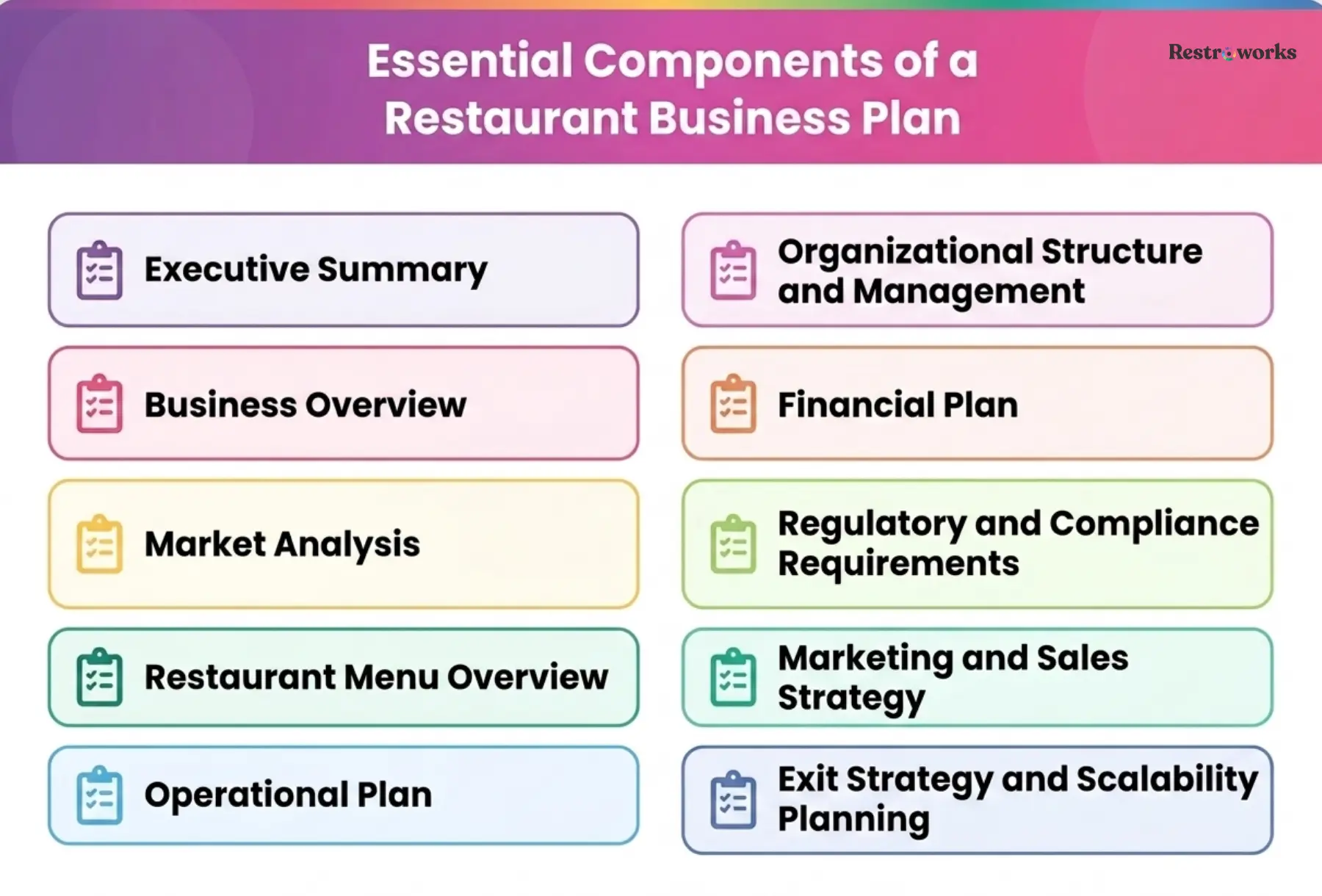
A. Executive Summary
This is the first section of your business plan, which is ironically, often written last. Your executive summary is a one-to two-page overview of the entire restaurant business, underscoring the key points covered in the business plan later. This includes brief highlights on-
- Your restaurant name, location, and concept
- Your execution strategy for the restaurant
- Menu and service style
- Target market and direct competitor analysis
- An overview of your costs and projected profit
- Elements that set you apart from competitors
This is where you’ll also write your objectives and the vision and mission statements. Think of it as a high-level snapshot of the business plan. Someone reading only the executive summary should still understand how the restaurant plans to operate, compete, and generate profit.
As a result, make sure this section is well-written, concise, and highly informative.
B. Business Overview
The business description outlines the history and core identity of your restaurant, along with the role it aims to play within the market. This section focuses on the concept, customer experience, brand positioning, service model, and the business direction you’d like to take.
So this is where you can answer these questions: What made you choose this business and the specific restaurant concept? Why do you want to build this business? And then describe your restaurant with details like-
- The restaurant’s name and location
- ItItsistory
- Food and concept
- Management structure
- Restaurant goals and objectives
C. Market Analysis
A market analysis looks at your surroundings: the state of the restaurant industry, your local competition, target customers, and the location you’re operating in. The idea is to determine your positioning and value proposition in the market with respect to these factors.
For this, you can conduct a SWOT analysis, listing the strengths you can play on, weaknesses you need to improve, the opportunities you can create in the market, and the threats you need to overcome. Additionally, a market analysis focuses on-
- Target customer demographics (age, gender, income levels, etc.) and spending behavior
- Local dining trends and consumer preferences
- Industry trends
- Competitor analysis and market gaps
- Average revenue/profitability of similar restaurants
- Pricing expectations within the market
- Delivery and takeout demand in the area
A market analysis helps you validate if the restaurant concept aligns with actual customer demand, operational realities, and revenue potential within your selected location.
D. Restaurant Menu Overview
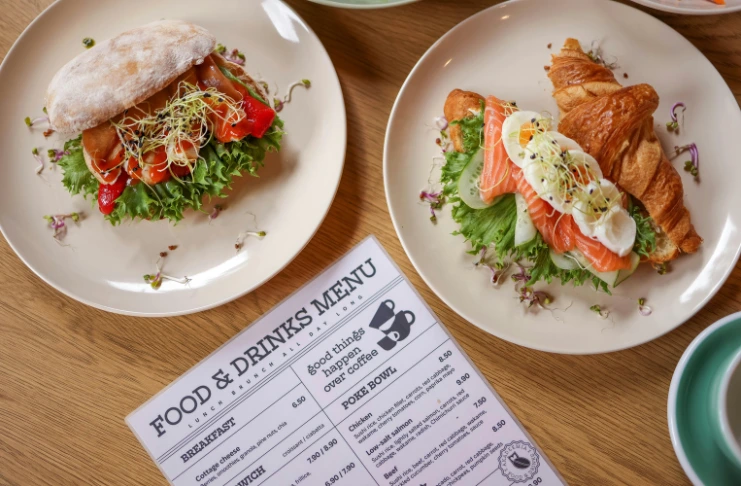
Most restaurant ideas begin with a menu or a recipe. Maybe it was a family recipe you love, a specialty dish that you always end up cooking, or a cuisine gap you discovered in the market. This is the section where you get to make that menu the focal point of your business
Start by explaining the customer experience you want to create. This includes your cuisine style, service format, and the overall positioning of the restaurant. Then define the sample menu items, descriptions, ingredients, preparation time, staffing needs, and a preliminary menu design.
Also, talk about your pricing strategy based on your production and operational costs, expected profit margin, and competitor pricing. You can also mention things like-
- Combo meals or bundled offers
- Seasonal specials
- Premium add-ons
- Delivery-specific pricing
- Expected average spend per customer
You don’t need to decide the full menu here. The idea is to focus on menu engineering to get a basic idea of your food and beverage concept.
E. Location Strategy
So you’ve found the perfect location. But is it good for your restaurant? If you pick a space in a busy commercial area for visibility, it will also bring high rental pressure. And if you go for a residential neighborhood with low rents and potential for repeat business, you may not attract the right customers.
In this section, that’s your only aim. To explain why your restaurant’s location or potential locations make sense for the kind of restaurant you are building.
For location assessment, evaluate and mention factors like-
- Population density
- Foot traffic and accessibility
- Available parking
- Competition within the area
- Delivery radius potential
- Rental costs
F. Operational Plan
Many restaurant business plans spend pages talking about the concept and barely discuss how the restaurant will function once service actually begins.
This section explains your ideas around everyday operations. For instance, what will the staffing structure be? Who will coordinate with suppliers and when? What will the kitchen workflow and floor service look like? Because these decisions directly affect consistency, labor costs, speed of service, and overall guest experience.
As a result, your operational plan should cover areas such as:
- Front-of-house and back-of-house structure
- Staffing requirements and hiring plans
- Kitchen workflow and service process
- Supplier and inventory management
- Food preparation and storage standards
- Technology and POS systems integration
- Delivery operations
- Daily operating schedule
G. Organizational Structure and Management
This next section focuses on your business entity and the organizational structure of the restaurant. Simply put, this involves declaring whether your restaurant is a sole proprietorship, limited liability company, a partnership, or a corporation.
Your business entity will impact your financial, legal, and tax structure and compliance, so start by talking to a financial expert to get started with business registration.
Next, explain who is responsible for running different parts of the business and how decisions will flow across departments. Depending on the size and format of your restaurant, you can define the following-
- Founders and ownership structure
- Restaurant manager responsibilities
- Head chef or kitchen leadership roles
- Front-of-house management
- Hiring and reporting structure
- Staff training approach
And even if you are starting small, defining responsibilities helps avoid confusion once you become operational. If you’re still in the process of filling in leadership roles, mention the kind of experience or expertise you plan to hire for.
Because more often than not, investors and stakeholders are only trying to gauge if your restaurant has the structure and leadership required for growth.
H. Financial Plan
So, how much money does it actually take to open a restaurant? Most restaurant owners start with a rough investment number in mind, which can often go from $175,500 to $750,000 according to estimates.
And then the reality hits. Renovation costs climb because the space needs plumbing fixes, the equipment you wanted isn’t available, or supply chain issues have increased the cost of raw materials. When only food costs account for 32.4% of a restaurant’s expenses, a financial plan helps you prepare for all the “what-ifs”.
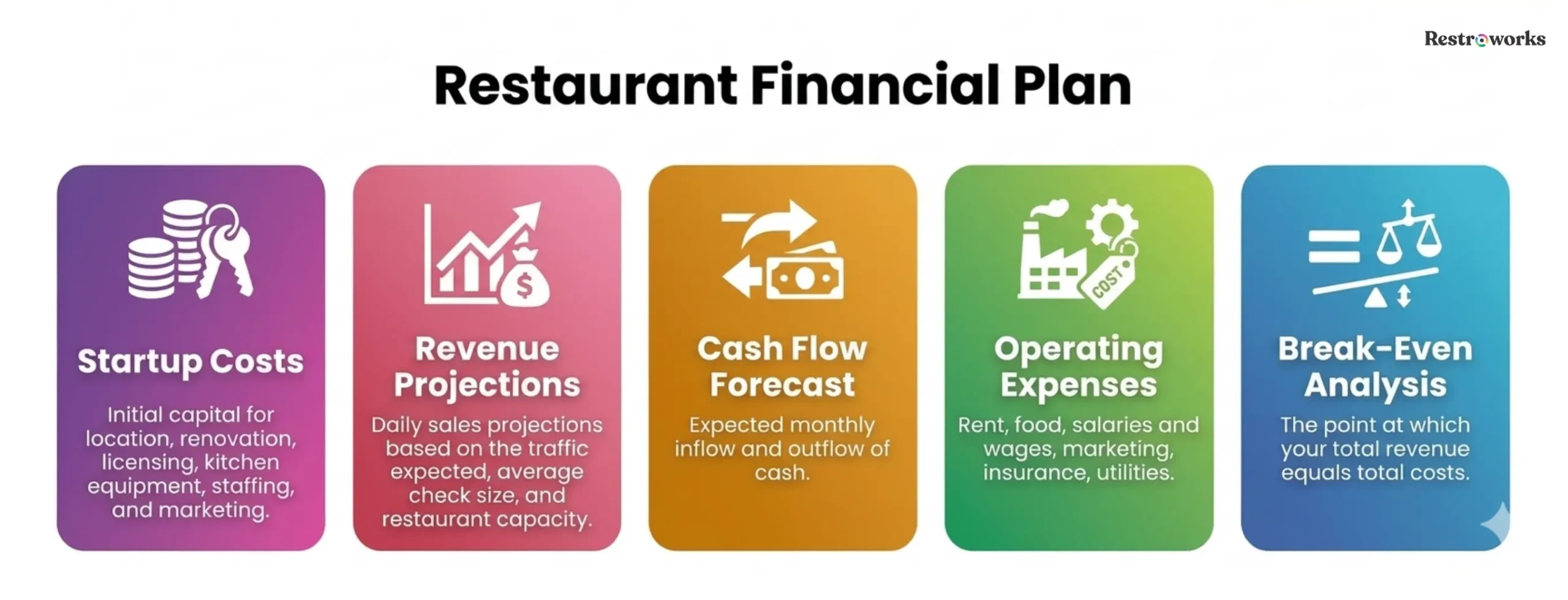
In most cases, investors and stakeholders, including yourself, need insight into the following-
- Startup Costs: Your initial capital for location, renovation, licensing, kitchen equipment, staffing, initial inventory, marketing budget, and working capital for a few months.
- Revenue Projections: Your daily sales projections based on the traffic expected, average check size, restaurant capacity, and seasonal variations.
- Cash Flow Forecast: The expected inflow and outflow of cash on a monthly basis, especially during the crucial first year. Highlight any potential cash gaps and how you plan to cover them.
- Operating Expenses: Cost projections for your rent, food, salaries and wages, marketing strategy, insurance, utilities, and any other operational expenses.
- Break-Even Analysis: The point at which your total revenue equals total costs, meaning your business starts making neither a profit nor a loss. This analysis helps stakeholders understand how long it will take for their investment to pay off and what their average monthly revenue needs to be to cover all fixed and variable costs.
In case you want to raise funding from investors or apply for a loan, mention the capital you need to launch and operate your restaurant through the initial stages. Explain the potential fund allocation across categories and the type of funding you seek.
I. Regulatory and Compliance Requirements
Restaurants operate in a highly competitive and regulated environment. Multiple departments and authorities oversee different aspects of the operations, from cleanliness and hygiene standards to proper food handling, building health, and fire safety requirements.
According to Hattan Bakor, Former CEO of Dhahia Juice, your compliance requirements are your foundation.
“We started having manuals; we started obtaining all the required ISO certificates, HACCP certificates, to make sure that everything is stable and good before we start. Because you know it’s like a foundation; if you build something on a fragile foundation, it will collapse.”
Your restaurant business plan should briefly outline the licenses, permits, and compliance requirements needed to operate legally within your location and business model, such as-
- Business registration and tax documentation
- Food safety licenses and certifications
- Health department approvals
- Fire and safety clearances
- Liquor licenses, if applicable
- Labor law and employee compliance
- Waste disposal and hygiene standards
- Employee insurance covering general liability, workers’ compensation, and so on.
Plus, include the expected licensing and insurance costs and prepare a timeline from application to approvals.
J. Marketing and Sales Strategy
A successful restaurant business plan must clearly define how you’ll market your restaurant to attract new customers and keep them returning. With marketing becoming more dynamic and customers more digital than ever, you need a multi-channel plan that includes SEO, social media, and strong branding to keep their attention.
- Branding Strategy: Your branding will reflect the experience, space, or even the colors you want customers to associate with the restaurant. This includes your restaurant name, logo, color palette, menu design, signage, and overall brand tone across online and offline channels.
- Digital Marketing Plan: Online discovery and reach matter as much as your offline visibility. A digital marketing strategy includes local SEO, Google Business Profile optimization, social media campaigns, short-form video content, email marketing, and platform-specific promotions.
- Customer Retention: Repeat customers are the biggest contributors to sales. Loyalty programs, referral offers, influencer partnerships, and local creator collaborations can help increase customer retention and strengthen brand visibility within your target market.
- Launch Plan and Promotional Campaigns: Your launch strategy is important for early visibility and customer interest before opening week. As part of it, you can push limited-time offers, media outreach, local partnerships, and opening events to generate hype around your restaurant.
K. Exit Strategy and Scalability Planning
This section outlines the long-term direction of the business and how the restaurant can scale over time. For some brands, this may mean expanding into new locations, introducing franchising, launching new menu items, or building multiple revenue streams through catering and delivery.
For others, the goal may simply be to create a profitable single-location business with strong operational stability. Within your business plan, talk about your expansion strategy, if and when that opportunity arises.
At the same time, your exit strategy section should also explain potential future ownership scenarios, whether through acquisition, partnerships, investor buyouts, or long-term succession planning. Even if an exit feels far away, including this section shows that you have planned the business with long-term sustainability and growth in mind.
Common Business Plan Mistakes That Kill Funding

Your restaurant business plan does not need to sound overly ambitious to attract investors. Investors are simply looking for evidence that you have planned the restaurant business realistically while keeping in mind the operational and financial processes.
So while you don’t have to aim for perfection, here are some common presentation mistakes that can impact its credibility-
- Writing Vague Revenue Projections: Writing things like “high demand” or “strong monthly sales potential” and not the exact numbers and how you arrived at them will lead to inaccurate projections.
- Focusing Too Much on the Concept: If you spend pages describing the ambiance, menu inspiration, or brand story but barely cover important aspects like staffing, kitchen operations, supplier planning, or cost management, the business plan may fail to serve its purpose.
- Adding Unrealistic Financials: In most cases, any experienced investor will be able to spot if you add optimistic break-even timelines, underestimated labor costs, or unusually high profit margins. So make sure your financial projections are based on operational realities and not ideal-case scenarios.
- Submitting Generic Template-Based Plans: Business plans that feel copied from standard templates without location-specific research or operational detail often fail to stand out. A restaurant business plan should feel tailored to the actual menu concept and market.
Your recipe for a successful restaurant starts with one key ingredient: preparation. And a business plan is the only way to do it right.
So start with thorough market research, define your goals, and start writing your vision for your restaurant in a clear, detailed business plan. In a dynamic industry where customer expectations, digital innovations, and competition are changing every day, your business plan is your roadmap to success.