

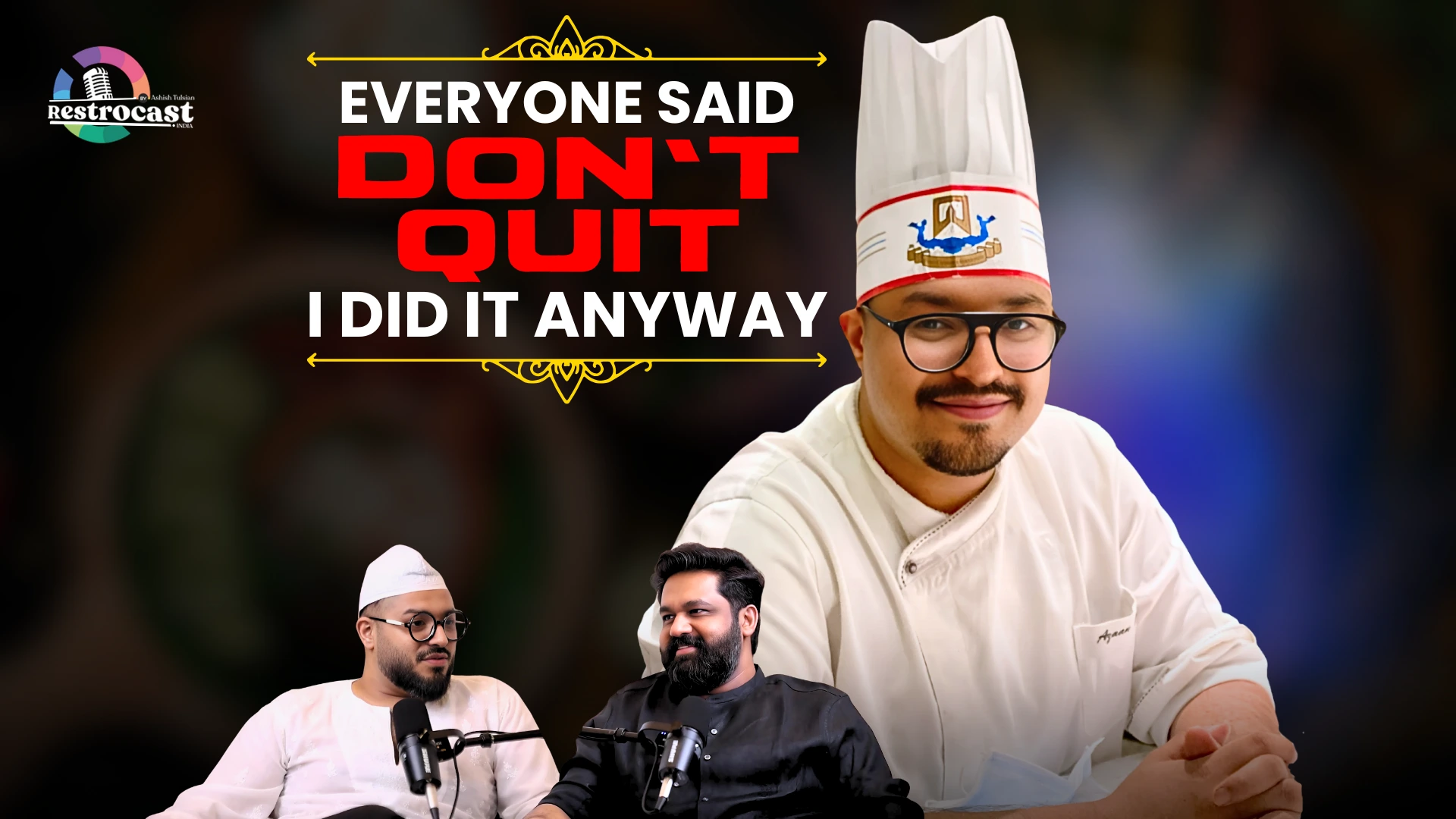
Born into one of India’s most iconic culinary families, Azaan Qureshi’s name has long been associated with legacy, tradition, and excellence. Yet, his journey is not merely a continuation of the Qureshi heritage; it’s a story of carving out his own path in the evolving world of hospitality. From choosing a military-style hotel management program over conventional training, to leading kitchens at ITC, rejecting culinary trends in favor of authenticity, and now shaping the future of Indian dining with Kesar Bagh, Azaan’s career is a study in balancing respect for tradition with the courage to innovate.
In this candid conversation, Azaan opens up about his career journey, his philosophy on cooking, the realities of the hospitality industry, and his vision for the future of Indian cuisine.
Tell us about how you shifted towards hospitality and your entry into the industry.
Azaan Qureshi: I decided to pursue a career in hospitality seriously and enrolled in a hotel management program. I chose the Welcome Legionnaire Program (WLP) by ITC Hotels, an elite course that selects just a handful of candidates from thousands. It was very different from traditional hotel management degrees. Over the course of four years, we provided both foundational training and management-level exposure. The program was run with a military-style discipline; its co-founders included Major S.S. Habib Rehman and a Brigadier, which shaped how I approached work.
Coming from a family celebrated more for talent and creativity than academic qualifications, I wanted to build a strong professional foundation. I was eventually selected for WLP-K, the kitchen-focused track, marking the first time in the program’s history that it was offered in this format.
That must have been a big moment. But you mentioned there was another side to it?
Azaan Qureshi: Absolutely. While being selected was a privilege, the first two years of my training were not spent in the kitchen. Instead, I focused on front-of-house operations like guest interaction, communication, and managing service pressures. These skills are often overlooked among chefs but are incredibly valuable. They taught me confidence, empathy, and how to handle real-time challenges; skills that extend beyond the stove.
That’s a very different path from the traditional chef’s journey. How did this shape your perspective on cooking styles?
Azaan Qureshi: It gave me a deeper appreciation of the balance between technical skill and human connection. For instance, in a bakery, everything is formula-based, precise measurements, and predictable results. Western cuisine, too, has established methodologies, including temperature control, timing, and standardized techniques.
But Indian cooking is completely different. It’s instinctive; the best results come not from following a formula but from understanding the soul of the dish. It’s about knowing the taste you want to achieve and having the intuition to get there. You can’t teach that through recipes alone.
How do you train people on instinct? How do you scale something that isn’t formulaic?
Azaan Qureshi: That’s the challenge. My own journey taught me that understanding taste and intuition requires experience; you have to cook, make mistakes, and refine your senses. At ITC Grand Bharat, where I began during its pre-opening phase, I faced challenging situations with limited infrastructure. But those experiences forced me to learn quickly and adapt.
Training chefs to cook instinctively takes time and mentorship. They must develop a feel for ingredients, flavors, and techniques. You can’t teach it the way you teach a formula; it’s more like passing down a craft. Once that instinct is built, though, it becomes second nature and can be scaled within a team that shares the same philosophy.
There’s often confusion between Awadhi and Mughlai cuisine. Even I’m not sure where one ends and the other begins. Could you help us understand the difference?
Azaan Qureshi: The simplest way to understand it is this: Mughlai cuisine is like a big tree; it refers to food from all regions that were influenced by the Mughals. Even when there’s a local adaptation, the roots trace back to the Mughal kitchens. In modern times, when people say “Mughlai,” they usually mean Delhi-style food, because that’s where iconic dishes like nihari originated.
Awadhi cuisine, on the other hand, developed in the region of Lucknow. Even when dishes share the same name, they are worlds apart, like nihari in Delhi versus nihari in Lucknow, which are as different as the sun and the moon. Awadhi cuisine is characterized by its refinement, no whole spices left in the dish, delicate nuances, and a strong emphasis on etiquette, a legacy of the Nawabi courts.
Despite all that, you eventually decided to leave ITC, a bold decision given your position. Why did you take that step?
Azaan Qureshi: It was not a decision I took lightly. There were multiple reasons, but two stand out.
First, I was too comfortable. I was well-established, had control over my work, and was second only to my father in our cuisine. But comfort can lead to stagnation. I didn’t want to be confined to the same 60 dishes on a menu. Our cuisine is much larger than that; it’s a living tradition that deserves exploration beyond what’s already been created.
Second, I wanted to step out of my father’s and grandfather’s shadow. They had built something remarkable, and I was proud to be part of it. But I needed to create something of my own, to write a new chapter that was authentically mine.
Let’s talk about the dining experience. Were there any unusual or challenging guest demands during your time at Dum Pukht?
Azaan Qureshi: Dum Pukht is a very different kind of restaurant, probably the only one of its scale in North India where butter chicken isn’t on the menu. And that was deliberate. I didn’t want to fall into the monotony of serving what everyone expects. Butter chicken has its place, but there are dishes far more complex and nuanced.
That’s why I found it strange when guests would come to Dum Pukht and ask for butter chicken. If you’re dining in a restaurant that celebrates Awadhi cuisine, you should come prepared for that experience.
The most difficult requests, though, were dietary. I once had a guest ask for lactose-free Awadhi food. But dairy is deeply embedded in our cuisine; it’s not just an ingredient, it’s part of the culinary DNA. Tomatoes, for example, are absent in traditional Awadhi cooking. Instead, curd is used as the souring agent. So if someone asks for nihari or biryani without dairy, or a dessert without milk, it’s practically impossible without compromising the essence of the dish.
Eventually, I started politely declining such requests. It was important to educate diners, to help them understand that this isn’t just food; it’s a cultural heritage. And not everything can or should be modified to fit expectations.
From the outside, hospitality looks glamorous: five-star settings, respect, perks. Insiders say “life is good, but they don’t pay.” As ITC’s No. 2 in your cuisine, what were the real perks, including travel?
Azaan Qureshi: ITC genuinely looks after established chefs, providing housing, a car with petrol, phone bills, and assistance with practical matters like school admissions and licenses. There aren’t Diwali or sales bonuses, but you do get LTA (Leave Travel Allowance) for leisure, modest, and more for nearby trips. Overall, it’s a decent salary complemented by strong in-kind benefits.
Then why does the industry still carry the “doesn’t pay well” tag?
Azaan Qureshi: Partly history and partly comparison. Before the 2000s, ITC offered pensions for management roles; my father still has that, which is rare in private companies. That changed by the time I joined. What helps at senior levels now are ESOPs, offered at subsidized prices. If you’ve stayed long and played the long game, ESOPs can bridge what you think you’re “missing” versus other industries. However, early career pay across hospitality can feel lean; the real value typically shows up later in benefits, ESOPs, and brand equity.
You left ITC despite all the comfort and brand equity. What did you do next, and why did you choose a TV show?
Azaan Qureshi: I wanted to step completely outside my comfort zone, so I hosted Zaika Awadh Ka on FoodXP, where I decided the recipes and stories myself. It served two purposes: announcing my transition gracefully since Qureshis rarely leave ITC and challenging myself in a new arena. I’d already conducted numerous demos and workshops, including virtual cooking sessions during the COVID-19 pandemic, so the show felt like a natural extension of my teaching and storytelling journey.
Talk to me about what’s trendy: molecular gastronomy and fusion. Where do you stand?
Azaan Qureshi: As a chef, it’s not my cup of tea. Molecular had its moment; it faded. Fusion, done with real creativity, can be exciting, but trends are like comparing a Ferrari to a Mercedes: both brilliant, but built for different roads and distances. My concern is: if five top Indian restaurants feel like five separate planets, what does a guest compare them to? In Naples, you can compare Neapolitan pizzas across pizzerias: sauce, crust, and fire. That shared grammar helps the cuisine mature in the guest’s mind. I’d rather play deeply within our idiom and push it forward.
Give me examples of how you “play deeply” within the cuisine.
Azaan Qureshi: I revived and refined dishes with lineage. Malai makhan, for instance, think of it as Indian whipped cream; its base has no liquid, unlike malaiyo/nimish/Daulat ki chaat, which does. Each has a different “code.” I also made chicken mutanjan, a rare Awadhi sweet biryani, and highlighted zarda, the refined sweet rice (from zard, “yellow”). On the savory side, juja limu, literally “lemon chicken” but rendered in an Awadhi way that’s far from the run-of-the-mill versions. For me, this isn’t gimmickry; it’s about restoring vocabulary that the public forgot it knew.
After the show, you worked with Pukhtan in Delhi, and now you’re launching Kesar Bagh. Tell us about both journeys.
Azaan Qureshi: Pukhtan is my uncle’s brand, I wasn’t a creative lead, but I helped as a founding member, setting up processes and scaling the cuisine without losing its soul. Now, I’ve partnered with Priyank Sukhija to build Kesar Bagh, a concept inspired by a complex of palaces in Lucknow designed to awe visitors before they met the Nawab. The name pays homage to Julius Caesar’s grandeur, and the story, which includes a saffron-painted wall commissioned by Nawab Wajid Ali Shah, reflects the theatrical and refined experience we aim to create.
Conclusion
Azaan Qureshi’s journey is a masterclass in balancing tradition with evolution. From mastering the fundamentals of hospitality to redefining Indian cooking as an instinctive art form, he continues to push the boundaries of what’s possible while honoring centuries-old culinary heritage. Azaan’s work reminds us that great cuisine is not just about what’s on the plate; it’s about preserving culture, telling stories, and constantly reinventing how those stories are served.