

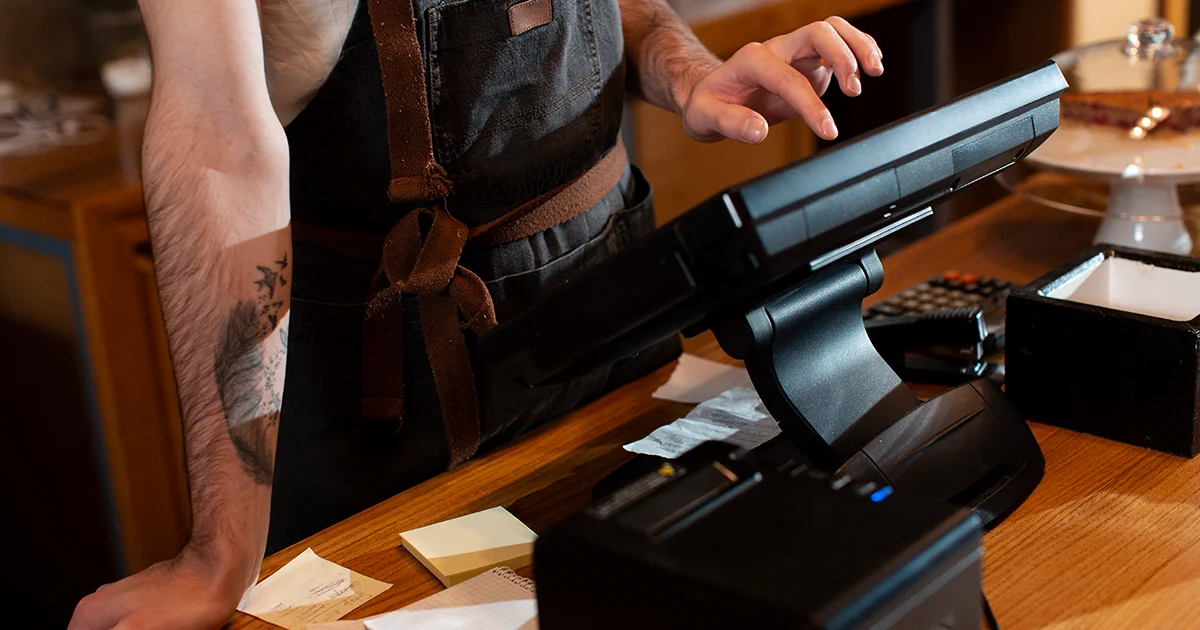
Point of sale terminals are input devices or specialized cash registers which help maintain sales, inventory and credit validation. Businesses use them to process customer transactions. They are the modern equivalent of the traditional cash register, but with a wider range of functionalities.
Origins of Point of Sale Systems (1879-1970s)
James Jacob Ritty and his Brother John are credited for inventing the first mechanical cash register which served as the genesis of the POS systems we see today. The primary focus of this invention was recording cash transactions and preventing pilferage. James and John Ritty patented the design in 1879, as “Ritty’s Incorruptible Cashier“.

When systems connectivity did not exist and when pretty much everything was manually recorded, a device called the pneumatic tube system was used to transport bills from one point to a central processing department. They were powered by vacuum or compressed air. If there were 5 restaurants in a hotel, these restaurants would transfer bills or checks, once signed by a guest, to the front desk cashier through pneumatic tubes. The Front Desk cashier would then make a manual entry of the bill in guest folio. This practice began in 1899.
Revolutionary Changes in the 1970s and 1980s
The earliest digital POS systems were simple cash registers where every physical key was programmed with menu items and various functions to generate a bill or check. Here an EPROM (Erasable programmable read-only memory) was used to store and manage Data. These cash registers used to work as standalone devices.
Until the 1970s, using either standalone systems or multiple disconnected systems to record various transactions was the norm. Big Companies were using mainframe computers with dumb terminals. IBM introduced POS systems which actually transformed the POS landscape for restaurants and retail outlets in 1973 and this was also the time when barcodes or UPC(Universal Product Code) were invented which made standardization and consolidation easier.

Remember the time when TCP/IP networking did not exist? There was always a need for systems to talk to each other to consolidate sales, inventory and employee data. This led to the creation of the RS-422 network where POS devices were connected to each other through a “daisy chain” topology, where all devices are connected in a series on a network line. This helped terminals and printers to communicate over a distance at multiple locations. RS-422 was preferred as it allowed transmission over a much greater distance (1200m) than for example RS-232 (15m).
Transition to Digital Transactions (1980s-1990s)
In the 1980’s credit card use started getting popular but these were processed manually by capturing the card information on sheets of paper using carbon paper, making digital storage of transaction data a painstaking process. With the advent of magnetic card readers in 1979 with POS machines, transactions could be processed much faster and digitally. This actually accelerated the adoption of POS systems across a wide spectrum of industries.

The 1980s to 1990s was a watershed period, with PC and UNIX systems entering the foray. UNIX systems were initially used for POS systems as they were known for their stability and sturdiness. These systems were connected with dumb terminals in restaurants, serving as input devices, while the actual processing took place on the UNIX Servers. Solutions developed during this time were based on the Client-Server Architecture and relational databases. It was also the era when touch screen-based systems were introduced, primarily powered by ELO touch. Initially, these touch systems were monochrome, and MICROS was one of the earliest companies to introduce touch systems for restaurants.
Software Innovations in the 1980s
Gene Mosher is credited with introducing the first graphical point of sale software featuring a touchscreen interface under the ViewTouch brand in 1986. It featured a color touchscreen widget-driven interface that allowed configuration of widgets representing menu items without low level Programming. The ViewTouch point of sale software was first demonstrated at Comdex, 1986 in Las Vegas Nevada and was the first commercially available POS system with a color graphic touchscreen interface.

In the 1980s, hardware interface standardization took place to streamline the connection of Point of Sale (POS) devices with peripherals such as printers or cash drawers. The OPOS framework, established by Microsoft, NCR, Epson, and Fujitsu, was one such standard. In the 1990s, Sun Microsystems, IBM, and NCR collaborated to develop JavaPOS, a framework aimed at facilitating the connection between POS systems and peripherals.

The aforementioned advancements marked a significant leap for systems. Once achieved, there arose a need to communicate with third-party systems. For example, in a hotel, a POS system would need to communicate with the PMS (Property Management System). RS-232 Communication was used for this purpose, and null modem cables facilitated communication between the two systems. Since a computer typically had only two RS-232 ports, an Equinox adapter was used to split the RS-232 port capability, allowing connection to multiple systems. This meant that one RS-232 port could connect to a POS system, a door lock system, and an EPABX system. Subsequently, integrations evolved to use TCP/IP communication and listening ports.

The Rise of Cloud Systems (2000 Onwards)
Following the Y2K scare and improvements in internet infrastructure from 2000 onwards, cloud systems emerged. Initially used for file and print sharing, cloud systems evolved with the advent of SaaS (Software as a Service) systems, facilitating transactions in the cloud. POS systems today come in various shapes and sizes, but the consensus is that they enhance efficiency. The majority of cloud-based systems now offer front-of-the-house functions such as creating bills or checks, back-of-the-house inventory management, and integrations with various systems like accounting, human resource systems, food and delivery aggregators, payment systems, all built on non-structured databases and multi-tenancy architecture.
Centralized data has led to actionable analytics and fraud prevention at restaurants, enabling on-demand tracking of sales, inventory, and employee data. The addition of self-ordering kiosks and order-and-pay-at-the-table using QR codes were two crucial features introduced to restaurant tech during the 2020 pandemic.
The evolution has progressed from standalone cash registers on EPROM to client-server architecture on both Windows and UNIX to SaaS transaction systems on the cloud. It is universally acknowledged that technology not only enhances the dining experience but also improves efficiency at the restaurant’s end.
The Way Ahead
Current SaaS systems and technology have enabled a multitude of features, allowing restaurant staff to spend more time with customers. Their comprehensive suite of software solutions addresses the specific needs of restaurants, encompassing everything from Point-of-Sale systems to inventory management and menu management. As customer demands evolve, restaurant margins remain slim, restaurant’s cannot afford to squander a minute in reinventing and optimizing their operations.
Cloud solutions give restaurants the ability to pivot, scale, manage multiple operations and take data driven decisions. The genesis of point of sale systems, from complex mechanical contraptions to the fascinating cloud based ecosystems of today, has been a story of immense innovation. What the future holds for this foundational tool of moving a business, is something I am thoroughly excited to explore and be a part of.