

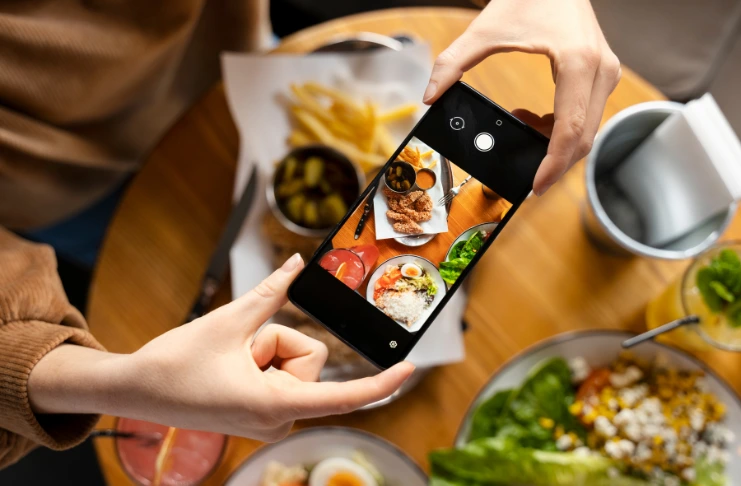
Why Social Media Has Become a Revenue Engine for Restaurants?
Social media now plays a direct role in how restaurants generate demand, influence guest decisions, and maintain long-term customer value. What once operated as a branding tool has become a performance channel, one that improves brand recognition and drives repeat visits when used strategically.
Here’s why social media has become a core revenue engine for restaurants-
1. It Drives High-Intent Discovery and Footfall
Social platforms are now one of the first places diners evaluate restaurants. Recent findings show that 62% of diners check the restaurant’s social media account before deciding where to eat. When customers see appealing menu visuals, ambience clips, or tagged guest photos, they move through the consideration stage much faster.
This behaviour translates directly into higher footfall and more reservation traffic. By showing dishes, atmosphere, and real guest experiences, restaurants reduce the uncertainty that often delays decisions and encourage visits.
2. It Improves Conversion Through Personalization and Relevance
Diners respond strongly to content that feels tailored to their tastes or context, whether it’s a seasonal special, a behind-the-scenes story, or a dish that matches trending preferences. Research shows that consumers rely on social platforms for “process, content, and social gratification,” meaning they want information that is relevant, convenient, and validated through community feedback.
Personalized content performs better than broad promotions because it reflects what customers actually care about in the moment, from flavour, experience, and authenticity. This relevance leads to higher engagement and a smoother path to conversion.

3. It Influences the Entire Customer Journey
Unlike traditional channels, social media supports every stage of the decision-making process:
- Awareness: Short-form videos and images introduce the restaurant brand.
- Discovery: Guests browse feeds, stories, and tagged posts to evaluate the experience.
- Trust: Real customer photos and comments build credibility.
- Booking: Integrated links turn interest into action.
- Loyalty: Post-visit engagement keeps guests returning.
A 2025 study shows that stronger social media brand engagement directly increases the intention to visit a restaurant. When guests repeatedly encounter content across this journey, the path from intent to reservation becomes far more predictable.
4. It Strengthens Competitive Positioning and Pricing Power
A strong online presence signals quality, relevance, and demand. In fact, 99% of full-service restaurants report having a social media presence in 2025, compared with only 69% that maintain a website, showing where operators see the highest impact.
Restaurants with stronger visual branding, active engagement, and consistent customer interaction tend to win against competitors with similar food or price points.
5. It Amplifies Reach Through Customer Advocacy
User-generated content has become one of the most powerful growth drivers in hospitality. Guests regularly post photos, videos, reviews, and check-ins, which extend a restaurant’s visibility beyond its own followers.
This network effect multiplies reach without additional ad spend. Every tagged post or shared story introduces the restaurant to new local audiences who already trust the source.
How Diners Discover and Choose Restaurants in 2025?
In 2025, diners increasingly turn to social media as their first point of contact with restaurants, often before websites, location-based apps, or word-of-mouth. What they look for online is authenticity, convenience, social proof, and relevant experiences, all in a few scrolls.
The content that wins their attention, such as short-form videos, user-generated photos, real reviews, and behind-the-scenes clips, shapes not only where they go but also whether they return.
How Do Customers Discover and Evaluate Restaurants?

- Social-First Discovery: Many diners now discover restaurants through social feeds through visual content, especially food photos and short-form videos that grab attention.
- Benchmarking and Comparison: Before choosing where to dine, customers often compare multiple restaurants based on menu variety, portion visuals, ambience cues, recent customer experiences, and pricing to understand which option offers the best value.
- Authentic Content and Social Proof: Real customer photos, honest reviews, tagged posts, and user-generated content (UGC) create trust.
- Convenience and Speed in Decision-Making: On-the-go browsing, quick comparisons, and easy access to menus/reviews/table reservations via social links make social media a go-to when diners want to decide fast.
- Post-Visit Sharing: Diners use social media after visiting, too, to share their experience, influencing peers and driving word-of-mouth-based discovery.
The data below highlights how powerful social platforms are for restaurant discovery and choice-
- Restaurants investing in strategic social media efforts saw an average 9.9% lift in B2C revenue, showing measurable commercial impact.
- Social platforms now guide dining choices for 74% of consumers, making them the leading source of restaurant inspiration.
- Roughly one in five diners (22%) say a restaurant’s social presence plays a direct role in their decision to return.
- More than half of diners (54%) discover new restaurants on social platforms each month, often from short videos or tagged content.
- Menu photos still matter, as 65% of customers say visuals heavily influence where they choose to eat.
- Adoption of short-form video marketing via TikTok nearly doubled among restaurants, rising from 26% in 2023 to 48% in 2024.
- Gen Z and millennial diners are especially influenced by social content, with 73% visiting a restaurant in the last 3 months because of a review they saw online.
EXPERT OPINION
Restaurant Social Media Statistics 2025: Top Social Media Platforms for the Restaurant Industry
Restaurants are no longer relying on a single social channel to reach diners. In 2025, customer discovery is spread across a blend of visual-first feeds, short-form video environments, review-driven communities, and local social groups.
Each platform type plays a different role in the dining journey, and operators see the best results when they build a mix that matches how guests search, validate, and book.
A. Facebook
- In the dining/hospitality sector benchmark for Q4 2024-Q1 2025, the average engagement rate on Facebook is around 1.3%.
- According to data, 59% of diners report using Facebook to discover new restaurants, reflecting the platform’s continuing role in restaurant discovery.
B. Instagram
- Among leading restaurant industry statistics sources, about 60% of consumers say they use Instagram to find new restaurants.
- Industry benchmarks in 2025 show that Instagram user engagement has increased, with a reported 28% growth in platform engagement (vs prior periods) among active users.
- For food and beverage brands, recent data shows Instagram video (Reels / on-demand posts) averaging ≈ 135.2K views per video, indicating strong reach potential.

C. TikTok
- Within the food and beverage industry, average video views per post on TikTok stand at 220.8K, higher than many other formats.
- TikTok is the “fastest-growing social platform” in 2024, with median monthly follower growth of 21% among brand accounts.
D. YouTube
- 70% of Gen and 65% of Boomers use YouTube, giving restaurants a broad demographic reach.
- In food and beverage social benchmarks for 2025, YouTube on-demand videos average ~323.2K views per post, the highest among major platforms.
How Different Demographics Engage with Restaurant Social Media?

Different age groups approach restaurant discovery and evaluation in distinct ways, shaping how restaurant owners should think about content formats, messaging, and platform mix.
Understanding these behavioural differences helps restaurants tailor their strategy to the audiences most likely to drive restaurant sales.
A. Gen Z
Gen Z diners rely heavily on social platforms as their primary guide for where to eat. Fast, visual, and peer-driven cues shape their decisions.
- 41% of Gen Z diners use TikTok to search for and discover new restaurants, making them the most active demographic in food discovery.
- 99% of Gen Z and millennials are more likely to choose restaurants using social media than Baby Boomers.
B. Millennials
Millennials tend to combine social media insights with more structured research before choosing where to dine. They value convenience but also look for credibility.
- Millennials are the most active generation on social media, with 69.2% of millennials using some social media platform in 2025.
- They are also more likely to choose a restaurant based on social media posts from friends and family, with 68% of millennials doing so, and 47% discovering new food trends online.
C. Gen X
Gen X diners rely less on short-form video and more on trust-building content such as reviews, ratings, and detailed descriptions.
- Gen X accounts for 28% of all social commerce spending worldwide, ranking third after Millennials and Gen Z.
- Gen X reportedly has the highest engagement on certain social platforms, such as Facebook.
- About 53% of Millennials and Gen X check online reviews and ratings before making a purchase decision.
What are the Latest Restaurant Social Media Engagement Trends?
Customer engagement with restaurant content has become more dynamic, more visual, and far more behaviour-driven than it has been in the past few years. Diners no longer scroll passively. They now react to formats that feel authentic, informative, and aligned with how they make dining decisions.
From video-heavy feeds to UGC-powered content, here are the key engagement trends for your social media marketing–
1. Short-Form and Video Content
Short-form video leads nearly every engagement metric for restaurants. Adoption of video content continues to grow, with restaurants reporting 2-3× faster audience growth with a video strategy compared to those without.
Within video content, customers respond more strongly to:
- Video shots of dish preparation
- Behind-the-scenes moments
- Staff stories
- Ambience walkthroughs
These formats consistently outperform static images in likes, comments, and saves. Video-led posts also boost action: diners are more likely to click menus or reservation links after watching a compelling clip, resulting in higher CTRs than image-only content.
2. User-Generated Content (UGC)
88% of diners trust online reviews as much as personal recommendations, which explains why customer photos, tagged posts, and reviews outperform branded content.
These posts typically generate more comments and shares, and they often trigger discovery within local communities.

3. Shift in Peak Engagement Times and Frequency
Engagement habits have shifted as diners increasingly browse during downtime. For restaurants leveraging social media, timing is everything-
- Stronger engagement with 3-4 quality posts per week, instead of daily posting.
- Higher interaction rates in evenings and weekends.
- Anchor feeds with strong posts and post stories to maintain daily visibility.
This aligns with findings that 63% of people are more likely to visit a business after a positive interaction on social media, reinforcing that timing and format matter as much as content.
4. Multi-Channel Engagement
Customers’ journey often spans multiple social media channels. While one platform may spark discovery, another may drive evaluation or booking. 58% of consumers discover local businesses through social media, yet decisions are commonly validated on review websites or community-driven platforms.
This shift pushes operators to rely less on follower counts and more on a combination of metrics, including engagement, CTR, conversions, and retention signals.
5. Text-Heavy and Community-Driven Content
Review-led environments play a major role in evaluation. 71% of diners read reviews when researching local restaurants, and these platforms remain key for credibility and decision-making. They help customers assess:
- Service consistency
- Recent guest experiences
- Value for money
- Ambience and hospitality
These platforms often drive high-intent traffic, especially when diners search within a specific radius or occasion.
What are the Social Media Best Practices for Restaurants?

Restaurants competing for attention in 2025 need a structured approach to social media, featuring strong content, active community engagement, and consistent efforts. To achieve that, here are some best practices to help drive measurable results-
- Create a Balanced Content Mix: Combine short-form video, high-quality images, stories, and customer-led content. This ensures you reach your target audience across multiple formats and maximize both discovery and engagement.
- Engage Actively: Respond to comments and direct messages within reasonable timeframes, and personalize replies where possible. Interaction signals reliability and improves conversion for guests making dining decisions.
- Encourage UGC: Use prompts such as table tents, links on food delivery apps, branded hashtags, or incentives, but avoid pressure tactics. Ask permission before resharing customer content to maintain trust.
- Make Decisions Using Data: Review monthly metrics such as reach, engagement, saves, clicks to menu/reservation links, and follower growth. Use a simple checklist to identify what’s performing and what needs refinement.
- Optimize for Mobile-First Consumption: Create vertical-friendly visuals, concise captions, and easy-to-navigate pages to access on mobile, as most users browse and decide on the go.
Conclusion
Social media now plays a defining role in how restaurants build visibility and attract guests. With diners relying on digital cues at every stage of their journey, restaurant operators need to treat these channels with intention through relevant content, timely interaction, and ongoing optimization.
Restaurants that adapt to these shifts can strengthen their brand, build deeper relationships, and turn social channels into a dependable channel to capture demand and customer loyalty.