

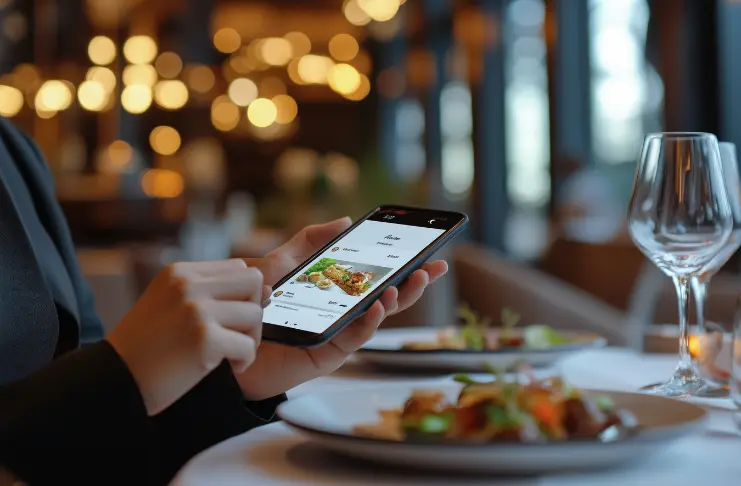
The Rise of Restaurant Mobile Apps
The restaurant app industry is witnessing significant growth, all thanks to emerging technologies and evolving customer expectations. Understanding these key statistics is crucial for adapting to the market changes and benefiting from the development.
1. Market Size and Industry Growth
The global mobile application market, which encompasses various sectors, including food services, was valued at $252.89 billion in 2023 and is projected to grow at a CAGR of 14.3% from 2024 to 2030.
The market for food delivery apps is expected to reach $62.83 billion by 2033, growing at a CAGR of 25% from 2021 to 2030. This growth is driven by increasing demand for enhanced customer experiences, operational efficiency, and the integration of advanced technologies.
2. Adoption Rates Across Restaurant Segments

Mobile app adoption varies across different restaurant segments, including nearby restaurants:
2.1 Quick Service Restaurants (QSRs) & Fast Casual
Quick-service restaurants (QSRs) and fast-casual establishments lead the industry in mobile app adoption, driven by consumer demand for convenience and speed.
- If offered, 70% of consumers would use a smartphone app to place orders at QSRs.
- Among QSR customers aged 18–54, 70% used mobile order-ahead features. Even among the 55–75 age group, 43% utilized this feature.
- Approximately 36% of consumers have installed five or more QSR apps, primarily to access loyalty rewards and exclusive promotions.
2.2 Full-Service Restaurants (FSRs)
Full-service restaurants are integrating mobile technology to enhance the dining experience and offer personalized service to their customers through tailored menu items.
- About 63% of customers at full-service restaurants are willing to place orders using a smartphone app.
- Approximately 62% of full-service diners prefer contactless or mobile payment options, indicating a shift towards digital transactions.
- In 2024, 27% of full-service restaurants planned to invest in developing smartphone apps, reflecting a growing emphasis on digital engagement.
2.3 Cafes and Coffee Shops
- Approximately 48% of consumers use mobile apps to order coffee regularly, reflecting this segment’s growing demand for convenience.
- Around 65% of coffee companies have invested in digital transformation initiatives to improve customer experience, including mobile app ordering and payment systems.
- Another 61% of coffee shop customers use mobile apps to get discounts and coupons.
2.4 Food Trucks
- 72% of food trucks accept mobile payments, streamlining transactions and catering to customer preferences for contactless options.
- 66% of food trucks have adopted mobile ordering systems and apps to improve user experience and reduce wait times.
- 61% of food trucks use digital menus to enhance clarity and ease of ordering for customers.
Key Restaurant App Features Driving Engagement

As mobile app ordering becomes less of a novelty and more of a norm, the question isn’t whether a restaurant should have an app but what that app should do to deliver real value. The difference often comes down to a handful of high-impact features that serve utility but build long-term loyalty.
From seamless ordering to real-time personalization, each feature plays a distinct role in shaping customer behavior, increasing frequency, and raising average check sizes.
Here are the key restaurant mobile app features that can help drive engagement with customers-
1. Online Ordering and Payments
The convenience of online ordering and mobile payments has made the dining experience more seamless for consumers. 75% of people use mobile phones to order food, highlighting the importance of mobile-friendly ordering systems.
By allowing customers to browse menus, place orders, and make payments through an app, restaurants reduce friction in the ordering process. This streamlined approach not only enhances customer satisfaction but also increases order frequency.
In fact, restaurants with mobile apps experience a 112% increase in reorder rates compared to those without, indicating higher customer retention.
2. Loyalty Programs
If you want a quick way to incentivize and encourage repeat business while enhancing customer satisfaction, loyalty programs embedded within mobile apps are an excellent way to achieve that. Loyalty program adoption rates have climbed 32% over the past three years, with 68% of full-service restaurants and 71% of quick-service establishments offering such programs.
With loyalty programs, you can reward your customers with points, discounts, or exclusive offers for each purchase. This helps drive repeat purchases, as 78% of customers are more likely to visit a restaurant where they can earn points, even if it’s less convenient.
As a result, 57% of restaurants have implemented reward and loyalty programs, with members visiting 20% more frequently and spending 20% more than non-members.
In addition, Gamification elements, such as badges or tiered rewards, tap into customers’ desire for recognition and achievement, fostering a deeper emotional connection with the brand.
3. Push Notifications
When it comes to customer interaction in the restaurant industry, push notifications serve as direct communication channels, influencing customer behavior and increasing order frequency.
With timely and relevant messages, such as exclusive offers or order updates, push notifications keep the brand top-of-mind and encourage repeat engagement. In fact, push notifications on mobile apps generate three times the conversion rates compared to mobile websites, highlighting the effectiveness of push notifications in driving customer actions.
4. Personalization and AI Recommendations
With consumers overwhelmed by options and accustomed to hyper-relevant digital experiences, generic interactions often fall flat. That’s where AI-powered personalization reshapes how restaurants understand, engage, and retain their customers.
AI engines embedded in restaurant mobile apps can analyze customer data across multiple dimensions such as order history, time of day, favorite items, dietary restrictions, cart abandonment, and even location. This data fuels dynamic, real-time recommendations tailored to individual customer preferences.
Why does it matter? Because 70% of people feel that menu recommendations based on past purchases make them feel recognized by the restaurant. What’s more, 41% of U.S. restaurant operators plan to use AI for sales forecasting and scheduling, while 33% are already utilizing it for personalized marketing.
5. QR Code Services
QR codes have gained traction as a simple, contactless way to connect diners with restaurant menus, ordering, and payments. Especially post-pandemic, when consumers prioritize safety and speed.
Restaurants that integrate QR codes into their apps enable guests to quickly scan a code and access digital menus without physical contact, order at their own pace, and pay without waiting for a server.
This convenience resonates strongly: the adoption of QR codes by restaurants in the U.S. has increased. 54.8% of restaurants use multiple QR codes for diverse applications beyond digital menus, such as payments and loyalty programs.
These multifunctional QR codes improve the dining experience and create additional touchpoints for building customer relationships and driving repeat business with just a few taps.

Restaurant Mobile App Statistics: Consumer Behavior and Preferences
From using restaurant apps to get discounts to viewing online reviews before placing their orders, consumers are shaping the mobile app experience in the restaurant industry.
- 71% of consumers prefer using restaurant-specific websites or mobile apps over third-party apps, citing benefits like lower costs, convenience, and personalized loyalty rewards.
- 60% of diners prefer ordering via mobile apps over traditional methods.
- 85% of consumers are likely to join loyalty programs that offer personalized rewards, emphasizing the value of tailored incentives.
- 88% of diners trust online reviews as much as personal recommendations, highlighting the weight of digital word-of-mouth.
- 68% of consumers order takeaway more than once a month, and 52% order delivery through apps more than once a month, indicating a strong demand for off-premise dining options.
- Around 37% of consumers find food delivery apps highly reliable for online ordering.
- According to a report by HubSpot, users ordering directly from a restaurant’s app spend up to 35% more on every transaction than those using third-party delivery apps.
Challenges to Mobile App Adoption in the Restaurant Industry
While mobile apps are increasingly central to restaurant operations and customer engagement, adoption is not without its friction points, especially for small and mid-sized operators navigating limited budgets and complex integrations.
1. Initial Investment and Maintenance Costs
Developing a branded mobile app with robust functionality—ordering, payments, loyalty, personalization requires capital. Not only could upfront development costs be high, but ongoing maintenance, updates, and feature enhancements add to the long-term expense. For independent restaurants, these costs can be discouraging without the potential for quick ROI.
2. Integration Complexity
Seamless functionality depends on how well the app integrates with the restaurant’s existing tech stack, such as POS systems, inventory software, CRM, and delivery platforms. Fragmented infrastructure or legacy systems often make these integrations technically challenging and costly.
3. User Experience Expectations
Today’s consumers benchmark their favorite restaurant apps against major tech platforms. If it features subpar design, slow loading times, or a lack of personalization, it can easily lead to customer dissatisfaction and abandonment.
4. Digital Fatigue
With so many branded apps competing for attention, customers are selective about what stays on their phones. Restaurants must offer a compelling reason, such as loyalty rewards, exclusive deals, or seamless convenience, to avoid getting the app uninstalled after a single use.
Without a strong retention strategy, even well-designed apps risk low engagement.
5. Data Security and Compliance
Handling customer data such as payment credentials, order history, and personal preferences comes with legal and ethical responsibility. Restaurants must invest in secure infrastructure and stay compliant with evolving data protection regulations. Neglecting this area can result in reputational damage or penalties.

How are Mobile Apps Modernizing the Restaurant Industry?
While most conversations focus on how apps serve customers, what’s often overlooked is how deeply they’re reshaping restaurant operations, staffing strategies, and data-driven decision-making.
Let’s explore the real impact of mobile apps behind the scenes and how they are driving growth in the industry.
1. Enhances Operational Efficiency
Mobile apps are quietly streamlining day-to-day operations. Tasks that once relied on manual coordination, such as taking orders, table reservations, assigning deliveries, and tracking kitchen output, are now handled digitally, often with real-time updates.
For instance, integrating online orders directly into the kitchen display system minimizes miscommunication between front-of-house and back-of-house staff, ensuring orders are prepared accurately and promptly.
This not only accelerates service but also allows staff to focus more on customer engagement and satisfaction.
2. Improves Customer Experience
Customer expectations have changed. In a world of instant gratification, people want convenience, transparency, and personalization. Mobile apps deliver all three. Features like saved orders, digital payments, live order tracking, and customer reviews help build loyalty through smoother experiences.
Plus, mobile apps put control in the customer’s hands. They allow customers to skip queues, avoid miscommunication, and reorder their favorites with a few taps while reducing the risk of human error.
This shift toward mobile-centric dining experiences has become a key differentiator. Restaurants offering well-designed apps with features like save my order, allergy filters, and live order tracking are considered reliable and customer-focused.
3. Collects Valuable Customer Data
Mobile apps also give restaurants a new kind of intelligence—insight into customer behavior that was previously difficult or impossible to track. Every tap on a screen generates useful data: what customers order most often, when they order, how often they redeem offers, and which dishes get abandoned in the cart.
This data is valuable for driving everything from menu design to personalized marketing. So, instead of generic promotions, restaurants can target users with personalized offers based on actual purchase behavior, improving redemption rates and customer satisfaction.

4. Boosts Order Value and Accuracy
One of the more tangible benefits of mobile ordering is its direct impact on check size. When customers order through an app, they’re more likely to add extras, driven by smart upselling prompts like “Want to make it a combo?” or “People also ordered…”.
Then there’s also a psychological angle: when there’s no pressure at the counter, customers take more time browsing, which often leads to larger, more considered orders.
On top of that, mobile ordering reduces order errors, which not only lowers food waste but improves customer satisfaction. When order accuracy is a top priority for consumers, with 63% ranking it as the most important aspect of their mobile ordering experience, mobile apps can add immense value to your restaurant operations.
5. Seamless Integration with Restaurant Technology
The best part about mobile restaurant apps is that they don’t function in isolation. Rather, they’re connected to everything else in the tech stack such your POS systems, loyalty platforms, kitchen printers, and third-party delivery aggregators to create a more cohesive and data-driven ecosystem.
For instance, mobile apps can connect with inventory management software and allow restaurants to track stock levels in real time and manage item availability based on the orders through the app. So, if a particular ingredient runs out, it can be instantly reflected in the app, preventing customer dissatisfaction.
Further, integration with kitchen display systems (KDS) ensures that once an order is placed, it moves seamlessly into the kitchen’s workflow.
This seamless integration with key front-of-house and back-of-house tech helps unify data, streamline workflows, and enable more strategic decision-making, all while improving service quality and reducing staff burden.
6. Access to New Markets and Audiences
Finally, mobile apps help restaurants expand beyond their physical locations. From ghost kitchens to multi-brand cloud kitchens, app-based ordering has created entirely new growth models. It’s especially powerful for restaurants in smaller towns or less foot-trafficked areas looking to expand their reach.
In addition, apps help tap into new demographics, including digital-native Gen Z and millennial audiences – those who may never walk through your door but will order regularly if the experience is frictionless. Social integrations, app-store promotions, and geo-targeted offers extend your brand’s visibility far beyond a static location.
Restaurants with robust mobile apps can launch new concepts faster, reach untapped markets, and stay top-of-mind via push notifications and loyalty nudges.
Conclusion
Among all the technologies shaping the modern restaurant, mobile apps occupy a unique position. These tools simultaneously interface with the customer and integrate with back-of-house systems, serving as a direct line between operational performance and customer experience.
Not just that, they highlight a shift in how restaurants acquire, serve, and retain customers in an increasingly digital-first dining economy. Across all restaurant mobile apps statistics —adoption rates, user preferences, market forecasts, and engagement trends—the data points towards one thing: mobile apps have become indispensable to the restaurant business model in 2025.
Ultimately, for operators, mobile apps form the foundation for customer engagement, operational alignment, and sustained growth in an increasingly digital industry.