
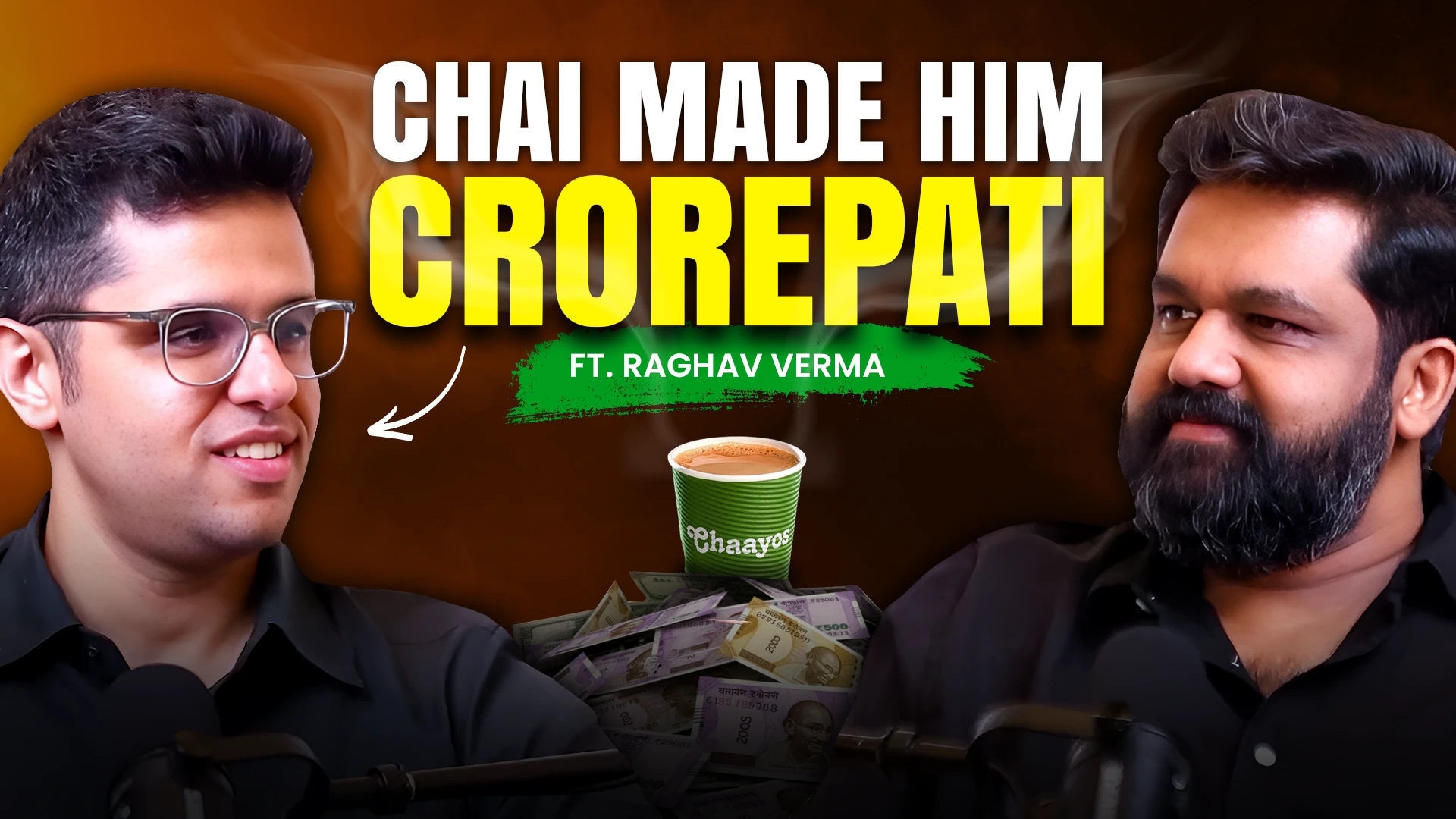
In 2012, when every investor dismissed chai as “too ordinary” to build a brand around, Raghav Verma and Nitin Saluja bet on something deeply Indian, the comfort of a freshly brewed, customized cup of tea. Over the years, Chaayos has transformed that belief into a thriving national brand, blending technology, consistency, and customer experience to redefine how India consumes its favorite beverage.
In this candid conversation with Ashish Tulsian, Raghav reflects on Chaayos’ journey from bootstrapping through funding winters and franchising experiments to building a culture obsessed with customer delight.
Raghav, in 2012, everyone thought tea was a big opportunity, yet it didn’t land as expected. What were people seeing then, and why did you still believe customers would pay for chai?
Raghav Verma:
When we started out in 2012, there were a few players trying to build businesses around tea. We believed there was a large white space between the ₹6 Tapri and the ₹200 Coffee Café. Coffee cafés had proven that consumers were willing to pay for experience. We thought: Why not create the same for chai lovers? A comfortable place to sit and enjoy a customized, freshly brewed cup of chai.
Investors didn’t see that gap. Almost every investor told us, “You can’t sell tea for ₹40–₹50. Nobody will pay.” But customers proved them wrong. Our first store opened in DLF Building No. 5, where about 3,000 people worked. We priced our chai at ₹35 plus tax, and people came daily. That became our proof of concept.
How long did that initial price sustain? And how did perception shift from “expensive” to “value for money”?
Raghav Verma:
Prices gradually increased over the years. In the early days, people said ₹35 was too expensive for tea. Today, surveys tell us customers find Chaayos the most value-for-money café in the market.
The difference lies in experience and category maturity. Over time, people began associating tea with a complete experience: ambience, food, freshness, and consistency. When you pair fresh tea with great food and a comfortable setup, ₹120 doesn’t feel expensive. The rise of premium coffee chains charging ₹300–₹400 also helped redefine customer benchmarks. Today, we run three formats: high street, mall, and business park.
Raghav, you started in 2012. When did you first raise funding, and how did things change after bringing VCs on board?
Raghav Verma:
Our first angel round came in 2013, followed by institutional funding in 2015. Back then, hardly any brick-and-mortar F&B brands were attracting top-tier VC interest, so we were among the early ones. We always wanted to build a 1,000-store brand, which required capital; each café costs ₹50–₹60 lakhs to set up. We raised $5 million from Tiger Global, their first non-tech investment globally. When we asked Lee, who led the deal, why he invested, he said, “If there’s ever going to be a Starbucks of India, it’ll be around tea.” That vision deeply resonated with us.
The 2016 funding winter was tough on many founders. How did it impact Chaayos, and what led you to try and then step back from franchising?
Raghav Verma:
The funding freeze hit us hard. Our first round was almost effortless: two Skype calls and $5 million in the bank. But by 2016, no one wanted to fund F&B. With limited capital, we experimented with franchising as a growth route. Between 2016 and 2018, we opened around 23–24 franchises while maintaining 20–25 company-owned stores. Some worked beautifully, but others struggled because our operations were still evolving and tea preparation was fresh, not factory-made. Standardization was tough, and until we could ensure consistent quality and predictable returns, we decided it was better to pause franchising and focus on strengthening our core operations.
Chaayos has always felt like the Starbucks of India in its consistency and customer experience. How did you build that level of standardization, and what changed when you shifted focus from sales to experience?
Raghav Verma:
From the start, we knew we were selling chai as an experience to people who already drink it at home every day. Coming from consulting, not F&B, Nitin and I built everything from first principles, structured processes, tech-driven standardization, and clear experience benchmarks across store design, SOPs, and training.
Two years ago, we doubled down by removing sales incentives and focusing solely on rewarding customer experience. We renamed operations as the Brilliant Customer Experience Team, focusing on details like clean washrooms, remembering names, and replacing any unfinished cups. Sales initially dipped, but from the second month onward, same-store growth actually rose beyond previous trends.
How do you measure and reward great behavior without turning it into a sales push, and what inspired the reset toward basics like clean washrooms and remembering names? Also, how do you sustain that culture at scale?
Raghav Verma:
We measure experience through mystery audits, Google review ratios, and our in-house Brilliant Customer Experience (BCX) score. Incentives are tied to these, not sales targets. The reset came after COVID when we realized our focus had drifted from the early days, where Nitin and I personally managed stores and learned that the small things, clean washrooms, remembering names, create real loyalty.
To scale that, we built Chaayos Academy in Delhi NCR for induction and cultural training, followed by ongoing store-level reinforcement. The talent pool is the same as other QSRs, but what sets us apart is the environment, how the uniform, rituals, and daily language focus on experience rather than transactions.
Mystery shopping isn’t common in India. How do you run it at Chaayos? How do you prevent teams from gaming the system, and what’s next in measuring customer experience?
Raghav Verma:
We conduct two mystery audits per store each month through an external agency, along with a PQSC audit, and manage product, quality, service, and cleanliness audits centrally once or twice a month. Teams sometimes dispute findings, so we continuously evolve metrics to stay ahead of gaming and preserve data integrity.
The next phase is tech-led observability, using tools like CCTV to verify whether required actions, such as hourly washroom checks, actually occur. The goal is to track behavior consistency 95 out of 100 times, rather than relying on just a couple of monthly audits.
You have been in for almost 13 years. How has the founder journey changed you?
Raghav Verma:
Every year has been different and unpredictable. That keeps it exciting but tough. Early on, there was a useful naivety and what we call stupid optimism. It is essential to start. Over time, I have become more measured, more empathetic to customers and teams, and far sharper about where to invest my time. Do fewer things. Ask why something needs to be done and whether it needs to be done by me at all.
You’ve rekindled your passion for music while also investing in leadership coaching at Chaayos. What sparked that personal comeback, and how has coaching influenced you and the organization?
Raghav Verma:
Music was a huge part of my college life; I played with Under Season and co-founded Antriksh. When Chaayos started, it took a backseat. Over time, I found my way back, bought a piano, carried my guitar to off-sites, and now make sure I play at least one live show a year. The trigger came from our coaches, Ratish and Venkat, who asked, “If you had 10 years to live, what would you do today?”
That question brought clarity; music is part of who I am. Coaching helped me recognize my blind spots, such as being too controlling, and taught me to delegate and trust the team. It’s transformed how we work: better listening, stronger collaboration, and a co-created vision everyone believes in.
Where does Chaayos stand today, and how long does it really take to build a brand that customers recognize?
Raghav Verma:
Chaayos is now in a category-creation phase, building the habit of chai consumption outside the home and through delivery. We have around 200 stores across seven cities, with a strong presence in Delhi, Mumbai, and Bengaluru. The focus now is on density, ensuring customers can walk to a store in five minutes or have chai delivered in ten.
And honestly, building a brand takes eight to ten years just to be noticed. Many still think we started only four or five years ago, that’s when the brand truly became visible. Real brand building takes time before it compounds.
How big can Chaayos get in India, and will you expand abroad before hitting that scale?
Raghav Verma:
In India, we see room for 1,200–1,500 stores, maybe even 2,000. Delhi-NCR alone has about 100 stores, and we’re still adding 15–20 each year, far from saturation. As we increase density, customer frequency rises because our USP, “my chai,” lets everyone enjoy their exact blend anywhere.
Internationally, yes, we’ll expand before 2,000 stores. Chai and Indian food are gaining traction globally, not just among the diaspora but also Asian audiences like Japanese and Koreans who love our ginger tea. No Indian QSR has scaled globally yet, and we see a real opportunity to lead that movement.
Conclusion
From defying investors’ doubts in 2012 to crafting one of India’s most beloved café experiences, Raghav Verma’s journey with Chaayos is proof that a simple idea, when built with conviction, structure, and heart, can redefine an entire category. What began as an experiment between a ₹6 tapri chai and a ₹200 coffee cup is now a movement that’s brewing habits, inspiring entrepreneurs, and setting the stage for India’s next global food story.