
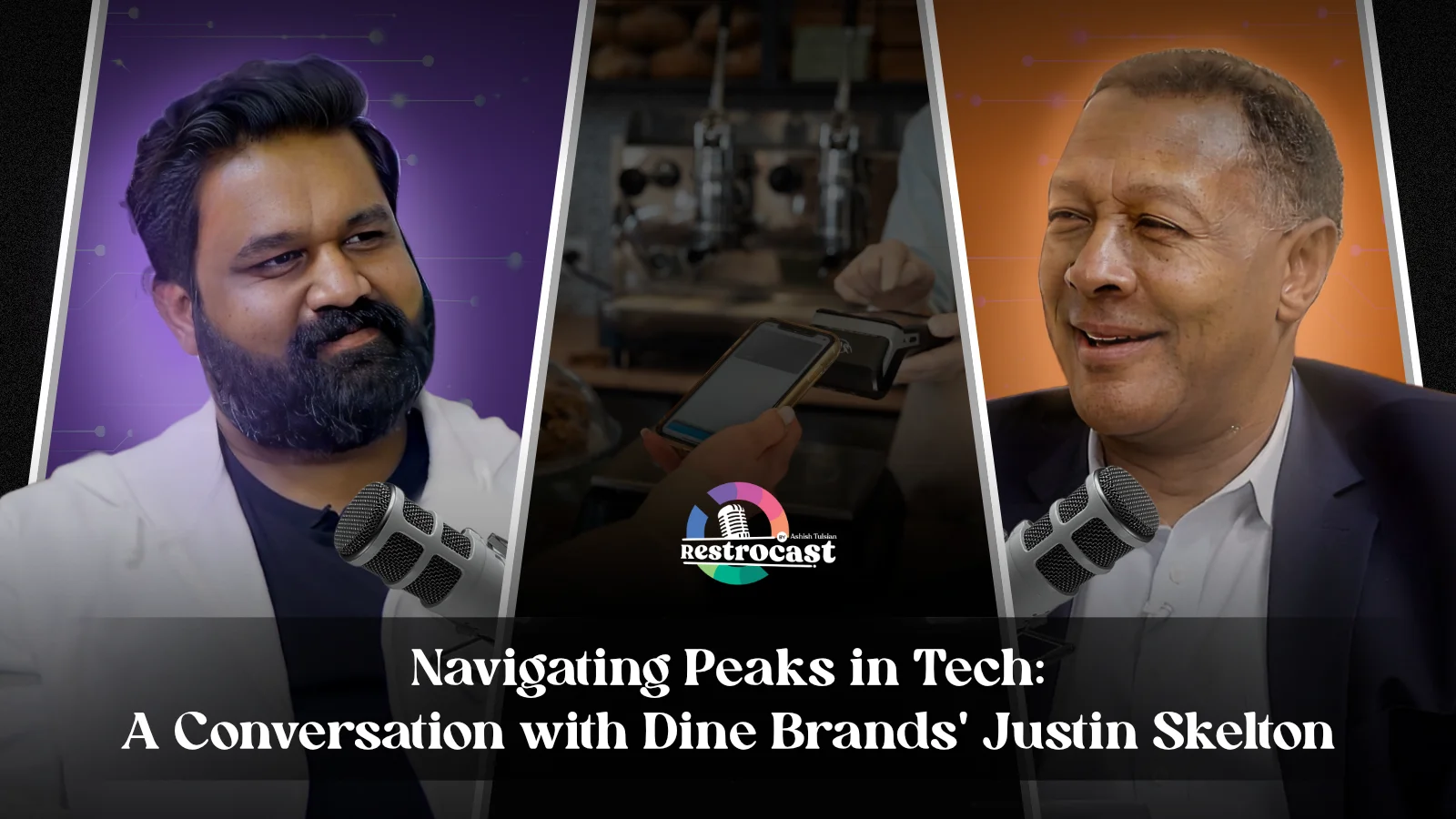
In this episode of Restrocast, Ashish Tulsian has a conversation with Justin Skelton, Senior Vice President and CIO at Dine Brands Global, which operates 3,766 restaurants globally under popular brands like IHOP, Applebee’s and Fuzzy’s Taco Shop.
Justin Skelton shared insights into his illustrious journey which can be summarized through his three marvelous peaks in his career as tech leader in America’s biggest brands across insurance, retail and restaurants.
Justin currently leads all aspects of information technology at Dine Brands Global, overseeing restaurant technology, off-premises technology, corporate systems, and infrastructure. Additionally, he is an integral part of the executive team, contributing to discussions on corporate strategy and the overall direction of the company.
Here are some excerpts from the riveting conversation-
What has your early life been like and how did it influence your leadership style?
Growing up as a military brat instilled in me the ability to adapt to change. I think we lived in five different states. I lived in Germany for three years. So basically, I would describe my childhood as being one of continuing to move almost every three years. Moving frequently and experiencing diverse cultures taught me tolerance, active listening, and the value of teamwork. These qualities have influenced my leadership style, emphasizing adaptability and collaboration.
Can you share some key milestones from your early career?
After completing my undergraduate at Cal State University of San Bernardino and earning an MBA from the University of Illinois, Chicago, I sought employment for financial stability. Landing a supervisor role at Allstate Insurance marked the beginning of my 19-year journey with the company. Amidst company consolidation, I seized an opportunity to relocate to Phoenix, working in underwriting and got into risk management. Transitioning to technology, I became the Chief Technology Officer at Triple A. The acquisition of Countrywide by Bank of America led me to various roles, including CTO for mortgage and insurance services. Intrigued by data management, I pursued a role at Bank of America before venturing into retail and healthcare technology at CVS Health. Subsequently, a recruiter from Dine Brands approached me, and I joined to work on cloud-based technologies.
Can you give us insights into your current role as Senior Vice President and CIO at Dine Brands Global?
Certainly. As the Senior Vice President and CIO at Dine Brands Global, I oversee all aspects of information technology, including restaurant technology, off-premises technology, corporate systems, and infrastructure. My role extends to participating in executive team discussions, contributing to corporate strategy, and shaping the overall direction of the company.
Dine Brands Global operates a franchise-heavy model. How do you manage IT in such a dynamic and diverse environment?
Managing IT in a franchise-heavy model requires ensuring consistency and leveraging scale for optimal technology solutions. I oversee in-restaurant systems, off-premises technologies, business intelligence capabilities, and corporate systems. The challenge lies in supporting a vast network of approximately 4,000 locations while maintaining technological cohesion.
How did Dine Brands adapt to the challenges posed by the pandemic?
The pandemic forced us to reevaluate our strategies and accelerate certain initiatives. The restaurant industry, especially dine-in formats, was significantly impacted. With in-restaurant dining becoming restricted, we had to pivot and focus on digital solutions. We prioritized technology that enhanced the guest experience and efficiency, such as contactless payment and digital menus. It was a challenging period, but we recognized the need to embrace digital transformation to survive.
How did your perspective change moving from industries like healthcare and retail to the restaurant business?
Transitioning from industries like healthcare and retail to the restaurant business was an interesting shift. While certain fundamentals of technology application remained consistent, adapting to the unique challenges of the restaurant industry required a different approach. The focus shifted to enhancing customer engagement, streamlining operations, and addressing the specific needs of franchisees. It underscored the importance of understanding the intricacies of each industry and tailoring technology solutions accordingly.
How do you evaluate technology, especially considering the influx of new tech in the restaurant industry?
Evaluating technology involves understanding the specific business needs and pain points. With a limited budget and time, it’s crucial to prioritize technologies that address identified challenges. For instance, we are currently exploring deep fry stations to improve back-of-house operations. Collaborating with brand partners and franchisees, we align technology investments with the strategic roadmap. The key is to strike a balance between innovation and practicality, ensuring that technology solutions align with the business objectives.
How do you manage budget constraints, especially in a franchised business model?
Managing budget constraints in a franchised business model requires collaboration and strategic planning. We work closely with brand partners to develop a strategic roadmap that outlines technology investments aligned with business goals. The budget planning involves discussions with franchisees, considering their contributions and preparing them for upcoming technology deployments. Communication plays a crucial role, and we prioritize investments based on the roadmap, understanding that some initiatives may require long-term planning and communication with franchisees.
Do you prefer taking bets on new, innovative companies or leveraging the stability of legacy systems?
We take a pragmatic approach, evaluating technologies based on their ability to address specific business needs. If a young, innovative company can scale and align with our enterprise requirements, we are open to taking bets on them. However, stability and credibility also matter, and legacy systems with a proven track record can offer reliability. The key is to assess the compatibility of the technology with our roadmap and prioritize solutions that best serve the business objectives.
Justin Skelton’s journey is a testament to the evolving landscape of technology leadership, where embracing change and driving innovation are at the forefront. As he continues to steer Dine Brands Global through the ever-changing tech landscape, his experiences offer valuable insights for aspiring leaders navigating the peaks of the technology realm.