Press ESC to close

Marketing Funnel Restaurant: How to Create an Engaging Funnel that Converts 

Read summarized version with

Table of Contents

The restaurant business is becoming more competitive, and diners constantly seek new restaurants to surprise their taste buds.

A study shows that 45% of US foodies spend 12.6% of their monthly income to dine at multiple restaurants. This is where a strategic marketing funnel for restaurants becomes imperative to save the day. 

A well-defined funnel attracts the perfect audience, makes your restaurant stand out, and keeps customers returning for more. Sounds interesting, doesn’t it?

A strategically designed restaurant sales funnel can guide prospective customers through a journey that transforms them into paying customers and eventually into repeat customers.

By using sales funnels, you can create personalized offers that cater to the specific needs and preferences of your audience, ensuring they become satisfied customers.

This approach not only helps in acquiring new diners but also plays a crucial role in retaining repeat customers, thereby boosting overall revenue and establishing a loyal customer base.

Let’s dive into the 6 stages of an ideal restaurant marketing funnel and discover how to build a loyal following that keeps your tables full. 
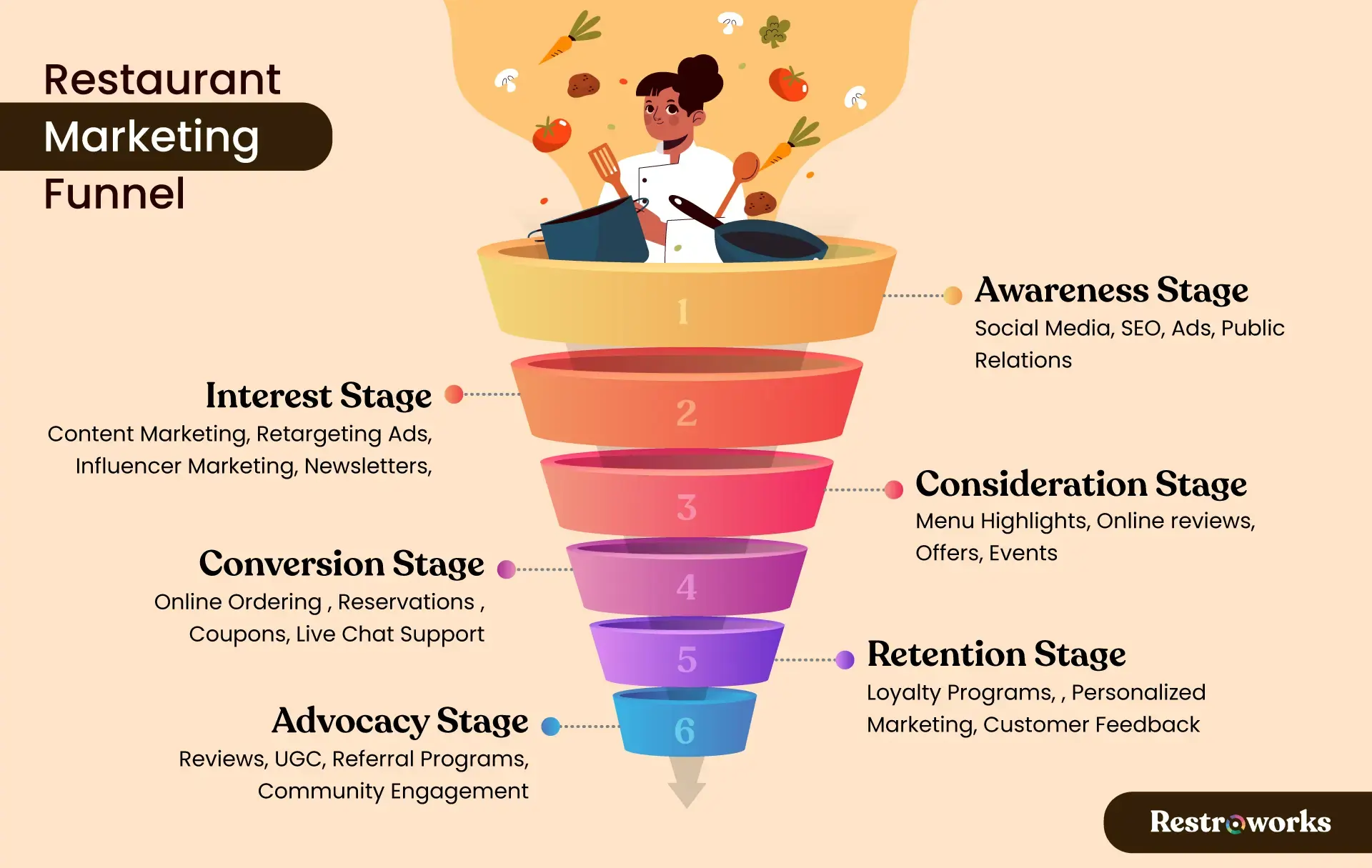
An image depicting the various marketing funnels

Stage 1: Awareness 

This stage focuses on building brand awareness about your restaurant and its offerings in front of potential customers through effective mediums.

Utilizing targeted marketing strategies, you can gather customer data to craft personalized marketing campaigns that resonate with your audience. By understanding the customer journey, you can encourage satisfied customers to share their experiences and encourage repeat business.

Combining traditional marketing methods with modern tactics helps ensure that your efforts are comprehensive and effective.

This approach is a crucial part of the restaurant’s sales funnel, driving awareness and encouraging repeat business.

Here are three practical ways to create awareness about your restaurant in the market. 

1. Social Media Marketing

According to research, a US adult spends 53.8 minutes on TikTok, 33.1 minutes on Instagram, and 30.9 minutes on Facebook on average.

Source – eMarketer

That’s why 82% of restaurants use social media to build brand awareness and drive restaurant sales. Here are some actionable steps to draw attention to your business. 

  • Define your audience: Have you ever wondered who your target audience is? Are they millennials on Instagram or busy professionals on Facebook? You need to pinpoint your exact audience demographics and recognize their social media habits to find out. This will help you choose the right platform. For instance, if your restaurant’s marketing funnel focuses on gourmet burgers and craft beers, Instagram and Facebook might yield more conversions than Pinterest. 

  • Create engaging content: Use those platforms to attract your potential audience with content that teases their taste buds. It could be high-resolution photos and short videos of mouthwatering dishes or happy customers enjoying their meals in a serene environment. 

  • Build connections: Social media isn’t just about pushing your promotional content for brand awareness. It is also essential to build a genuine connection with your audience. So, remember to promptly respond to comments and queries to foster trust and loyalty. 

2. SEO and Content Marketing

Search Engine Optimization (SEO) is a slow process, but unlike a one-time ad campaign, the rewards stay long. You create fantastic content that gets your restaurant noticed on search engines.

Those rankings keep bringing hungry customers your way for months or even years. 

How exactly does this work? Let’s break it down step by step:

  • Research keywords: 

Keyword tools like Ahref, SemRush, or Google Keyword Planner can help identify popular and low-competition keywords. For instance, if you specialize in Neapolitan pizza, your target keywords may be “best pizza near me” or “[city name] Neapolitan pizza restaurants,” amongst many others.

  • Optimize your marketing content 

Create marketing content around the targeting keyword, such as guest blogs, articles, and how-to videos. Use the keyword in page titles, meta descriptions, and image alt tags. 

  • Promote your content 

Share your marketing content across different social media platforms to grab eyeballs. You can also submit guest blogs to relevant online directories and food websites. Make sure the content provides value to readers. This will mark more conversions and drive traffic to your website. 

3. Advertising 

Paid advertisements are the fastest way to draw attention to your brand. It is better to leverage a strategic mix of online and offline channels. 

  • Online Ads

You can create eye-catching ads on Google and Facebook based on your target keywords and location. Add eye-catching visuals and include a CTA to drive specific conversions. For instance, you can run a Google ad on the keyword “Italian food near Chicago” by highlighting special offers or happy hour deals with a clear CTA like “Order Online” or “Book a Table Now.” This way, hungry customers can find you and fill your seats quickly!

Source – Domino’s

  • Offline Ads

You can also try traditional offline marketing hacks like flyers and billboards. However, you have to be very creative to draw maximum conversions. For instance, keep the content simple while designing flyers with a clear CTA. 

Ex: “[Restaurant Name] Weekend Brunch Offer- Buy 1 Get 1 – Order Now [website address/app icon/phone number]”

Place your flyers and billboards near high-traffic areas like highways, public parks, offices, or busy streets. 

Stage 2: Interest 

When people connect with your message, your marketing content attracts and converts potential customers.

The key challenge is building this desperate interest in your product. To retain that curiosity, you must repeatedly push content in front of your potential customers through various means.

Here is the three-step process for doing it. 

1. Create Engaging Content 

Customers don’t like to see just another “Spaghetti and Meatballs Recipe” video or fake customer testimonials on their screens.

You must be more creative than your competitors to turn heads toward your brand. For instance, starting a series of “Global Street Food at Home,” like Thai Pad See Ew or Mexican Elote, is just one of the ideal inspirations. 

Source – Atomic Design & Consulting

People also like to see the personalities behind the food. You can introduce your busy, neat kitchen and the dedicated staff to your customers through short videos on your social media handles.

Further, add a pinch of marketing about your kitchen hygiene and the use of local ingredients to connect people with your brand emotionally and ethically. 

2. Push through Smart Email Marketing 

Email marketing can nurture leads, convert them to customers, and drive repeat business when executed creatively.

There are many smart ways to use email marketing to experience these benefits. 

Source – Superb Experience

Here are a few inspirations:

  • Recipe teasers: Tease your potential customers with a small teaser clip of a new recipe video in your email. Add a CTA to see the full video on your website or social media. 

  • Special Days: Celebrate customers’ special days (birthdays/anniversaries) with a special offer or discount. Most importantly, personalize the email using their first name to make maximum impact. 

  • Season menus and events: Prompt receivers to try your new seasonal menus or book reservations for upcoming events through early bird offers. 

However, that’s not all.

You can easily leverage the quality content production of micro-influencers to reach more potential customers.

3. Capitalize Further with Influencer Marketing 

69% of consumers (including those in the restaurant industry) look for influencers rather than brands to make smart purchases.

So, restaurants collaborate with local influencers with the ideal target audience to curate interest and count healthy conversions.

However, the conversion is more likely to meet your expectations when you go with the following action plan. 

  • Collaborate with the right influencers:

Micro-influencers are more valuable than mega or macro influencers, with 10k-50k followers matching your target audience. Also, look for the content style of micro-influencers. If the micro-influencer is too focused on the gastro-pub niche, you may not see more conversions for promoting family restaurants. 

  • Partner for engaging content 

Reach out to ideal influencers with lucrative offers (money, complimentary meals, food coupons) to create engaging sponsored content for your restaurant. Try to go beyond meal photos—food challenges, DIY menu deconstruction, Blind Taste Test challenges, etc. 

Source – Counter Talk

  • Track and Improve 

Use trackable links to see how many people visited your website or made reservations through partnered influencers.

Also, track the likes, comments, and shares on the influencer’s post. Based on the performance feedback, improve your overall strategy to experience more ROI. 

You have now taken significant, solid steps to make people aware of your brand. The next phase of the funnel is to prompt ‘influenced’ potential customers to take positive action. 

Stage 3: Consideration 

In this stage of the marketing funnel, restaurants try to push potential customers to the edge so that they will easily convert to the next stage.

All marketing efforts aim to tap customers on a psychological level. 

1. Special Offers and Discounts 

A recent study found that 31% of diners look for discounts, and 57% of millennials seek coupons online when ordering food. Offers and discounts are important, but again, you should never forget the core motive behind such moves—to tap into your customers’ psychology to drive positive actions.

Here are some vetted tips to try and see guaranteed results. 

  • Create a sense of urgency: Create limited-time offers to encourage immediate actions. For instance, “Buy 1 Get 1” can be modified to “Buy 1 Get 1 for Next 3 Hours” to create FOMO (Fear of Missing Out) and drive more conversions. 

  • Focus on values: Instead of offering discounts, focus on experiences or memories. For instance, offers like “Brunch for Two for $25” or “Free Appetizer with Your First Online Order” focus on good experiences more than just discounts. 

2. Reviews and Testimonials 

69% of customers feel confident dealing with a brand with positive user reviews.

Restaurants engage different channels to showcase positive customer experiences about their food and services. 

Three significant platforms to show reviews and testimonials 

  • Website: Scroll customer reviews horizontally and ratings on every page of your website. Include customer names and photos to add authenticity. 

  • Business listings: Encourage customers to leave positive reviews on your business listing profiles (e.g., Google My Business, Yelp, Trip Advisor). Display the star power of your business listing profiles on your marketing brochures. 

  • Social Media handles: Regularly post positive customer reviews and testimonials on all your social media handles. Try to tag customers to showcase genuine promotions and earn their trust. 

3. Add Detailed Menus and Nutrition Information 

This trick always works because it attracts health-conscious customers and builds transparency.

Here is how to do it like a pro. 

Tease taste buds with mouthwatering menu descriptions

Always use descriptive language to engage with the senses of your customers. For instance, use “crispy” and “melt-in-mouth” to describe texture. Add “freshly baked” and “herb-infused” to let readers imagine the level of aroma you’re talking about.

Source – Doordash

To create a sense of preparation and freshness, use action verbs like “sizzled,” “marinated,” “tossed,” etc.  

Build trust with transparency 

Provide nutritional information on your menu to target customers concerned about their diet and calorie counts for good health.

Tag items made explicitly for vegan, gluten-free, or low-calorie purposes. For instance, you can mention vegan penne arrabbiata in the menu something like this: 

“(V) Vegan Penne Arrabbiata: A spicy tomato sauce tossed with penne pasta, fresh basil, and olive oil. (450 calories)”

When you offer a little pushover to your potential customers with the above marketing strategies, it’s time to taste the juicy part of the marketing funnel. 

Stage 4: Conversion 

You’re all set to welcome new customers, make their experience memorable, and remarket to convert more customers from the last stage of the funnel under the conversion phase.

First, make the customers comfortable with the conversion process. 

1. Online Ordering and Reservations 

Customers like to keep the transaction process smooth and straightforward while ordering online or booking tables.

Here are some tips that you should consider implementing in your ordering system. 

For Online Ordering

  • Clear online menu: To entice customers, clearly display all items on your menu with transparent pricing and quality photos. 

  • Options for customization: Customers should be able to easily add or remove items from the cart and choose portion sizes to target more customers. For instance, you can offer the “Build a Burger” option with various toppings. 

  • Simple and secure checkout: Make the process simple with different payment options. Integrate secured payment gateways to keep customers’ transactions safe. 

  • Real-time order tracking: Offer real-time order tracking so customers can prepare to accept orders at the right time. 

Source – My Arena Network

For Online Reservations 

  • Show calendar availability: Display real-time table availability for online reservations 

  • Flexible booking options: Customers might want to book reservations for different party sizes or time slots. Make sure your POS system has that flexibility.

  • Confirmation emails or reminders: To confirm conversions, send reminder emails (or messages) to your guests a few hours (or a day) before the booking date. 

  • Mobile-friendly platform: Your online reservations system should be mobile-friendly with cross-device functionalities to avoid customer frustrations. 

2. Remarketing

Remarketing strategies aim to convert interested customers into loyal diners.

The following methods can push them into the conversion stage. 

Find them with tracking pixels 

Google Ads and Facebook Ads offer tracking pixels to track customer behavior and segment them for remarketing.

You can segment them based on their actions, such as viewed menus, abandoned carts, etc. 

Create remarketing ads

Run targeted ads with extra discounts or create limited-time personalized offers for such specific customers to mark more conversions. 

3. Target the right platform and placement 

We talked about reaching the right people, but where do they hang out online? It’s not about blasting your message everywhere. You want laser focus! Using platforms like Google Display Network, Facebook, Instagram, or even email marketing, you can put your restaurant right in front of people who are already interested.

Ensure your ads show on relevant websites frequently visited by your target audience to increase the chances of conversions further. 

Stage 5: Retention 

Attracting new customers is great, but did you know it costs way more than keeping the awesome ones you already have?

It is five times costlier than retaining existing customers. If you already have customers who love your restaurant, why not make them raving fans? Here are some proven methods to easily retain customers for repeat business growth. 

1. Exceptional Customer Service

It is imperative to invest in training staff to be experts on everything from the menu to how to make your guests feel special. Customers also like to have staff who can quickly resolve their queries. When staff are well-trained in demonstrating knowledge and authoritativeness on the table that benefits customers, it prompts customers to return for that robust hospitality.

Remember to try the following hacks as well: 

  • Addressing customers by their first name whenever possible

  • Remember their diet preferences from the previous visits 

  • Offer complimentary appetizers on their special days

  • Anticipate their needs before they are voiced 

2. Loyalty Programs 

At least 83% of consumers admitted to participating in a loyalty program. Loyalty programs can be very useful for fine-dining restaurants, increasing repeat visits, improving guest CLV, and promoting brand loyalty. However, designing an effective loyalty program requires many considerations. 

Source – Restro App

  • Analyze your customers: identify frequent diners and their spending habits to tailor the loyalty program for a mass appeal. 

  • Design a unique program structure: Keep the points and rewards systems simple and easily understood. Consider implementing a tired system where customers unlock higher rewards for higher spending thresholds. 

  • Offer a variety of rewards: Offer different types of rewards, such as discounts, free menus, merchandise, exclusive experiences, etc. You can also run limited-time bonus point offers to play with FOMO techniques. 

3. Follow-Up Emails 

You would not want your visit to end as soon as your customers walk out the door! Send follow-up emails to customers with thank you’s, feedback requests, or personalized offers just after their visit. This will significantly increase the retention stage. However, keep the following tips in mind: 

  • Don’t wait too long. Send your first follow-up email to customers within 24-48 hours of their first visit while the experience is still fresh in their minds. 

  • Personalize the email by adding your customer names to increase the opening rate. 

  • Express sincere gratitude for their business. 

  • Politely ask for feedback on their dining experience in exchange for small incentives, such as discounts or loyalty points. 

4. Community Building 

Engaging with your customers beyond just food to build a strong connection translates to recurring business in the future. Here are some practical ways of creating a loyal customer base:

  • Social media engagement: Post high-quality photos and videos of your food, ambiance, and happy dining customers while tagging users’ accounts to create strong interactions.

  • Run Events: Organize themed events, such as cooking classes or live music nights, to entertain customers in a fun atmosphere.

  • Support Communities: Sponsor local charities or community events to showcase your social responsibility and build goodwill. 

Stage 6: Advocacy 

Most restaurant marketing funnels end at the retention stage. However, some marketers consider customer advocacy an extension of the retention stage. Because when your loyal customers become advocates, positive word-of-mouth brings more footfalls. If you can incentivize those advocacies, the method even takes a snowball effect and draws massive new traffic to your restaurant. Let’s look at some popular techniques that work in this regard. 

1. Encouraging Reviews 

Word-of-mouth is powerful, primarily online! Train your awesome staff to subtly mention customers leaving positive reviews on platforms like Google, Yelp, and TripAdvisor. Alternatively, you can send this inside your first welcome email with a short message like “We’d love to hear your feedback on Google or Yelp!”. 

2. Create Referral Programs 

Creating referral programs that reward customers for bringing in new business. Structure the program so the referrer and the referred customer receive a reward. Reward options, including discounts, free menu items, loyalty points, or exclusive offers, may vary. However, using a unique tracking code or a referral link is essential to reward the participants somewhat. 

Source – Referral Candy

3. Leverage User-Generated Content 

User-generated social media content (UGC) can increase brand awareness and attract new customers. You must incentivize customers to share their positive dining experiences on social media using branded hashtags and content. Alternatively, you can encourage genuine participation through interactive polls, quizzes, and Q&As to keep them returning for more. 

Conclusion: Marketing Funnel Restaurant Strategies

An effective marketing funnel for your restaurant can transform casual visitors into loyal customers. You can strategically attract and retain customers by focusing on each stage—awareness, interest, consideration, conversion, retention, and advocacy. Implementing the abovementioned strategies will help you stand out in a competitive market and ensure a steady stream of satisfied diners. Start applying these strategies today to see your restaurant thrive and your tables consistently filled.

Frequently Asked Questions 

The food sales funnel is an alternative term for a marketing funnel in the restaurant business. It follows the same stages as a marketing funnel: awareness, interest, consideration, conversion, retention, and advocacy. 

Typically, a marketing funnel without factoring in repeat business can be narrowed down to four stages: awareness, interest, consideration, and conversion. However, this is not ideally recommended for the restaurant industry as most profit comes from repeat business.

Let’s see how a typical marketing funnel works for a restaurant. Imagine a customer searching online for “Italian food near me” comes across your restaurant (Awareness). They see your ads with delicious photos (Interest). Now, they visit your website to check the menu (Consideration).  They see a pop-up saying “50% off on your first order,” and they decide to check out with a few items in the cart (Decision). They finally paid for the items and placed the order (Conversion). After a few days, they receive an SMS offering 20% off on their second order and decide to go for it (Retention). After a couple of happy experiences, you requested them to share a positive review on your Yelp profile, and they happily obliged with a small discount coupon (Advocacy). 

Some marketers do not consider advocacy one of the funnel’s stages. In such cases, the five stages of a marketing funnel restaurant are awareness, interest, consideration, conversion, and retention. 

There are typically six stages of a marketing funnel restaurant: 

  1. Awareness (marking your presence in the market)
  2. Interest (curating the interest of people in your products)
  3. Consideration (prompting them to consider your brand over others)
  4. Conversion (driving actions through online order booking or table reservations)
  5. Retention (attracting converted customers to keep coming back to your restaurant for repeat business)
  6. Advocacy (incentivizing happy customers to spread positive word-of-mouth about your restaurant on social media and other marketing channels. 

Categories:

logo

Restroworks is a leading platform that specializes in providing technological solutions to the restaurant industry. It stands out for its ability to streamline operations, enhance customer experiences, and enable scalability for global restaurant chains.


Subscribe to Our Newsletter

Stay ahead of the curve
with Restroworks industry insights.

Read what transforms how leaders think and act

Newsletter subscription banner