

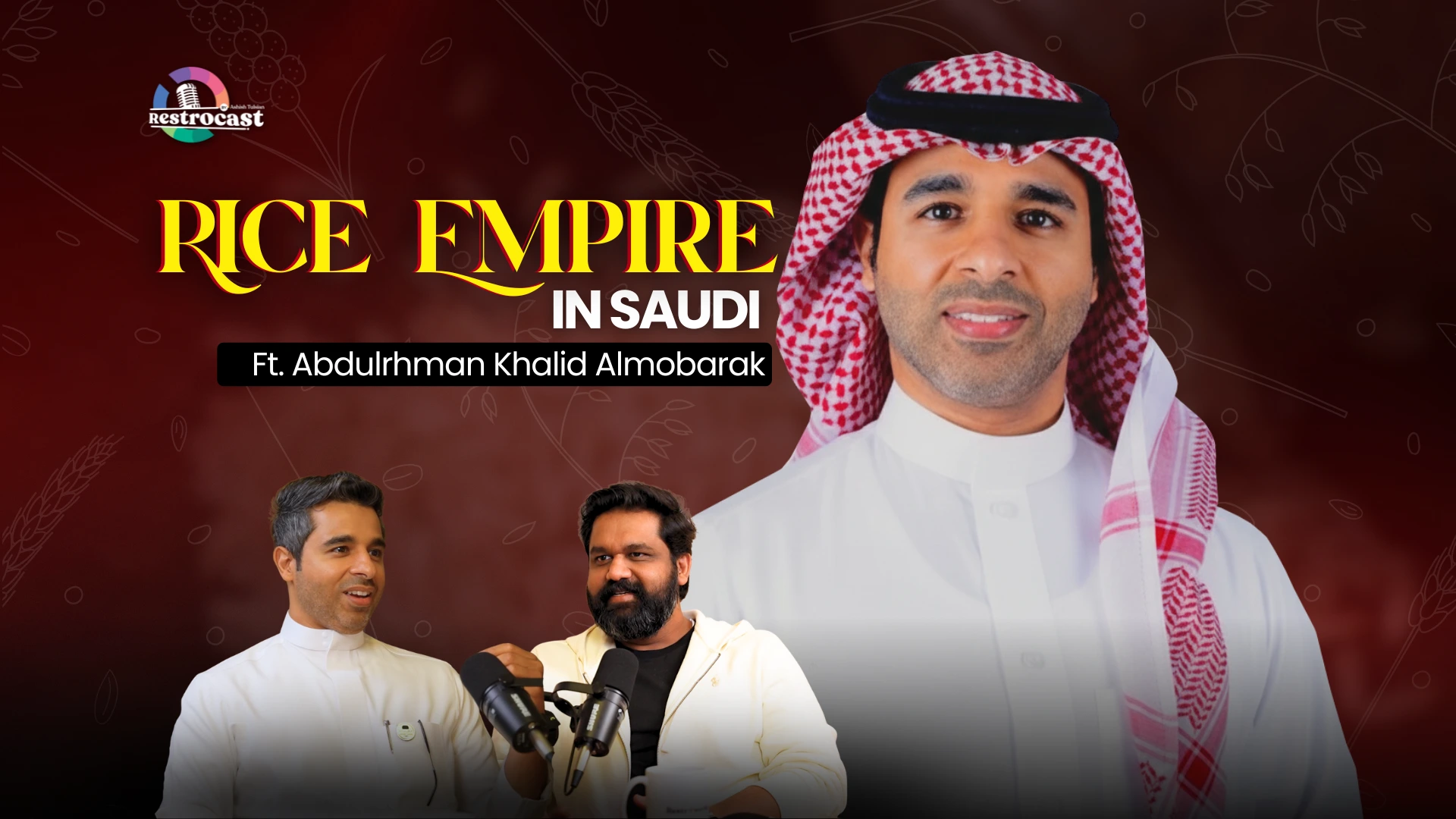
In just a few years, Maqloba has gone from a bold idea to one of Riyadh’s most talked-about rice concepts. At the heart of it is founder and chairman Abdulrhman Almobarak, an IT and healthcare professional turned restaurateur who set out to answer a simple but powerful question: Why is there no global rice brand, when rice is the main dish for millions of people?
In this conversation with Ashish Tulsian on Restrocast, Abdulrhman talks about how Maqloba was born, why he walked away from a prestigious hospital job, his deliberate choice not to franchise too early, and how he leads a young Saudi brand in a world shaped by Gen Z, technology, and constant change. He also opens up about family sacrifices, phone addiction, and his hopes for Saudi Arabia’s food scene under Vision 2030.
You’re an engineer by training, worked in healthcare, and then chose to build a rice-focused restaurant brand. Why rice, and how did that idea evolve into Maqloba as we know it today?
Abdulrhman Almobarak:
For me, any business must solve a real problem. Rice is the main dish in Saudi Arabia, the Gulf, and even in countries like India, yet there was no global “McDonald’s of rice.” That always made me wonder why no one had built a strong, scalable rice brand.
At the same time, I noticed a local issue: rice in Saudi restaurants was often served in basic aluminum trays, making it difficult to eat neatly at work, despite being our everyday food. So there was a gap, rice is central to our diet, but not convenient for modern life.
Maqloba was my answer. The name means “flipped upside down,” from the original Palestinian dish. We serve rice in a box with an aluminum pot and tray; you simply flip it onto the tray and eat right on your desk: no mess, no struggle. It keeps the tradition and flavor of rice, but in a fast-casual, practical, and slightly theatrical format that fits today’s lifestyle.
Leaving a stable IT role at a top hospital to open a rice restaurant is a huge leap. What gave you the confidence to take that risk, and how did your family respond?
Abdulrhman Almobarak:
My father is very conservative about business; he has always believed that a stable job is the safest path. But in my twenties, I saw risk differently. I was willing to bet on myself.
I took a bank loan, opened the first Maqloba while still working at the hospital, and even went on a six-month unpaid leave to test the concept. From day one, the queues were out the door. People joked we were creating lines on purpose, but when I spoke to customers, I realised there was real demand and that we’d opened a completely new segment: QSR rice.
A close friend and mentor finally pushed me over the line. He said, “You have a successful product, now you need to focus. Without a backup plan, you’ll be truly committed.” That’s when I told my manager I wouldn’t be coming back, kept the bank loan on my shoulders, and went all-in on Maqloba.
You’ve built twelve successful, company-owned Maqloba stores and clearly cracked something that works. With so much demand, why haven’t you franchised yet, especially when you know rice is hard to scale?
Abdulrhman Almobarak:
We’re actually franchise-ready on paper: the studies are done, systems are built, and we have a long waiting list inside and outside Saudi. But I strongly believe you don’t throw your problems onto franchisees. Before asking someone to invest their savings and dreams into Maqloba, I need to fully understand every downside myself: operations, costs, margins, while it’s still my own capital at risk. If a franchisee doesn’t make money, it hurts them and it damages our brand, because customers don’t care who owns the branch; they only see that Maqloba failed.
Rice makes this even more sensitive. Basmati is a delicate product; even slight changes in time, temperature, water, or handling can significantly affect the result. That’s why you don’t see a global “rice giant” yet: it’s much harder to standardize than burgers or sandwiches. We’ve solved many of the technical issues in our own stores, but franchising that reliability across markets is another level of complexity. Until we’re absolutely sure we can make franchisees profitable and support them properly, we prefer to keep growing through company-owned outlets and feel the same “heat” they would feel.
You’ve said cooking basmati rice “like at home” is very hard to standardize. How did you crack that in a QSR format?
Abdulrhman Almobarak:
Basmati is very delicate, so you can’t rely solely on a great chef; you need a comprehensive system. We engineered everything around the rice: the ovens, cooking cycles, holding methods, so the grains stay long, moist, separate, and aromatic even after some time. It took a lot of work to secure that, but I believe we’ve succeeded. That’s also why you don’t see many scalable rice brands; rice is one of the hardest things to standardize, and we had to solve that technically before thinking about real growth.
You worked for seven years as an employee before becoming an entrepreneur. What changes did you personally experience during that transition?
Abdulrhman Almobarak:
Almost everything. As an employee, you have a clear job description, fixed tasks, and you can switch off when you go home. As an entrepreneur, you are the system; you’re the boss, HR, finance, operations, and even the psychologist on some days, because at the start, you can’t afford specialists for every role. Your phone is always on, your mind never really stops, and for the first 7–10 years, you live with every problem.
Now that I’ve moved from CEO to chairman, I’ve been able to let go a bit and focus more on strategy than daily firefighting. But the business still feels like your child and your reputation. That emotional attachment pushes you to perform, but if you’re not careful, it can also become a burden, so learning to balance it is critical.
You’ve said you weren’t a restaurant expert when you started, you’d never even been inside a restaurant kitchen before your own. How did that shape your leadership style?
Abdulrhman Almobarak:
It humbled me from day one. I knew many people around me understood the restaurant business better than I did, so I chose to trust them and build Maqloba as a true team effort, not a one-man show. We gave shares to key individuals who were with us from the start: our chef, purchasing head, designer, marketing team, CFO, and COO; anyone who demonstrated honesty and treated the business as their own. They earned that ownership, and the result is a deep sense of commitment: today, some of their sons and brothers also work with us. That family-like, shared-ownership culture is a big part of Maqloba’s strength.
The restaurant world is changing fast: regulations, technology, Gen Z, and Gen Alpha behavior. How do you stay adaptable at Maqloba and still build a brand they care about?
Abdulrhman Almobarak:
You have to accept that change is constant and accelerating; social behavior, regulations, technology, even taste are moving all the time, and Gen Z/Gen Alpha are driving a lot of it. They’re digital-first, visual, and trend-led; they live on TikTok, Instagram, Snapchat, and will try whatever looks new and exciting that week. That means you can’t just say, “My positions are filled, so I’m fine.” As a founder, you must stay curious, even nosy, about what’s happening in your stores and in the market. At Maqloba, we’ve built this into our strategy: whoever replaces me in the future will have one core job, to continuously watch the business and keep improving it. Adaptability is no longer optional; it’s a survival skill.
If Gen Z and Gen Alpha are always chasing the next new thing and have almost no traditional brand loyalty, how do you make Maqloba sustainable?
Abdulrhman Almobarak:
Our research shows they aren’t loyal to brands, they’re loyal to trends and concepts, so we don’t rely on a static menu or fixed experience. We respond with continuous menu engineering and enhancement: unique flavors, creative presentations, and packaging that people want to photograph and share. However, creativity alone isn’t enough; you must institutionalize change across all aspects: menu, décor, technology, and the ordering journey. Look at McDonald’s and leading shawarma/QSR brands: they’re constantly rolling out new items and limited-time offers, not just once a year. Today, you must “always be launching” while staying true to your core identity. Ongoing innovation is now integral to both scalability and long-term sustainability.
Which brands in Saudi Arabia do you look up to as benchmarks, and why?
Abdulrhman Almobarak:
In Saudi Arabia, three homegrown brands inspire me a lot. Albaik for its incredible scale, speed, customer centricity, and flawless execution. Shawarmer for taking shawarma, industrializing it with a factory, 200+ branches, and very creative marketing and menu innovation. And Maestro Pizza, which has become the go-to pizza for many Gen Z and Gen Alpha, ahead of global giants like Domino’s. All three started from scratch and are now expanding beyond Saudi Arabia. I believe they’ll be global names. Maqloba aims to follow a similar path: proudly Saudi, but with a global vision.
You once told your daughter you wouldn’t recommend she open a restaurant, yet you clearly love what you do. How do you defend that at home?
Abdulrhman Almobarak:
My family sees the cost up close. My daughters often tell me, “Daddy, when you’re home, put the phone away,” and they’re right. The restaurant business doesn’t really stop at the door, and it’s not only a necessity, it’s also an attachment and a bit of dopamine. Even after stepping back from the CEO role, I still feel emotionally tied to every detail.
They’ve been incredibly patient with me answering work messages at the dinner table, and I owe them a lot for that. Now, one of my main personal goals is simple: less phone, more presence.
Running restaurants means your peak work hours clash with everyone else’s social time, and you’ve also spoken about phone and work addiction. Has this made you more anti-social, and what habits have you changed to manage it?
Abdulrhman Almobarak:
In some ways, yes, but it’s not just restaurants; it’s a global phone problem. You can sit in any restaurant and see people reach for their phones within minutes. What I can control is my own behavior. When I’m with people, I keep my phone off the table, in my pocket on silent, and focus on real conversation. In winter, my friends and I go camping in the desert where there’s no signal; those trips feel like a one-year mental reset.
I’ve also changed how I start my day: I never touch my phone when I wake up. First coffee, then the gym, and only after that do I check messages. It sounds simple, but it stops my mind from being hijacked by other people’s priorities from minute one. We think constant engagement equals productivity; in reality, it just keeps us busy. Creating that buffer has made me calmer, more focused, and more present with work and with my family.
Before we close, how do you see Saudi Arabia’s food landscape, and where does Maqloba fit into Vision 2030 and beyond?
Abdulrhman Almobarak:
I’m very optimistic. By 2030, I believe Saudi Arabia will be seen as one of the world’s most exciting food destinations, with incredible diversity in cuisines and flavors. As part of the new generation of Saudi entrepreneurs, we’re proud that Maqloba is one small piece of a larger story, local brands evolving into regional and global players. With the country’s vision and the rapid transformation of the restaurant sector, the potential is huge, and we’re committed to contributing to it inside Saudi Arabia and, inshallah, across the world.
Conclusion
Abdulrhman’s journey with Maqloba is more than a founder story; it’s a snapshot of where Saudi food, entrepreneurship, and youth culture are headed. He’s trying to build what doesn’t yet exist: a scalable, systems-driven rice brand while refusing to rush into franchising or compromise on unit economics.
At the same time, his answers reveal the human side of the journey: the emotional cost on family time, the addiction to the phone, the shift from operator to chairman, and the deliberate choice to share ownership with his team.
If Vision 2030 is about Saudi Arabia stepping confidently onto the global stage, Maqloba is a good example of how that looks in food: proudly local, technically sharp, globally ambitious, and deeply aware that the next generation won’t settle for anything less than constantly evolving, story-worthy experiences.