

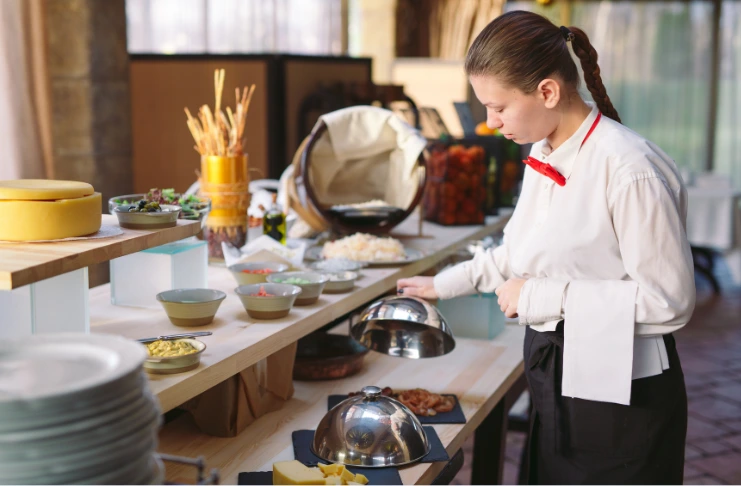
It’s Friday evening at a small hotel. The restaurant’s buzzing with happy guests, the kitchen’s moving fast, and plates look picture-perfect. But behind the scenes, the finance team spots a problem: the food costs for the month are way too high. This happens more often than you’d think.
Whether you’re running a luxury hotel or a cozy café, one thing stays the same: the food you serve needs to make your guests smile and keep your business profitable. Food cost isn’t just about expenses; it’s about smart choices, portion sizes, pricing, and planning.
In this guide, we’ll explore how to accurately compute actual food cost, determine your ideal food cost percentage, assess cost per serving, and benchmark against industry standards. Additionally, we’ll demonstrate how the total food cost percentage relates to total food sales, cost of goods sold, and total revenue, as well as provide guidance on how to adjust menu prices if necessary.
1. Understanding Key Concepts
What is Food Cost?
Food costs refer to the expense of purchasing ingredients used in menus over a specified time. In hotels, this includes all purchases of perishable and non-perishable food. The cost of goods sold (COGS) is directly tied to this number:
COGS = Beginning Inventory + Purchases – Ending Inventory
The actual food cost for a period is essentially your COGS. It represents the true cost of inventory consumed, adjusted for wastage and transfers.
What Is Food Cost Percentage?
The food cost percentage measures the ratio of food expense to revenue from food sales:
Food Cost Percentage = (Cost of Goods Sold ÷ Total Food Sales) × 100
Also known as total food cost percentage, it’s a vital efficiency metric that shows what fraction of your total revenue from food goes toward food expenses.
If COGS = ₹80,000 and total food sales = ₹200,000 in a month, your food cost percentage is (80,000 ÷ 200,000) × 100 = 40%.
Ideal Food Cost & Benchmarks
Use your historical data to determine your ideal food cost percentage tailored to your hotel’s concept, cuisine, labor costs, overhead, and desired profit margins.
Most industry sources cite an ideal food cost percentage between 28–35% (some suggest 30% as the target) for hotels and restaurants, depending on service level and cuisine complexity. For upscale 4 or 5-star operations, food cost expectations hover around 35%, with beverages at around 25% to yield an overall cost percentage of ~32%.
Your ideal food cost is your target ratio based on your operating model and goals. Comparing the actual food cost percentage to the ideal food cost percentage helps identify efficiency gaps.
Another useful concept is theoretical food cost, the cost of perfectly executing recipes with zero waste. Comparing theoretical vs. actual reveals inefficiencies or waste.
You can compute your ideal target by subtracting labor, overhead, and profit goals from projected total revenue:
Ideal Food Cost = Total Revenue – (Labor + Overhead + Profit Goal)
Ideal Food Cost Percentage = Ideal Food Cost ÷ Total Revenue
2. The Food Cost Formula: Monthly Calculation

Step-by-Step to Calculate Monthly Food Cost
- Beginning Inventory Value: Stock value on day one of the period.
- Purchases: Total cost of food purchased during the period.
- Ending Inventory Value: Stock value at the end of the period.
- Adjustments: Account for wastage, transfers, and complimentary meals.
Compute:
Total Food Costs (COGS) = Beginning Inventory + Purchases – Ending Inventory
Your actual food cost is this figure. Then calculate:
Monthly Food Cost Percentage = (Total Food Costs ÷ Total Food Sales) × 100
Here’s an example:
- Beginning inventory: ₹500,000
- Purchases: ₹1,200,000
- Ending inventory: ₹600,000
→ Total food costs = ₹500k + ₹1.2M – ₹600k = ₹1.1M
If food sales were ₹3.5M that month:
→ Food cost percentage = (₹1.1M ÷ ₹3.5M) × 100 = ~31.4%
This metric helps assess whether your operations align with your ideal food cost percentage.
Why Inventory Value Matters
Getting your inventory numbers right both at the start and end of the month is crucial for tracking real food costs. If your closing inventory is overstated, it makes your actual usage look smaller, which falsely lowers your food cost percentage. That can mislead your financial decisions and hurt profitability over time.
To avoid this, regular physical inventory counts or digital systems that sync with your POS can give accurate, real-time data. This helps ensure your reports reflect true consumption and cost, so you’re not basing business decisions on unreliable numbers. Precision here can make or break your food margins.
Benchmarking Against Industry
Most sources agree:
- A restaurant or hotel should aim for a food cost percentage between 28–35%, often centering on 30% as a working figure.
- Resorts and upscale hotel F&B departments often see food cost ~35%, beverages ~25%, so the total food cost percentage is around ~32%.
- In 2024, average restaurants saw COGS/food cost ratios above 40%, showing rising input costs and pressure on margins.
When your computed actual food cost percentage significantly exceeds your ideal, it’s time to dig into root causes: waste, theft, portion control, or pricing mismatches.
3. Menu‑Wise Food Cost: Cost per Serving & Per Dish

How to Calculate Food Cost Per Serving
For each menu item:
- List ingredients with quantities and cost.
- Adjust for yield and portion size.
- Sum the ingredient costs per portion to determine the cost per serving or per dish cost.
- (Optional) Add a prep or labor cost per plate.
Then: Cost per Serving = Sum of ingredient costs (adjusted)
Or compute Food Cost Percentage Per Dish:
Food Cost Percentage Per Dish = (Cost per Serving ÷ Menu Price) × 100
For example, suppose you sell Grilled Chicken for ₹400, with ingredient cost ₹120 per portion: Food cost percentage for dish = (120 ÷ 400) × 100 = 30%
This helps you compare each menu item’s profitability to your ideal food cost percentage. Menu‑wise costing allows you to identify high‑cost, low‑margin items and take action.
Menu Prices and Margins
If your dish’s food cost percentage goes beyond your ideal target, there are a few practical ways to bring your margins back on track. The key is to adjust thoughtfully without compromising guest satisfaction or brand value. Here are your options:
- Reduce cost per serving by sourcing cheaper ingredients or trimming portions
- Increase menu prices strategically to match cost changes
- Reformulate or remove items with unsustainable costs
- For bestselling premium dishes, you might accept a slightly higher food cost percentage, especially if they boost total food sales and overall revenue
Theoretical vs. Actual Food Cost
Theoretical food cost = cost per dish × quantity sold across menu. This assumes no waste or shrinkage. Comparing that to actual food cost (from inventory data) helps detect losses from waste, over‑portioning, or theft. The difference is the variance you want to minimize.
4. Combining Monthly & Menu‑Wise Metrics

Calculating Total Food Cost Percentage
Use: Total Food Cost Percentage = (Total Cost of Goods Sold ÷ Total Food Sales) × 100%
This gives your overall ratio for the period, combining all menu pricing and sales data. With actual food cost percentage in hand and your ideal food cost percentage benchmarked, you can measure performance and strategize corrective actions.
Example Workflow
- Compute actual food cost from inventory adjustments.
- Divide by total food sales to get the actual food cost percentage.
- Compare against ideal food cost percentage (target ~30%).
- Drill down by dish or category using menu‑wise food cost.
- Identify variances between theoretical and actual costs.
- Take action: reduce waste, adjust suppliers, increase menu prices, implement portion control, or re-engineer recipes.
5. Common Causes of High Food Costs
Why might your hotel’s total food cost percentage be higher than ideal? Here’s what to watch out for:
- Inventory Errors: If you miscalculate your inventory, especially if the ending stock appears higher than it really is, it hides the real food usage and leads to incorrect cost percentages.
- Too Much Waste: Preparing more than needed, storing food poorly, or letting ingredients spoil means throwing money in the bin. Every bit of waste adds up.
- Theft & Poor Portion Sizes: If food is stolen or staff serve inconsistent portions, the kitchen uses more ingredients than it should, without any extra revenue.
- Wrong Pricing: Ingredient costs go up, but if your menu prices don’t adjust, profit margins shrink. The same dish might be costing you more than it did last year.
- Complicated Menu: Offering too many different items can lead to buying more ingredients, inefficient storage, and creating more chances for waste.
If menu items exceed the ideal food cost percentage, it’s time to act: reduce portion size, renegotiate supplier rates, or increase menu prices strategically. Ongoing menu audits are the key to balancing quality, cost, and guest experience.
6. Tips to Reduce Food Costs and Align with Ideal Food Cost

A. Portion & Recipe Control
Standardize recipes and train staff to serve at a precise cost per serving. Regular yield testing ensures portion sizes are accurate. Reducing over‑portioning lowers actual food cost without affecting quality.
B. Inventory Management
Perform physical counts frequently and monitor inventory value closely. Using POS‑linked systems helps reduce variance. Track ending inventory carefully to avoid miscalculating COGS.
C. Supplier & Purchase Efficiency
Negotiate better rates, use seasonal local suppliers, and monitor price fluctuations. Better purchasing reduces ingredient cost per serving and overall total food costs.
D. Menu Engineering
Promote high-margin items and reassess those with high food cost percentages. Use menu‑wise food cost data to adjust offerings strategically and guide guests toward profitable choices.
E. Adjusting Menu Prices
When food input costs rise, sometimes the only way to maintain margin is to increase menu prices. Evaluate dishes whose food cost percentage is above the ideal food cost percentage, and consider gradually raising prices to optimize profits without shocking customers.
F. Monitor Theoretical vs. Actual
Compare your actual food cost (inventory-based) to your theoretical food cost (recipe-based) to uncover inefficiencies. Each variance point is an opportunity to retrain or adjust processes.
8. Tracking and Reporting
Monthly Financial Reviews
Every month, calculate:
- Total food costs (COGS) using beginning inventory, purchases, and ending inventory.
- Total food sales from POS.
- Food cost percentage.
Include comparisons to ideal food cost percentage, previous months, and theoretical cost.
Dish-Level Reporting
For each menu item, track:
- Cost per serving
- Food cost percentage per dish
- Sales volume versus profitability
Highlight items with high food cost percentage and low contribution margins.
Variance Analysis
Calculate variance:
Variance % = [(Actual Food Cost – Theoretical Food Cost) ÷ Theoretical Food Cost] × 100
High positive variance indicates waste or theft; negative variance suggests under‑portioning or data error.
9. Tools & Software
Managing food costs in a hotel can be complex, but the right tools make it far easier, faster, and more accurate. Today’s technology allows hotels to track monthly and menu-wise food costs without relying entirely on manual calculations, which often leave room for error. Here’s how these tools work:
- POS Systems with Inventory Tracking: Modern POS systems often come with built-in inventory modules. They automatically record ingredient usage, update stock levels, and connect consumption data to food sales, helping calculate your food cost percentage more reliably.
- Recipe-Costing Software: This software calculates the cost per serving and food cost percentage for each dish based on real-time ingredient prices and portion sizes. It’s perfect for menu-wise analysis and identifying which items deliver healthy margins.
- Analytics Dashboards: Many systems offer dashboards that compile total food costs, total food sales, and any variance between expected and actual costs. These visuals simplify decision-making and highlight problem areas instantly.
- Manual Templates (Excel/Google Sheets): For smaller hotels or start-ups, spreadsheets remain a solid solution. You can track beginning inventory, purchases, ending inventory, and food sales manually. While not automated, they offer full control and flexibility.
Why These Tools Matter: Automated systems reduce errors, offer precise food cost reporting, and link inventory values directly to sales data. Most importantly, they help detect when food cost percentages are off-target, so you can adjust menu prices, portion sizes, or supplier terms quickly and confidently. In short, they turn food cost management into a smarter, smoother part of daily operations.
Conclusion
Effectively managing food costs is essential for a hotel’s financial health and long-term success. When you consistently track and compare your actual food cost percentage against your ideal benchmarks, it becomes easier to pinpoint inefficiencies and make informed decisions. By calculating cost per serving, analyzing menu-wise food expenditure, and identifying the gap between theoretical and actual costs, hotels can uncover hidden issues like waste, pricing mismatches, or poor inventory practices.
Monthly monitoring of total food costs and sales ensures your financial strategy stays grounded and proactive. If your food cost percentage strays from the target, it’s important to take corrective measures. Whether through tightening inventory control, standardizing recipes, negotiating better supplier rates, cutting down on waste, or adjusting menu pricing with care. Each of these steps strengthens your control over operations and restores profit margins. With consistent attention to detail, hotels can align actual performance with expectations and protect their bottom line effectively.