

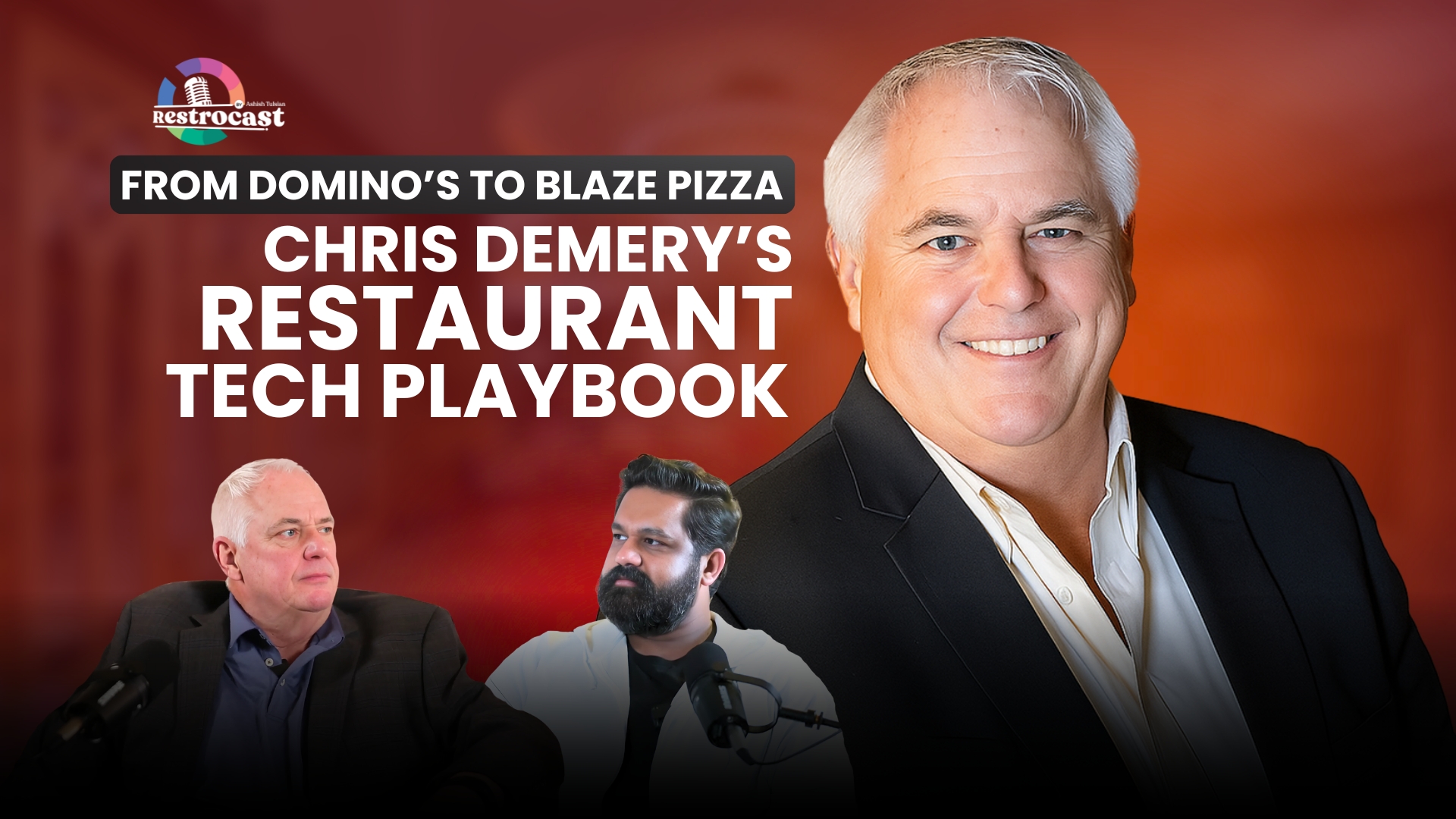
In this exclusive Restrocast interview, Ashish Tulsian, Co-Founder & CEO of Restroworks, sits down with Chris Demery, CTO of Blaze Pizza, to discuss his journey from the military to revolutionizing restaurant technology at brands like Domino’s, Bloomin’ Brands, PF Chang’s, and more. Chris shares candid insights into innovation, listening to frontline workers, and why hospitality remains close to his heart.
Chris, your career path is anything but conventional. How did your early days shape who you are today?
Chris Demery: I started in the military. I had a full ROTC scholarship and initially wanted to become a doctor through the Army. But I pivoted and became a Signal Officer instead, working with tactical infantry, field artillery, and Special Forces. I genuinely thought I’d become a general one day. Over time, I earned a master’s degree in computer science, realizing there was life outside the military and outside waking up at 4 a.m. every day. That set me on a different path.
So, when you transitioned into civilian life, how did you end up in technology and then in the restaurant industry?
Chris Demery: I first worked in a consulting firm in D.C., then I worked as Director of Software Quality Assurance. I helped assess engineering teams worldwide for compliance with software quality standards. Later, I was asked to help manage their struggling Domino’s program. That eventually led to Domino’s offering me a full-time role to lead the next-generation store solution project. That was 2000, and I spent the next 12 years there.
What did you work on at Domino’s during that time?
Chris Demery: We built Domino’s Pulse, the next-generation point-of-sale system. I also led the development of near real-time reporting, the Pizza Tracker, and two iterations of their e-commerce platform. We focused heavily on architecture principles. For example, we only considered systems with a three-tier architecture, knowing it would help us evolve and scale. That foundation made it possible to adapt, replace APIs, and support global expansion later.
How do you decide whether to build or buy technology?
Chris Demery: If it’s commercially available and doesn’t differentiate you, buy it. But if it’s something that can give you a competitive advantage, like Domino’s delivery systems or Blaze’s in-store innovation, then build it. That’s the rule I follow: build to differentiate, buy to support.
You also worked on off-premises dining at Bloomin’. That seems ahead of its time.
Chris Demery: Liz Smith, the CEO, asked me to lead off-prem. We built self-delivery models for Outback and Carrabba’s and reversed declining traffic. Everyone said Bonefish Grill’s seafood wouldn’t travel well, but I believed in letting the guests decide. We turned on Uber Eats at one Bonefish, and sales jumped. We had to pause it because too many drivers were crowding the bar area and cutting into alcohol sales! But that proved our point: if guests want it, give it to them, when, where, and how they want it.
Then came your stints at CKE and PF Chang’s. How did those roles evolve?
Chris Demery: At CKE, I came in to lead IT. Shortly after, the existing CIO was let go. I was on track to become CTO, but the private equity group brought in someone else. That’s when PF Chang’s reached out. They wanted help building a small-footprint, off-prem-focused concept. Then COVID hit. Eventually, Blaze Pizza contacted me.
What’s one myth people outside the restaurant industry. especially tech folks often believe that’s completely off?
Chris Demery: The classic one: “How hard can it be to make a pizza?” People really underestimate how complex it is. At Blaze, we have 43 ingredients, and every pizza is custom. Amazon, with all its logistics, got out of food delivery, it’s just too hard. We’re not shipping sweaters in two days; we’re making custom food in 15 minutes and delivering it in 30. That’s not easy.
Most new franchisees enter thinking it’s simple. However, if you don’t manage labor, food, or lack situational awareness when reading the restaurant like a live system, you’ll fail. That’s why so many brands start each year and shut down just as fast.
How do you ensure new technologies like AI are actually usable during a busy restaurant shift?
Chris Demery: That’s exactly what we’re solving with what I call Heightened Time Awareness, delivering real-time, actionable insights to managers without disrupting their workflow. If digital orders spike, a bot might prompt: “You forecasted 20 orders/hour, it’s now 40.” No dashboards, no reports, just timely alerts via audio or screen prompts. We’re building this with partners like QBeyond and Fresh Tech.
The key is: AI should surface insights, not make decisions. Managers who are often young and under pressure need clear context, not commands. Even at Domino’s, we had a makeline ticker showing forecast vs. actuals and labor impact. That kind of awareness helped stores manage within 0.1% of forecast, true operational excellence.
What makes a successful tech leader in the restaurant space and how do you balance innovation with real-world operations?
Chris Demery: Two things:
1) Have a clear strategy for innovation aligned with where the brand is going.
2) Be able to talk like an operator. If you can’t speak their language, you can’t build for them.
That’s what sets great CTOs apart. You must understand food costs, labor, training, and operations, then build solutions around those.
Tech should drive measurable efficiency, not just look impressive. Tools don’t run the business, people do. Our job is to make their work easier, their decisions smarter, and the guest experience smoother. Anything else is a distraction.
Conclusion
Chris Demery’s journey is a reminder that the best solutions don’t come from technology alone; they come from empathy, experience, and execution. Whether it’s replacing legacy systems, building off-prem infrastructure, or reimagining AI in the flow of a lunch rush, Chris keeps the operator and guest at the center of every decision. That’s what makes his leadership rare and incredibly relevant in today’s rapidly evolving restaurant landscape.