
The old prescription for restaurant success was simple:
- Good location
- Good restaurant design
- Good food
- Enough repeat business to keep the doors open
That prescription, of course, still works. It just no longer describes what is possible.
A parallel food service economy has developed over the past decade. Before the pandemic, the US restaurant industry was growing 3 to 4 percent per year, while delivery sales were increasing at roughly twice that pace, i.e., at 7 to 8 percent annually. Today, that gap has only widened. Online ordering now accounts for more than a quarter of all restaurant and convenience-store orders nationwide.
COVID-19 hit, and the dining room business went away. The delivery business went on. The dining rooms reopened, but the delivery habits formed during the pandemic stayed. Consumers who discovered third-party ordering between 2020 and 2022 kept ordering that way.
The global cloud kitchen market was valued at $36.9 billion in 2023 and is projected to reach $74.6 billion by 2030, growing at a CAGR (compound annual growth rate) of 10.6%. On top of that, a 2022 Grubhub and Technomic survey found that 41% of independent restaurant operators in the US are running at least one virtual restaurant concept.
This is no longer a story of disruption or competition. Cloud kitchens and traditional restaurants have become allies. Brinker International, in fact, proved it when It’s Just Wings was on track to reach $150 million in annual sales from existing Chili’s kitchens, without a single new lease. How does this kind of alliance work? To understand it, you must know what each model is designed to do in the first place.
What Is a Cloud Kitchen Business Model?
A cloud kitchen is a commercial kitchen that specializes in preparing food for online orders, without a storefront or any customer-facing presence.
The terms cloud kitchen, ghost kitchen, and virtual brand are often used interchangeably, but they describe different things. A cloud kitchen is a delivery-only commercial kitchen facility — the umbrella term for the physical space. A ghost kitchen is a third-party-operated shared facility where multiple operators lease stations and share infrastructure. A virtual brand is a delivery-only restaurant concept that may operate from a cloud kitchen, a ghost kitchen, or an existing restaurant’s kitchen.
A cloud kitchen business removes unnecessary elements from a food business. There are no host staff. There is no customer seating. There are no walk-in customers. It is a very simple business model based on a single principle: take in food orders from food delivery platforms, cook and package the food, and hand it off to delivery drivers.
Cloud kitchens operate under four distinct models –
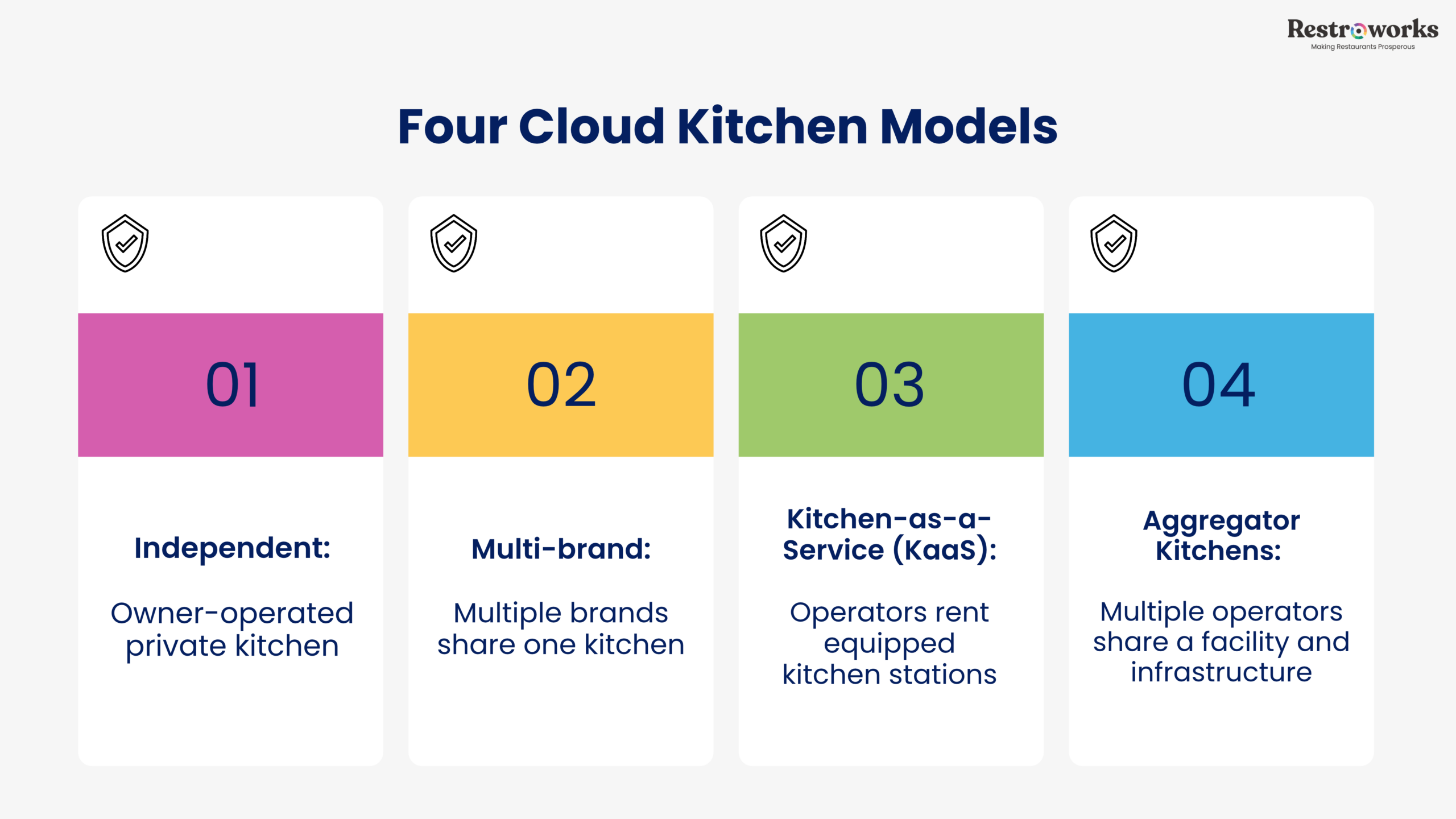
- An independent cloud kitchen is owner-operated from a private facility.
- Multi-brand cloud kitchens operate multiple brands from one space.
- Kitchen-as-a-Service (KaaS) providers lease fully equipped stations to operators.
- Aggregator kitchens bundle multiple independent operators under one roof with shared infrastructure.
For restaurant owners adding a delivery brand, KaaS offers the lowest entry barrier: no second lease, no equipment purchase. In the US, providers like CloudKitchens (operating in Los Angeles, Chicago, Dallas, and other metros) and Kitchen United (which closed its physical locations in late 2023 and pivoted to software) lease fully equipped stations to operators. Industry pricing for turnkey cloud kitchen stations in major US metros typically falls in the $3,500-$6,000 per month range, depending on the market, kitchen size, and included services. Independent kitchens offer more control but require the full capital commitment of a standalone facility.
How a Cloud Kitchen Operates Day to Day
A cloud kitchen’s daily workflow follows five steps:
- Online orders arrive through food delivery apps (DoorDash, Uber Eats, Grubhub) and the kitchen’s own direct ordering system.
- A digital order management system such as Restroworks cloud kitchen software aggregates orders from multiple delivery platforms into a single queue.
- The system routes each order to the correct kitchen station based on brand and cuisine type.
- Kitchen staff cook and package the order using delivery-optimized containers.
- Delivery drivers collect the packaged order from the ghost kitchen for last-mile fulfillment.
There are no hosts, servers, or dining spaces to maintain. Labor costs are structurally lower. Cloud kitchens can save 30-40% of labor costs as compared to traditional restaurants. A typical cloud kitchen generating $30,000-$50,000 in monthly revenue operates with 3-5 kitchen staff per shift, compared to 8-15 staff (kitchen plus front-of-house) for a similarly sized dine-in operation.
A cloud kitchen can operate multiple brands from the same facility, be it a burger brand, a noodle brand, and a healthy grain bowl brand, all sharing one kitchen. One facility, multiple revenue streams. Ghost kitchens work on a similar principle but typically operate as third-party facilities, offering less control over branding and operations.
Cloud Kitchen: What the Numbers Actually Look Like
Cloud kitchen costs look like:
- Startup costs: $20,000-$60,000 for a ghost kitchen (the $20,000 entry point reflects shared commissary spaces in markets like Houston, Dallas, and Atlanta where operators lease a station with equipment included); $50,000-$250,000 for an independent facility (based on US shared-kitchen operator pricing and industry benchmarks, 2024)
- Profit margins (optimized): 8-15% for cloud kitchen operators, depending on format and direct-order mix
- Break-even timeline: 6-18 months depending on format and market
- Monthly revenue potential: $20,000-$60,000 per well-positioned cloud kitchen unit
A ghost kitchen trades the dine-in experience and direct customer interaction to focus solely on delivery, gaining lower overhead costs compared to traditional restaurants, operational efficiency, and the ability to reach delivery customers entirely through online platforms. The trade-off is structural, not fixable with better packaging. Know what you’re giving up before you launch.
What Is a Traditional Restaurant?
A traditional restaurant is a foodservice establishment with a physical location where customers visit, dine, and interact with the brand.
This includes a tremendous range, from fast-casual in New York to full-service in California to fine-dining in Chicago. The National Restaurant Association estimates over one million restaurant locations operate in the US, with projected sales of $1.55 trillion in 2026 and an industry workforce of 15.8 million. What they share is a customer experience beyond food alone: the environment, service quality, ambiance, and direct human interaction are all part of the product.
Traditional restaurants can and do deliver food. They can and do have virtual brands. The business operations, real estate, staffing, and loyalty of traditional restaurants are all based on dine-in customers.
How Traditional Restaurants Operate
For operators managing 25-100+ locations, that kind of systematic, data-led approach is the difference between a scalable food business and an operationally chaotic one.
If You’re Planning an Exit
Traditional restaurants with established locations sell at a median of 1.85 times seller’s discretionary earnings, according to BizBuySell data from 8,692 completed US transactions between 2021 and 2025. Equipment, leasehold improvements, and liquor licenses add floor value. Cloud kitchens command lower multiples unless they own proprietary brands with proven direct-order channels.
For operators adding a virtual brand, the hybrid approach can lift total valuation — the dine-in operation provides the asset base while the delivery brand demonstrates growth and revenue diversification.
The Hybrid Model: Where Smart Operators Are Landing
The cloud kitchen vs restaurant debate is becoming less binary. The most interesting operators in 2026 aren’t choosing one model; they’re using both.
Hybrid configurations typically take one of three forms:
- A dine-in restaurant that launches delivery-only virtual brands from its existing kitchen (the Brinker model below).
- A cloud kitchen operator that opens a small pickup-and-takeout counter to build local brand presence without a full dining room.
- A multi-unit operator that runs some locations as dine-in and others as delivery-only, matching format to each neighborhood’s demand profile.
The Brinker International Playbook
In June 2020, Brinker International, the Dallas-based parent company of Chili’s, announced the launch of It’s Just Wings, a delivery-only virtual brand created entirely within existing Chili’s and Maggiano’s kitchens, with delivery offered exclusively through the DoorDash network.
No new leases, no new dining rooms, no new kitchen staff — simply leveraging existing infrastructure to build a new restaurant business revenue stream.
It’s Just Wings was on track to reach $150 million in annual sales in its first year, pacing at roughly $3 million per week. In its first month, 70% of sales came from customers who had not previously ordered from Chili’s.
As then-CEO Wyman Roberts put it, “it’s not overbuilt, maybe it’s just underutilized.”
The story didn’t end there. By 2023, diner demand for virtual brands had weakened as pandemic-era dining restrictions faded. Under new CEO Kevin Hochman (who succeeded Roberts in June 2022), Brinker “graduated” It’s Just Wings into the real world, adding it prominently to Chili’s bar and dining room menus, giving the brand the marketing power and foot traffic of the core chain. Brinker also discontinued its Maggiano’s Italian Classics virtual brand as part of an effort to simplify operations. The pivot made the hybrid argument stronger, not weaker: the virtual brand ultimately fed the dine-in menu, proving that cloud kitchen concepts and traditional restaurants can strengthen each other.
IHOP and Applebee’s followed with their own delivery-only virtual brands operating from existing kitchen infrastructure. Applebee’s Cosmic Wings and similar efforts were eventually folded or wound down as demand for standalone virtual brands cooled, further reinforcing the hybrid integration model over pure virtual-brand expansion.
What Happened After the Hype: The 2023–2025 Shakeout
The ghost kitchen sector’s pandemic-era momentum did not last. As diners returned to restaurants and delivery growth plateaued, several high-profile operators pulled back or shut down entirely:
- Kitchen United, which had raised approximately $175 million in funding and operated virtual commissary locations inside select Kroger supermarkets, closed all its physical locations in late 2023 and pivoted to a software-only model.
- Brinker International discontinued its Maggiano’s Italian Classics virtual brand and moved It’s Just Wings onto Chili’s in-store menus rather than keeping it delivery-only.
- Applebee’s wound down Cosmic Wings; its dedicated website now redirects to the main Applebee’s site.
- Wendy’s, once bullish on virtual brands, reversed course and pulled back from the model.
The shakeout did not kill the cloud kitchen concept. It corrected the market. Operators who survived shared common traits: disciplined unit economics, direct ordering channels that reduced platform dependency, and tight quality control. The lesson for anyone entering the space in 2026 is that a cloud kitchen business is viable, but the pandemic-era assumption that any delivery-only brand would find demand has been thoroughly disproven.
Cloud Kitchens as Proof-of-Concept Platforms
The reverse hybrid works just as well. Instead of the initial investment of half a million dollars into a physical space, a lease, and a full staff, you test first in a virtual kitchen or ghost kitchen. Build a delivery presence through a ghost kitchen. Determine what sells, what gets returned, and which cuisines draw online orders in your target area. Build working capital for a fraction of the initial investment a restaurant business buildout would cost.
Most restaurants that fail do not fail because the food was bad. They fail because the operator committed to a concept, location, and cost model without enough data to support any of those decisions. A cloud kitchen or ghost kitchen mitigates that risk.
A widely cited Cornell Hotel and Restaurant Administration Quarterly study that tracked 2,439 restaurant permits in a major US metro found that 26% closed or changed ownership in year one and roughly 60% within three years. Bureau of Labor Statistics data shows restaurant survival rates broadly mirror other small businesses over a five-year window.
Figure out what works and what does not, with minimal capital exposed. Then build the restaurant business — not as a gamble, but as a validated next step.
Common Mistakes That Kill Both Models
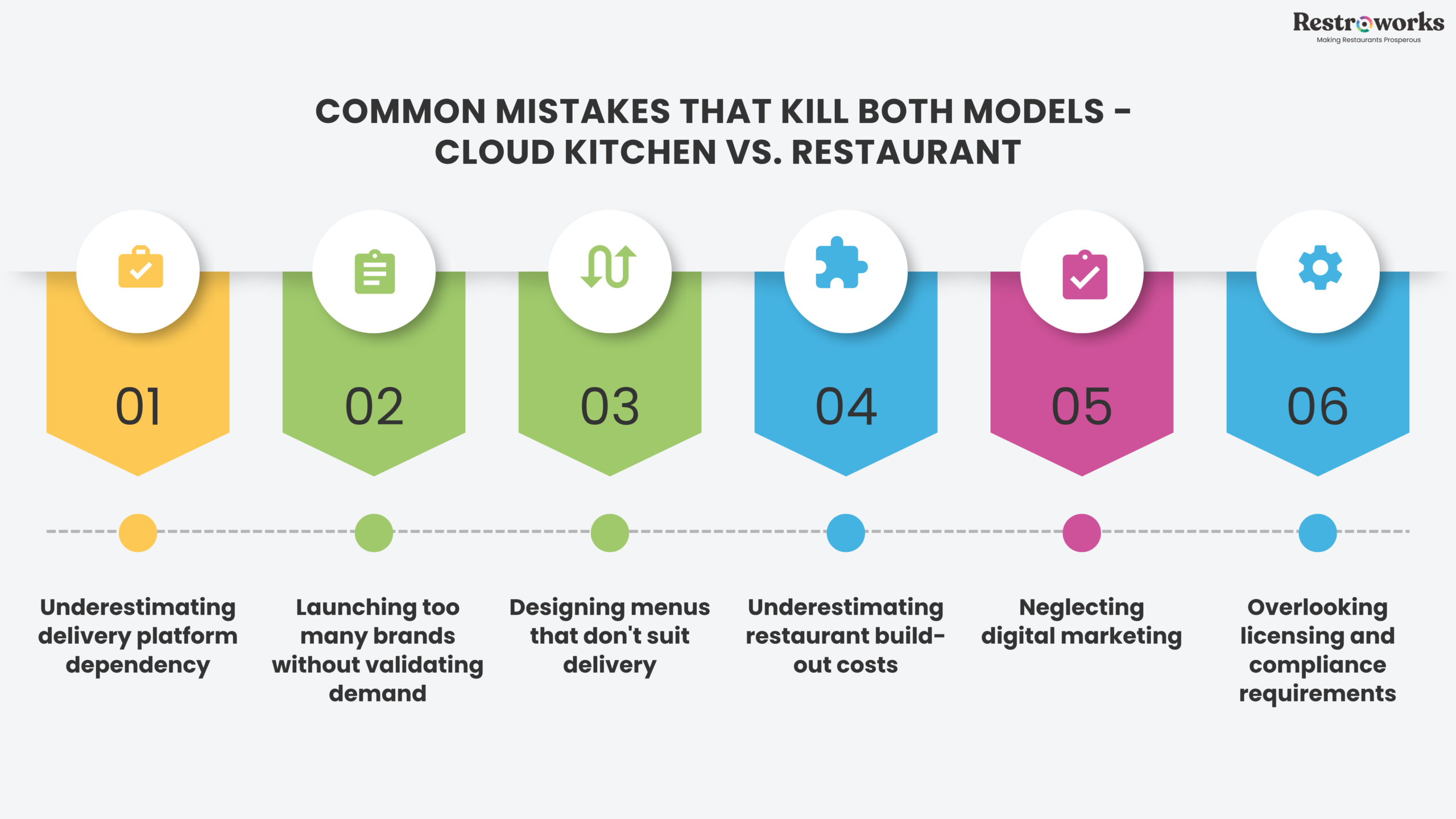
Whether you’re building a cloud kitchen or a traditional restaurant, these failure patterns are common. The common thread: each mistake is a structural problem that compounds over time, not a one-time error that can be corrected after launch.
Underestimating dependency on delivery platforms — margin ceiling locked at 70–85%
When commissions run 15–30%, only 70–85% of each order’s list price reaches the kitchen — setting a hard ceiling on achievable margins before food, labor, and rent are paid. A cloud kitchen that earns 90% of its income through third-party delivery platforms has effectively locked itself inside that ceiling. The operators building durable food businesses are creating their own direct channels (websites, apps, and loyalty programs) in addition to the platforms.
Talkin Tacos is a specialty taco restaurant in South Florida that was losing over $20,000 per month in delivery app commissions. They have since built their own direct ordering platform and now earn $120,000 monthly in direct online sales.
Third-party delivery platforms own the customer data: order history, preferences, contact information. If the platform changes its algorithm, raises fees, or suspends your listing, you lose those customers overnight. Direct ordering channels are a data ownership strategy, not just a margin play.
Launching too many virtual brands without validating demand — complexity kills execution
The idea of launching multiple restaurant brands does not translate into more revenue. Without validated demand, too many brands add complexity, increase food waste, and compromise execution quality across every brand. The KLC approach (launching each brand to fill a validated cuisine gap) is the discipline to learn from.
Before launching a second brand, validate demand in five steps:
- Analyze delivery platform search data in your zone for underserved cuisines
- Check competitor density. If more than 15 listings already serve that cuisine within your delivery radius, the market is likely saturated
- Test with a limited menu of 8–12 items for 30 days before building a full brand
- Set a minimum order threshold (100+ orders per week) to justify the added complexity
- Confirm that adding the brand does not increase ticket times for your primary brand by more than 2–3 minutes.
In saturated delivery markets like Manhattan, Los Angeles, and Chicago, hundreds of ghost kitchen brands compete for the same zones. Without paid promotion or platform-preferred placement, orders may not materialize regardless of food quality.
Designing menus for dine-in, not for delivery — 25 minutes changes everything
Food that looks great on a plate does not automatically translate to food quality after 25 minutes in a delivery bag. Food preparation and menu engineering for delivery are distinct disciplines in the food industry. The food must travel well, maintain food quality within acceptable temperature ranges, and arrive in a condition that justifies the price paid. Cloud kitchen operators with menus engineered for delivery will outperform those without.
Under FDA Food Code 2022, Section 3-501.16, the safe holding threshold is 135°F. That temperature constraint eliminates many traditional plating techniques and requires delivery-specific packaging and menu engineering.
Neglecting the total cost of a physical dining space — build-out overruns sink year one
Restaurant build-out costs in the US range from $100 to $800 per square foot depending on the space’s condition, concept complexity, and market. A 2,000-square-foot casual dining space in a second-generation location might cost $200,000-$400,000 to build out; the same footprint as a ground-up fine-dining concept can exceed $1 million.
Back-of-house construction (commercial kitchen equipment, hood and fire suppression systems, grease traps, walk-in coolers) typically accounts for 35–45% of total build-out spending, with the balance going to dining-area finishes, furniture, signage, and ADA-compliant restrooms. Owners of traditional restaurants often over-invest in front-of-house aesthetics before the kitchen is dialed in. A beautiful dining area draws first-time customers, but consistent food quality and service execution are what bring them back; those are built in the back of house, not the dining room.
Neglecting digital marketing for cloud kitchens — invisible means zero orders
A cloud kitchen without effective digital marketing strategies is essentially invisible. Unlike traditional restaurants that benefit from foot traffic and signage, cloud kitchens exist only inside delivery apps, and organic placement depends entirely on the platform’s algorithm.
The two primary paid channels are DoorDash Sponsored Listings, which use a pay-per-order model where merchants set a bid and daily budget (DoorDash reports an average return of $6 for every $1 spent, based on a study of 15,700 merchants), and Uber Eats Sponsored Listings, which use a cost-per-click model where restaurants set their own CPC bids and weekly budgets. Most cloud kitchen operators allocate $500-$1,500 per month per brand across platform ads, Google local campaigns, and social media. Without that spend, a new cloud kitchen brand in a competitive zone like Manhattan or Los Angeles may see fewer than five orders per day regardless of food quality.
Overlooking licensing and compliance differences — permits vary by state and city
Cloud kitchens in the US require a food service establishment permit, a business license, and health department approval — the same core permits as any restaurant. The difference is zoning. Many commercial zones that permit dine-in restaurants restrict or prohibit delivery-only operations. Some states require a separate commissary kitchen license for operations without a public-facing storefront.
Costs and requirements vary significantly by state and city. In California, food facility permit fees vary by county and establishment type. San Diego County, for example, charges annual restaurant permit fees ranging from $842 to $2,087, depending on employee count. Food handler card requirements and costs also vary: Riverside County charges $28 for its certificate, while San Bernardino County charges $22 for its county-specific card.
In New York City, a standard food service establishment permit costs $280 annually, plus $25 for establishments manufacturing frozen desserts. At least one supervising manager must hold a Food Protection Certificate and be on-site during operations; the in-person course and certificate cost $114, while the online course is free with a $24 exam fee. Businesses conducting activities covered by New York State’s Article 20-C food-processing rules may also need a separate license, generally costing $400 for two years, with reduced fees or exemptions available to eligible operators.
Operators adding a delivery brand often assume their existing permits cover the new operation. A delivery-only concept at a different address typically requires its own permits, inspections, and liability coverage. Most US landlords and commissary operators require cloud kitchen tenants to carry $1 million-$2 million in general liability insurance.
When Neither Model Is the Right Answer
Not all food concepts are suited for delivery-only models. If your restaurant business model relies on ambiance, service theatre, or experiences that require the patron to be physically present, then a traditional restaurant model with a proper dine-in space is non-negotiable. There are no cloud kitchens that offer this. Food entrepreneurs learn the hard way when they try to force experience-dependent concepts into delivery-only models.
If your menu economics cannot sustain 15–30% delivery fees, then the issue isn’t the model. Is it your menu pricing or your food costs? Fix these first.
Consumer behavior in the food industry has shifted permanently towards the convenience of delivery, driven by emerging food trends that aren’t going back. However, not all dining experiences have shifted. It’s the entrepreneurs who understand the nuances of these differences who build food businesses with staying power.