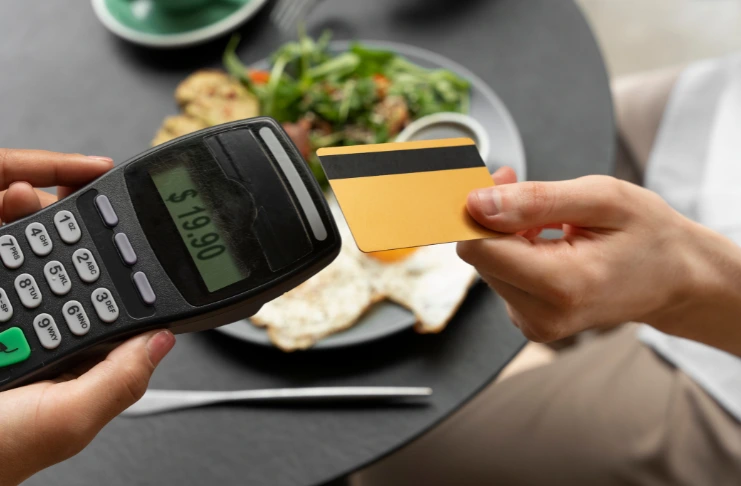

How Dine-In Restaurant Payment Behaviors Are Changing?
Dine-in payment behavior has moved steadily toward card and digital methods. The pandemic accelerated this migration, but younger diners and convenience-driven expectations have kept it in place. Restaurants are now operating in an environment where payments are a crucial aspect of service speed and flow, with card and digital payments now dominating everyday spending.
Recent industry data show a clear preference shift-
- Cards outpace cash in overall consumer payments. In 2024, U.S. consumers used credit cards for 35% and debit cards for 30% of all payments, while cash accounted for 14%.
- Restaurant guests show even stronger card preference. In one industry study, 71% of diners said they prefer paying by card in restaurants when given the choice.
- Card usage continues to rise year over year. Federal Reserve data shows card payment frequency increasing across categories, mirroring what restaurants experience at the table.
Here’s what’s driving this shift-
- Digital Comfort: Younger diners have normalized the use of tap-to-pay and mobile wallets.
- Perceived Efficiency: Faster checkout and fewer touchpoints encourage card-first behavior.
- Rewards and Tracking: Many diners choose credit cards to earn points or keep clearer spending records.
However, even as overall cash usage declines, certain segments continue to rely on it, such as
- Budget-focused diners who prefer fixed limits.
- Older consumers who maintain long-standing cash habits.
- Specific dining occasions such as quick meals or small-ticket visits.
Cash may be shrinking, but it remains a meaningful choice for groups that value control, familiarity, or simplicity, and this preference shapes how restaurants manage payment workflows.
Cash vs Credit Card Dine-In Restaurant Statistics: How Do Customers Pay?

Understanding diners’ preferred payment methods is critical for restaurants designing service workflows, staffing models, and checkout experiences. The following breakdown highlights where cash, cards, and digital payments stand today based on current research and restaurant industry data.
A. Share of Payment Modes
- In U.S. restaurant spending, credit card payments accounted for $29.8 billion in restaurant sales, compared with $25.3 billion for debit cards in 2022, underscoring how card-based transactions lead the sector’s revenue mix.
- Credit and debit card payments together accounted for over 42% of total transaction value in the global restaurant payments market in 2024, underscoring the predominance of card-based revenue globally.
- U.S. businesses, including restaurants, paid over $172 billion in swipe fees and credit card processing fees in 2023.
- Cashless payments accounted for 62% of all transactions in the U.S. in 2024.
B. Credit vs Debit Card vs Cash Usage Patterns in Food-Service
- 37% of diners reported paying at restaurants with a debit card, while 33% used a credit card to do so.
- 79% of U.S. consumers prefer contactless or mobile payments when dining out, indicating that a large majority of restaurant spending now flows through tap-to-pay or wallet methods when available.
- In full-service settings, 62% of customers would use contactless or mobile options, and 57% specifically said they would use a digital wallet such as Apple Pay or Google Pay.
- QR code payments are also growing steadily, with 46% of US adults choosing the option to pay the check on their smartphones using a QR code.
C. Rise of Contactless Payments

- Digital and contactless options are rapidly expanding as alternatives to traditional card swipes or cash. Restaurants increasingly support mobile wallet and QR code payments to meet guest expectations.
- The global contactless payments market is expanding rapidly, projected to grow from $34.55 billion in 2021 to $164.15 billion by 2030 at a 19.1% CAGR.
- By 2023, contactless payments made up for 25% of all card transactions across industries, an impressive increase from just 3% in 2017.
- 73% of diners tend to tip more when they use a digital platform to settle the bill instead of cash.
E. Digital Wallet Preferences
- By 2025, mobile wallet transaction volume is projected to surpass $10 trillion globally.
- 57% of diners using mobile payments prefer Apple Pay or Google Pay, making them the dominant digital wallet options in restaurants.
- Mobile wallet usage in hospitality grew 40%+ year-over-year between 2022 and 2024.
- Among digital wallet users, over 60% cite speed as the main reason for adoption in restaurants.
EXPERT OPINION
Demographic Breakdown: Who Prefers Cash, Cards, or Digital Wallets?
Age, income, geography, and cultural exposure to digital tools all influence how diners choose to pay, and those differences often explain why certain payment modes perform better in specific locations or service formats.
- 66% of Gen Z diners use digital wallets in restaurants or POS systems, making them the most mobile-friendly generation.
- A 2022 study found 54% of Gen Z shoppers prefer contactless payments, while only 22% prefer cash.
- Older generations use cash at a notably higher rate than younger generations, with individuals 55+ more likely to use paper money than younger cohorts.
- By age 25, around 73% of Americans own a credit card, making it the most common source of spending for young adults.
- 60% of higher-income individuals make none of their typical weekly purchases in cash.
- Lower-income adults with household incomes under $30,000 are more likely to use cash for most purchases (about 30% use cash for nearly all transactions).
How Do Customer Payment Preferences Shape the Dine-In Experience?

Payment choice directly affects how fast tables turn, how much staff time is tied up in end-of-meal steps, and how predictable reconciliation becomes. Here’s how-
- Checkout speed varies significantly by payment method
Contactless and card-based payments move guests through the final step of service faster than cash transactions, reducing the back-and-forth between staff and tables. Cash adds extra time for counting, tendering change, and resolving discrepancies, which can slow closing stages during busy service periods. A faster checkout flow also reduces perceived wait times for guests waiting to settle their bill.
- Staff workload changes based on the dominant payment type
Handling a high volume of cash requires more touchpoints, which include collecting bills, confirming denominations, organizing change, and securing tills. Card and digital payments streamline these steps, allowing servers to focus more on tables rather than cash-handling tasks. In restaurants with high card or contactless usage, service teams can manage more tables with less friction.
- Reconciliation becomes simpler with card and digital payment modes
Cash-driven operations spend more time balancing drawers, preparing deposits, logging variances, and conducting end-of-day audits. Card and digital transactions settle automatically, reducing manual work and lowering the margin for human error. This efficiency compounds during peak periods or in multi-shift environments.
- Cash-handling carries operational risks
Counting errors, counterfeit bills, and misplacement can add risk and administrative burden. That said, digital payments introduce their own challenges, such as occasional terminal connection issues or input mistakes, but these tend to be less frequent and easier to correct than cash-related discrepancies.
- Table turnover and guest satisfaction improve with frictionless payments
Restaurants that support faster payment methods often see smoother table transitions and more predictable pacing across the dining room. When guests don’t experience delays at the end of their meal, overall satisfaction scores rise, and staff can reassign tables more efficiently during high-demand periods.
Restaurant Customer Motivations: Why Diners Choose Cash, Cards, or Digital Wallets

Diners choose a payment method based on what they value most at the end of a meal—speed, control, convenience, or reassurance. These motivations shape whether they reach for cash, a card, or a digital wallet.
Motivation 1: Convenience and Speed
Guests who prioritize a quick, low-friction checkout gravitate toward cards and digital wallets. Tap-to-pay, stored cards, and mobile wallets eliminate back-and-forth with staff and shorten the time between finishing the meal and leaving the table. For many diners, especially younger ones, convenience outweighs any attachment to traditional payment methods.
Motivation 2: Budget Control and Spending Awareness
Some diners prefer a method that sets a clear spending boundary. Cash supports this mindset because the physical limit encourages intentional ordering and discourages unplanned add-ons.
Guests who manage tight budgets, split meals carefully, or prefer fixed spending often choose cash because it offers immediate visibility and helps prevent overspending.
Motivation 3: Trust, Familiarity, and Reassurance
Payment preference is influenced by how comfortable diners feel with the method itself. Older guests or ithose less engaged with digital tools often stick to cash due to familiarity.
Others prefer cards because they trust built-in protections, such as fraud monitoring or dispute resolution. The reassurance of a secure, traceable transaction can be a decisive factor.

Motivation 4: Rewards, Tracking, and Financial Organization
71% of diners choose credit cards for restaurant payments because they connect payment to broader financial goals, such as earning rewards, maintaining digital records, or streamlining monthly budgeting. For frequent diners, the ability to accumulate points or cashback makes card payments more attractive than cash or digital wallets.
Motivation 5: Device-First Lifestyles and Post-Pandemic Habits
Diners who default to their phones throughout the meal naturally prefer digital wallets. This group values fast, contactless interactions and sees mobile payment as an extension of everyday behaviour. Post-pandemic hygiene awareness only strengthened this shift, making touch-free payment feel cleaner and more intuitive.
Tipping Patterns Across Cash, Card, and Digital Payments
Tipping behaviour in restaurants changes materially based on how guests pay, as it determines their perspective of the checkout process at the restaurant.
Cash introduces friction and limits, as diners are constrained by what they have on hand and often round tips based on denominations. With card and digital payments, diners make a proportional decision instead of a fixed one, choosing a percentage relative to the bill rather than a remaining amount in their wallet.
Digital payment flows further influence this choice by presenting default tip ranges, which anchor expectations and reduce the likelihood of skipping a tip altogether.
For restaurants, these mechanisms affect not only average tip values but also how earnings are distributed to staff and the accuracy of end-of-day reporting.

The statistics below show how these behavioural differences play out across cash, card, and digital payment methods-
- As of early 2025, the average tip at full-service restaurants in the U.S. was about 19.4% when guests paid by credit card or digital payment methods.
- In the same dataset, the average tip at quick-service restaurants was 15.8% when guests used card or digital payments.
- According to a 2025 trend report, 75% of full-service restaurant diners tipped using a card or digital payment, compared with about 49% at quick-service restaurants.
- 64% of American diners tip at leasy 10% more when paying digitally instead of cash.
- A survey measuring tipping fatigue found that 66% of consumers feel pressure to tip when prompted by a digital payment screen, especially when the server is present.
- However, cash is still the go-to method of transaction for many, with 26% of people using cash while dining and 29% using it for tipping.
How Can Restaurants Ensure Security and Compliance Across Payment Modes?

While offering flexible payment methods allows your restaurant to meet varying customer preferences, each method also brings with it certain operational risks. As restaurants handle a mix of cash, cards, and digital payments, understanding how risk differs across each mode helps you decide where control matters most-
1. Limit Exposure to Card Fraud
Card payment fraud continues to grow in absolute dollar terms, reinforcing why proactive controls matter. According to the Nilson Report, payment card fraud losses worldwide reached approximately $33.83 billion in 2023, and that figure is on track to grow as transaction volumes rise.
This has direct operational implications for restaurants: even if fraud events in dine-in settings are less frequent than online, the sheer scale of underlying card fraud means that every terminal, POS integration, and payment flow must follow strong security practices to reduce risk.
This includes adhering to EMV standards, implementing tokenisation, and ensuring secure connections.
2. Prepare for Chargebacks Early
Chargebacks occur when a cardholder disputes a transaction, often due to suspected fraud, unrecognized charges, or service-related complaints.
While they are less common in dine-in restaurants than in online commerce, chargebacks still represent a security risk because repeated disputes can signal weak controls and increase scrutiny from payment networks.
For restaurants, the most effective defence is prevention through accuracy and traceability. Clear itemized receipts, correct timestamps, consistent tipping records, and verifiable transaction data reduce the likelihood that disputes escalate or are ruled against the merchant.
3. Control Cash-Related Losses
Unlike card risk, cash losses are entirely internal and irreversible. Theft, miscounts, and handling errors directly reduce revenue and often go unnoticed until reconciliation.
4. Standardize Compliance Across Payment Types
Compliance requirements differ sharply between card and cash payments. Card transactions rely on PCI DSS standards, which are largely procedural and easier to scale once implemented. Cash, by contrast, depends on day-to-day discipline, such as drawer controls, audits, and deposit accuracy.
Conclusion
The data shows a clear shift in how diners settle their bills, with credit cards now accounting for a larger share of dine-in spending while cash continues to decline. Cards influence not only how often guests pay, but how much they spend, how they tip, and how transactions are tracked.
Cash, meanwhile, still plays a role for specific guest segments and operating models. For restaurant owners, the focus shouldn’t be on choosing one over the other, but understanding where each payment method performs best and planning systems, controls, and service flows accordingly.