
What’s Driving Fast Food Startup Costs in 2025?
The cost of a fast-food startup in 2025 is being influenced by various factors: tighter competition for small, high-traffic spaces, expectations for higher efficiency in the kitchen, and the need for more reliable supply chains.
Understanding these drivers up front helps you budget based on how your operation will actually run.
1. Location Demand and Changing Real Estate Patterns
High-footfall spaces have become harder to secure, especially smaller units that suit fast-food formats. Landlords are filling vacancies faster, and operators are competing for sites that support both walk-in and delivery traffic.
This shift affects not only rent but also build-out timelines, utility access, signage approvals, and layout flexibility.
2. Higher Expectations for Efficient Kitchen Operations
Fast-food kitchens now need to support faster prep times and consistent output during peak hours. That pushes operators toward equipment that heats quickly, holds more accurately, and uses energy more efficiently.
These upgrades improve speed and consistency, but they also increase upfront costs and influence the electrical, ventilation, and space requirements of your kitchen.
3. Complex Menus
Your menu is now one of the biggest cost drivers. A focused menu reduces prep areas, refrigeration capacity, and the number of cooking stations.
A broader menu, with multiple proteins, fry items, specialty sauces, and baked components, requires more equipment, more storage, and a more involved workflow. This directly changes the size of the kitchen and the equipment budget you need to allocate.

4. Staff Training Requirements
Staff of a fast-food restaurant are expected to be more cross-trained and consistent from day one. This means restaurant owners need to budget for structured training time before opening, and not just wages during the first week.
Your staffing model also affects equipment choices, as the more cross-functional your team is, the more you rely on equipment that supports speed, accuracy, and simplified workflows.
5. Higher Utility Infrastructure Requirements
Fast-food kitchens now require stronger electrical load, improved ventilation, and better grease-management systems to support modern equipment.
These upgrades directly affect your startup budget because they determine how much you’ll spend on electrical rewiring, hood installation, plumbing adjustments, and HVAC support. Even in small footprints, utility readiness can become one of the most expensive parts of the build-out.
INDUSTRY INSIGHT
Fast Food Business Startup Costs: Key Investments
Fast-food startups carry a distinct cost structure because the model depends on speed, consistency, and high-volume output from day one. On average, opening a fast food restaurant in the US requires investment ranging from $300,000 to $1 million+.
Understanding these cost pillars early helps you build a strong and financially viable business. Here are the major upfront costs relevant to a fast food restaurant business-
1. Location and Space Setup

Location decisions set the foundation for your entire startup budget. Lease terms, site conditions, and the amount of work required to make the space kitchen-ready will determine how quickly your costs climb.
Fast-food concepts have to focus on high throughput, which means the right site must support ventilation, utility load, workflow, and customer access from day one.
A. Site Selection Costs
Securing a fast-food location now comes with tighter competition and higher expectations around visibility and convenience. As a result, costs start stacking before any construction work begins.
Key cost drivers for location include-
- Lease rates in high-traffic areas versus lower-density community locations
- An average QSR restaurant establishment is often 1,000-2,000 sq. ft., depending on menu and service model
- Upfront commitments such as security deposits, advance rent, and brokerage or legal fees
- Site condition, which determines how much you’ll need to invest in utility readiness and kitchen conversion
In many U.S. markets, initial lease and deposit costs for small fast-food formats might range from $10,000 to $30,000 as lease deposits and about $5,000-$15,000 as monthly rent. A prime site can reduce long-term marketing costs and improve daily volume, but it requires a larger initial budget.
On the other hand, smaller locations may have lower rent but may need more investment in parking, delivery access, or exterior signage.
B. Build-Out, Renovation, and Compliance
Transforming a raw or outdated space into a fast-food-ready operation carries significant technical requirements. Most of your spending goes into systems that support speed, safety, and consistency.
Typical build-out components include-
- Ventilation and hood systems sized for fryers, flat-tops, and high-heat equipmen
- Fire suppression setups, plumbing adjustments, and upgraded electrical capacity
- Front-of-house finishing, if you offer dine-in seating, such as floors, lighting, counters, and customer flow design
- Regulatory compliance, including health department approvals, ADA alignment, and exterior signage permissions
Build-out costs vary widely depending on whether you’re modifying a former restaurant or starting from a cold shell, and can cost about $150,000-$450,000.
2. Kitchen Equipment
Equipment choices shape both your upfront investment and how smoothly your kitchen performs once you open. Fast-food operations depend on speed, consistency, and high output, which means you’re budgeting for gear that can handle volume without compromising food quality.
Whether you’re designing a compact cook line or a full production kitchen, equipment becomes one of the largest capital expenses in any fast-food startup budget.
A. Essential Cooking Equipment
A fast-food kitchen relies heavily on high-heat, high-throughput equipment. These items form the core of your capex and directly influence your electrical, ventilation, and layout requirements.
Typical equipment costs include:
- Commercial fryers: Usually $2,000-$30,000 per unit, depending on capacity and filtration features.
- Flat-top grills or griddles: $1,500-$6,000
- Ranges or cooklines: $2,000-$12,000+, depending on size and configuration.
- Refrigeration and prep tables: $,1000-$15,000 per unit, depending on doors, drawers, and capacity.
These items determine how fast your kitchen moves during peak hours and how much space and utility load you’ll need.
B. Food Prep, Storage, and Holding Equipment
Beyond the hot line, fast-food operations need reliable cold storage and holding capacity to maintain consistency and reduce bottlenecks.
Key cost drivers include:
- Walk-in coolers or freezers: Often $10,000-$30,000+, depending on size and whether installation is included
- Reach-in coolers/freezers: $2,000-$6,000 per unit
- Heated holding cabinets or warming drawers: Typically $1,200-$5,000 depending on volume and configuration
These systems support batch prepping, faster assembly, and steadier service during rush periods.
C. Technology and Back-of-House Equipment
Even without naming platforms, every fast-food kitchen now depends on basic digital tools that streamline ordering, prep visibility, and labeling.
Common technology investments include:
- POS hardware (terminals, card readers, cash drawers)
- Kitchen display screens for order flow management
- Label printing systems for prep, holding, and packaging
- Networking and installation for your back-of-house setup
- Basic inventory or scheduling tools
Technology doesn’t replace labor in fast food, but it reduces errors, speeds up prep, and supports consistent output.
3. Licensing, Permits, and Regulatory Approvals

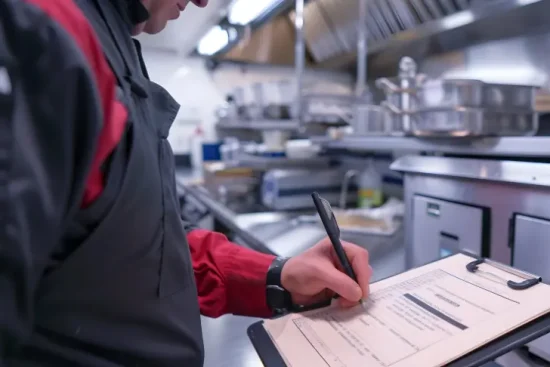
Fast-food operators have to apply for a set of licenses and inspections before opening, with each one carrying both direct fees and indirect costs tied to timelines.
These requirements vary by state and city, but they’re unavoidable. Budgeting for these early approvals ensures you don’t run into delays or last-minute expenses as your build-out progresses.
A. Core Licenses
Every fast-food operation needs baseline approvals to legally prepare and serve food. These are typically the first items you secure and the ones that determine how quickly you can move into inspections.
Typical requirements include:
- Business license: Generally $50-$500, depending on jurisdiction.
- Food service license: Often $100-$1,000+ based on seating capacity and service type.
- Health department certificates: Pre-opening inspections and certifications usually total $200-$1,000.
- Fire safety inspection: Fees range from $100-$500, but required changes can add to the budget.
These approvals confirm your operation meets the minimum requirements for food handling, ventilation, sanitation, health and safety standards, and fire safety.
B. Additional Approvals
Beyond core licenses, fast-food concepts often need secondary approvals that depend on your layout, menu, or guest-facing elements.
Common additional costs include:
- Signage permits: Typically $100-$1,000, plus fabrication and installation costs.
- Music licensing: Around $250-$500 annually.
- Waste management setup: Onboarding fees for garbage, recycling, and oil/grease pickup often run $200-$1,000+, depending on the vendor and frequency.
These approvals help finalize your storefront, workflow, and compliance obligations before moving into final inspections.
4. Labor and Training Costs
Labor is one of the earliest—and most important—investments in a fast-food startup. You begin spending well before opening day because your team needs time to learn the menu, understand prep standards, practice service flow, and get comfortable with equipment and safety requirements.
Pre-opening payroll typically includes recruitment time, hourly wages during training, and the management hours spent building checklists, refining workflows, and setting operating procedures.
Most small fast-food concepts start with a compact team that can handle high-volume service without adding unnecessary payroll pressure. Core roles usually include:
- Shift supervisors to handle daily oversight, line checks, and team coordination
- Cooks are responsible for the hot line and batch prep
- Assemblers or packers who keep the speed high during peak periods
- Cashiers or order takers for counter service or handheld ordering
- Drive-thru staff, if the format includes a drive-thru lane
Your total labor costs will vary based on local wages and how long the training period runs, but you should expect at least 2-4 weeks of payroll before generating revenue.
5. Opening Inventory, Packaging, and Supplies
Your first month of inventory sets the baseline for food quality, consistency, and workflow. Fast-food concepts move high volumes from day one, which means opening with the right mix of ingredients, packaging, and prep supplies is essential.
Unlike build-out and equipment costs, these are recurring, fixed monthly expenses, but your initial stocking order is larger, and it needs to account for training, soft-launch periods, and early demand fluctuations.
A. Initial Raw Ingredient Inventory
Fast-food menus rely heavily on core proteins, frozen items, sauces, buns/tortillas, produce, dry goods, and prepped components. Operators typically budget for 2-4 weeks of inventory for launch, depending on menu breadth and expected volume.
Typical opening inventory range:
- Small, focused menus: $4,000-$12,000
- Multi-category menus (fried items, sandwiches, sides, beverages): $10,000-$25,000+
B. Packaging and Disposables
Packaging is a major cost driver for fast-food operations, especially for concepts with heavy takeout and delivery demand.
Common packaging costs include:
- Branded or high-quality containers
- Portion cups and sauce containers
- Bags, wraps, liners
- Napkins and cutlery
Operators typically spend $2,000-$8,000 on their opening packaging load, with eco-friendly or custom-printed options landing on the higher end.
C. Smallwares and Prep Supplies
These are the tools the kitchen relies on every day, items that aren’t equipment but are critical for prep and assembly.
Typical needs include:
- Knives, cutting boards, prep tools
- Sheet pans, trays, tongs, ladles, scoops
- Storage containers and labels
- Cleaning and sanitation supplies
Opening orders for smallwares generally range from $1,500-$6,000, depending on the size of the team and the complexity of the menu.
6. Marketing, Branding, and Launch Campaign Costs

The marketing budget for a fast-food startup is tied to how quickly you want to build recognition and steady foot traffic. You’re creating a brand customers can identify instantly, preparing the neighborhood for your launch, and running a focused campaign that brings in volume during the first weeks.
These costs sit alongside your build-out and equipment spend, but they play a different role. They help you convert early visibility into paying customers. Key investments typically include:
- Brand identity and visual assets: Logo development, menu board design, in-store signage, exterior branding, and staff uniforms.
- Pre-launch marketing: Local outreach, printed materials, digital ads, community tie-ins, and early awareness efforts.
- Grand opening activity: Introductory offers, sampling, limited-time items, and launch-week promotions to drive trial and repeat visits.
A well-planned launch budget ensures people know who you are, what you serve, and why they should visit during your first month, a period where momentum matters most.
How to Reduce Startup Costs Without Cutting Quality?

Many fast-food operators assume most startup expenses are fixed, but several early decisions can meaningfully lower your budget without affecting output, consistency, or service speed.
Here are a few tips for fast food restaurants to manage their initial costs without compromising on efficiency-
1. Lease Second-Generation Spaces
Second-generation spaces, which are locations previously used as restaurants, offer the fastest and most cost-efficient path to opening. Much of the expensive infrastructure is already in place, allowing you to focus your budget on improvements rather than full construction.
Cost-saving advantages include:
- Existing hood systems and ventilation that reduce mechanical installation costs
- Pre-installed plumbing lines and restrooms that limit demolition and utility work
- Electrical capacity designed for kitchen equipment, avoiding costly upgrades
- Shorter build-out timelines that reduce rent paid before opening
- Lower design and permitting costs due to an already restaurant-ready layout
2. Streamlining Menu Design
A focused menu lowers startup costs by reducing equipment needs, prep complexity, and the amount of inventory required to launch. It also shortens training time and improves early execution when your team is new.
With a more streamlined menu design, you can reduce costs through-
- Fewer cooking stations mean fewer high-heat equipment purchases
- Less refrigeration and storage space required
- Smaller batch prep reduces opening inventory costs
- A simplified workflow shortens the training period
- Lower ongoing waste during the ramp-up phase
3. Lease or Buy Refurbished Equipment
Not every piece of equipment needs to be purchased outright. Strategic leasing or selected refurbished purchases can significantly lower upfront capital requirements while still giving you reliable performance.
Practical cost benefits include:
- Reduced initial cash outlay for high-ticket items like refrigeration or cook lines
- Ability to upgrade equipment later without a large replacement cost
- Manufacturer-backed warranties on refurbished units
- Flexibility to scale or adjust equipment as your menu evolves
- More capital available for build-out, marketing, or opening inventory
4. Efficient Labor Modeling
Building a cross-trained team early helps control both payroll and training expenses. With fewer, more capable team members, you maintain speed and consistency without carrying unnecessary labor at opening.
Ways smarter labor planning cuts early costs:
- Lower total headcount during the first weeks of operation
- Shorter training periods due to simpler workflows
- Fewer supervisors required when roles overlap effectively
- Reduced risk of errors or rework during early service
- Ability to scale staff gradually as sales stabilize
5. Phased Tech Implementation
A phased approach to technology keeps your opening budget focused on the essentials needed for daily operations. Additional features can be added once revenue stabilizes and workflows become predictable.
Benefits of a phased tech plan:
- Lower upfront tech investment during the build-out phase
- Simpler system training for new staff
- Less hardware required at launch
- Ability to add features based on real operational needs
- Flexibility to scale systems without unnecessary early spend
Conclusion
Opening a fast-food business in 2025 comes down to understanding where your money needs to work hardest. From the space you choose to the equipment, labor, and inventory you invest in, each decision shapes how quickly you can operate with confidence.
If you approach these costs with a clear plan—one built around your menu, workflow, and expected volume—you set yourself up for a smoother launch and fewer surprises in the first months.