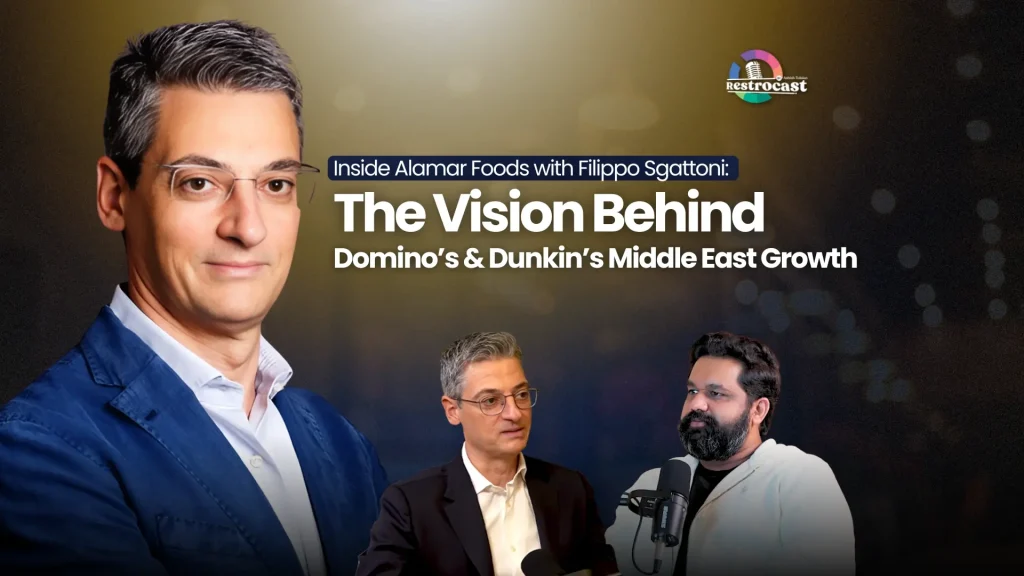

From a small Italian coastal town to leading Alamar Foods, the master franchisee of Domino’s and Dunkin’ across the Middle East, Filippo Sgattoni’s story is one of curiosity, adaptability, and leadership evolution. A finance professional who grew into a business operator, Filippo has spent decades navigating different cultures, industries, and markets. In this conversation with Ashish Tulsian, CEO of Restroworks, he reflects on the milestones that shaped his journey from his formative years at Autogrill to building a modern, youth-driven food empire in Saudi Arabia and beyond.
Filippo, you’re leading Alamar Foods, the company behind Domino’s and Dunkin’ in the Middle East but your journey didn’t begin in restaurants. You started in finance. How did that evolution happen?
Filippo Sgattoni:
Yes, I come from a finance background, but I’d say a very unique one. I spent around 17 years with Autogrill, which at that time was the largest food service operator for travelers, serving people on motorways, in airports, and train stations.
That experience allowed me to combine my financial skills with a deep understanding of operations and customer behavior. I was always curious about food, retail, and business, and Autogrill gave me the opportunity to be close to the action to influence decisions and test ideas using numbers, not just to record them. That’s how my transition from pure finance to business leadership began.
I’ve always believed that while starting a business might be an art, scaling it is a numbers game. People from finance often excel at leadership because they understand the logic behind sustainable growth. Do you agree?
Filippo Sgattoni:
To some extent, yes, but with a caveat. Having a strong financial background is an advantage, but it can also become a limitation if it’s too rigid. Financial people are naturally risk-conscious. If that dominates your decision-making, it can hold back growth.
You can’t run a company only from an Excel sheet. Just like a car, the engine must be efficient, but the design and driving experience matter too. Operations and financial discipline are important, but so are customer experience and emotion.
That’s why a leader must learn to balance the known and the unknown, the numbers with intuition. If you’re turning around a struggling company, being data-driven helps. But once the company stabilizes and is ready to grow, the leader must shift gears, becoming more open to experimentation and creativity.
So you joined Autogrill just when tech and systems were transforming business. How did that shape your career?
Filippo Sgattoni:
Completely. Autogrill was expanding aggressively, acquiring companies across Europe and the US, including HMS Host. I grew with it, moving from Italy to Spain, the Netherlands, Germany, and beyond. I was often the first Italian assigned to new acquisitions, responsible for integrating systems, cultures, and teams.
Those years taught me adaptability, cultural intelligence, and how to lead diverse teams effectively. I learned that true leadership starts with understanding how people think and work.
At what point did you feel you were developing that business muscle, moving from being a finance professional to a business operator?
Filippo Sgattoni:
It happened in the Netherlands when Autogrill was expanding into new markets like Sweden, Denmark, and Ireland. Working under Walter Seib, who fully empowered me, I learned to lead by solving problems, not by title.
I remember being sent alone to Ireland to open operations in Cork Airport. We had to transition staff from the old terminal to the new one overnight. It was chaotic, but it taught me how to make fast decisions under pressure and take calculated risks, even unconventional ones.
That’s a defining moment for sure. So, how did your move to Saudi Arabia and Alamar Foods come about?
Filippo Sgattoni:
After nearly twenty years at Autogrill, I wanted a new challenge and faster growth. In 2015, a headhunter approached me for a CFO role in a Middle Eastern food company, Alamar Foods. At that time, little was known about Saudi Arabia, but learning that Carlyle was an investor gave me confidence. A trusted contact in Dubai told me the AlJammaz family was solid and reputable.
When I met Mr. Ibrahim AlJammaz, we instantly aligned on vision and values. I joined Alamar Foods on October 15, 2015, just a day after my birthday, feeling I had found the right place and the right partner for the next chapter.
Saudi Arabia in 2015 must have been very different from what it is today. What was that transition like?
Filippo Sgattoni:
Yes, it was very different, much less open than today. But I never saw it as a challenge. My experience across Europe had taught me to look for touch points, not differences.
Between Italy and Saudi Arabia, there are many similarities; both are family-oriented societies, religion plays a key role, coffee culture is strong, and relationships matter deeply. By focusing on similarities, I could build trust faster.
Cross-cultural adaptability has been one of the most valuable lessons of my career. Wherever I go, I start by finding those bridges; they make everything easier.
What KPIs or operating assumptions did not translate well for Saudi and the wider GCC?
Filippo Sgattoni:
Productivity metrics were less meaningful. Labor is almost entirely full-time, overtime is minimal, and manpower has historically been inexpensive. Cost structure leaned heavily fixed, not variable. When I arrived in 2015, companies tended to overstock because everything was imported. The system was built with redundancy to prevent supply interruptions. That made sense historically, but it tied up cash and inflated working capital.
Taking over from a founder is never simple. What mindset shift helped you step into the CEO chair?
Filippo Sgattoni:
Mindset first. I asked myself what the new normal is. Look at the ten largest US listed companies by market cap. Founders often remain deeply involved. You probably do not know the CFO’s name at Tesla or Google, but you know the founder. Accepting that reality avoids frustration. Second, I did a self-assessment of my gaps. I knew Saudi and the GCC better than before, but there was still a lot I did not know about family networks and how big groups operate. In the GCC, many families empower executives but retain control, partly because expat tenures are uncertain. If you accept these truths, you can engage productively. It does not remove every frustration, but it gives you solid footing.
When did Alamar go public, and how did life change as a public company CEO?
Filippo Sgattoni:
We listed in August 2022. Life changes. There is a new workload around investors and analysts. Numbers are public, good or bad, and the family is more exposed, so reputation management matters even more. Above all, I feel accountable to shareholders who invest their savings. The agenda also changes. Investor relations and potential inorganic opportunities take meaningful time.
You operate two of the world’s most iconic brands. How are you thinking about Gen Z and Gen Alpha who do not share millennial and boomer nostalgia for Domino’s and Dunkin’?
Filippo Sgattoni
We need a double effort in this region. The population is young, and society is changing fast. Engagement must be authentic and not only transactional. Talk to their minds and hearts, not just their wallets. In Saudi this month there is the eSport Wargamer event. Gamers are a new audience. We are testing how to engage, sometimes even by doing something free. One idea is to host an e-team training inside a store to build community. We are also engaging women differently. For example, we sponsored the first female driver to compete in the Paris Dakar. Do not position women only as mothers or wives. Recognize their expanded roles in society.
How much room do you really have to adapt a legacy brand like Domino’s? There are clear guardrails from the franchisor. Yet you have to fit a new country and a new time. What have you actually changed on the ground that most people would not expect?
Filippo Sgattoni:
There is meaningful flexibility, with the right approvals. New product development has space. If you look at other large Domino’s markets like Australia, you will find categories beyond pizza such as burgers, sandwiches, and pasta. We took a similar spirit and worked with a local chef to launch a dates pizza. Some guests treat it like dessert, others as a different style of pizza. Flexibility also exists in formats. You can open with a full menu or a tight, single-size offering if the site demands speed.
How do you square all this with very different consumer economics between countries you operate in?
Filippo Sgattoni:
We operate in markets with very different purchasing power. Egypt is not Saudi. Currency realities differ. The system must keep us affordable and profitable at the same time. Domino’s is like an open-source ecosystem. We learn from other countries and they learn from us. The Middle East adds unique ingredients: a young demographic and fast social change. Only a few regions like China or parts of the Far East are comparable in pace.
I heard you experimented with food trucks. Is that real, and what is the purpose?
Filippo Sgattoni:
Very real. The key is to define the purpose clearly.
- Events: Trucks let us join large gatherings with a compact footprint.
- Seasonal stores: Think beach zones like Jumeirah or Egypt’s North Coast.
- Refurb continuity: If a store closes for renovation, a truck preserves traffic.
- Market test: In fast-growing cities like Riyadh or Jeddah, a truck can probe a new neighborhood before committing to a lease.
One asset. Multiple jobs.
What has changed in you over the last decade as a leader?
Filippo Sgattoni:
Coaching helped a lot. Mr. Ibrahim invested in four years of one-to-one coaching for me, plus a week at Stanford. I had high energy that needed channeling to fit a new culture and more complex interpersonal dynamics. Today I prepare mentally before tough meetings, manage emotions better, listen to learn rather than only to fix, and ask different questions. In public forums I aim for a calm tone that harmonizes ups and downs. Leaders cannot be impulsive. They must provide clarity, consistency, and resilience.
Conclusion
From managing spreadsheets to steering a multinational enterprise, Filippo Sgattoni’s story is a testament to growth through self-awareness and adaptability. He sees leadership as a balance between data and instinct, tradition and innovation, global standards and local culture. Under his guidance, Alamar Foods continues to redefine how legacy brands like Domino’s and Dunkin’ stay relevant in a region and an era that’s changing faster than ever.