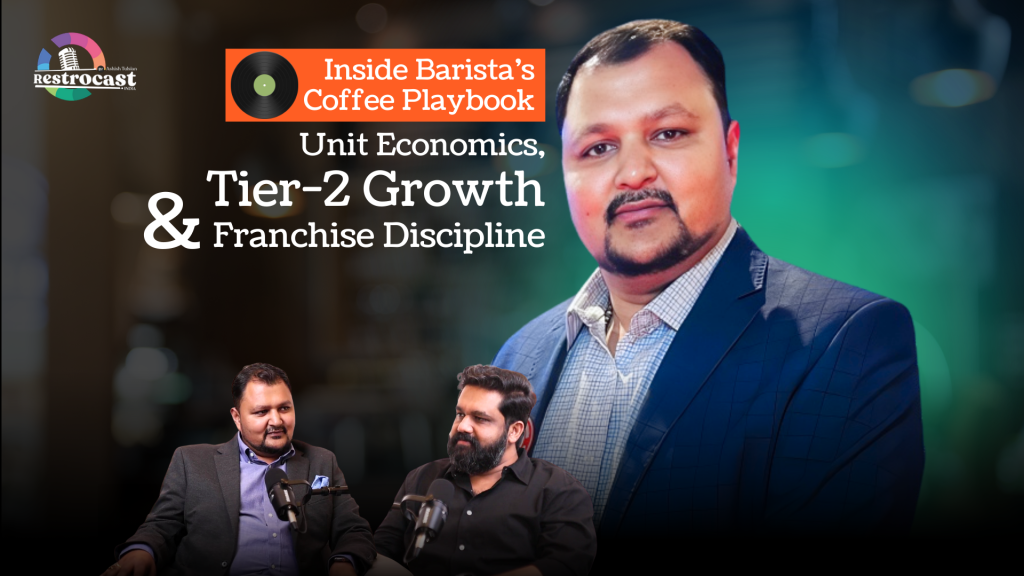

India’s café scene is growing fast, but running a successful café takes serious discipline. In this conversation, Barista CEO Rajat Agrawal shares his journey from being a chartered accountant to leading a café chain. He talks about why strong systems matter more than hype, how tier-2 and tier-3 cities are driving growth, and how their franchise model keeps things running smoothly.
Rajat, my thesis is that nobody really enters the restaurant industry with a plan. People fall into it almost by accident. What’s your story? How did you get into this business?
Rajat Agrawal: You’re absolutely right, Ashish. Most restaurateurs never plan this journey. I’m a chartered accountant by training. During my CA days, I never imagined I would be running a café chain. I worked in global consultancies, mainly on the M&A side. In 2014, while working on an F&B business acquisition, I got involved in handling the operations as part of the post-M&A process. The agenda was simply to sanitize the business, put teams in place, and hand it over. But I got engrossed, and here I am, 11 years later, still running the business.
So what’s Barista about today? Can you share the scale and size of the business?
Rajat Agrawal: When we took over from Lavazza in 2014, Barista had about 120–130 outlets. Today, we operate over 480 stores, making us India’s largest homegrown café chain, with a presence in Sri Lanka and plans for other markets. But this journey wasn’t just about growth. The first 2–3 years were about stabilization. We realized F&B wasn’t the high-margin, high-return business people imagined. We had to prioritize processes over chasing outcomes. That philosophy helped us sustain and scale. I’m proud to say we’re the only coffee chain in India that’s consistently profitable.
That’s impressive. What was your approach that made the business turn profitable when it had never?
Rajat Agrawal: From 2000 to 2014, Barista never made money. We only became profitable in 2017. Initially, I spent a considerable amount of time on the ground, learning everything from the bottom up. While everyone focused only on customer experience, I felt strongly that commercial value had to be tied to that experience. My CA background helped. We built processes around financial discipline, menu economics, and sustainability. Learning by doing was my mantra. That’s how we created a meaningful and profitable enterprise.
Did you notice that many “veterans” of retail and cafés struggled when it came down to commercial realities?
Rajat Agrawal: Yes, I did. People from large enterprises tend to focus on scaling quickly, but our intent was different; we wanted stable, sustainable growth. Changing that mindset isn’t easy. Since I had no prior retail experience, I didn’t carry that baggage. I had to learn everything in-store: front of house, back of house, customer experience. That ground-level immersion helped me ask the right questions and build a balanced view between finance and operations.
The Indian café industry feels nascent compared to global markets, yet leaders like you are rare. Surely you had opportunities elsewhere. What made you stick with Barista?
Rajat Agrawal: Two things. First, the freedom to operate. Our investor group trusted me fully, and as I remained accountable, I was given independence to run the business, make tough calls, and shape its direction. That’s empowering for any leader. Second, the emotional journey. I started in corporate finance; today, I’ve built a career and identity in the coffee industry. That transformation is personal. Add to that India’s buoyant retail market, the passion of the people I work with, and the owner-level freedom, and it keeps me motivated every single day. I’ve completed ten years here, and I see many more ahead.
With so many new brands coming up, is there enough demand?
Rajat Agrawal: There is demand, but it’s segmented. Metros and category-A markets lean toward premium coffee experiences. Tier-2 and tier-3 markets are still adapting but show a strong appetite for affordable caffeine and café culture. Interestingly, our biggest growth in recent years has come from these smaller cities. That’s where the real momentum is today.
What’s a surprising discovery from these tier-2 or tier-3 towns?
Rajat Agrawal: Punjab is a great example; we have nearly 100 stores there, including places like Fazilka, Jind, and Yamuna Nagar. These aren’t just surviving; they’re performing at par with our metro stores. Patna is another surprise; we run 10 stores there, which I wouldn’t have imagined a decade ago. This demonstrates how brand consciousness and willingness to spend on social experiences are expanding beyond metropolitan areas. For coffee chains, you can’t just stay a metro phenomenon; deep India is where the real opportunity lies.
If someone were to start a coffee chain today, how long would it take before they see real demand catch up?
Rajat Agrawal: If it’s a passion project, that’s different. But if you’re talking about commercial viability, I’d say at least a decade. Gen Z is the first generation adopting coffee as a habit. Boutique cafés are doing great in pockets, but scaling is a different game; it requires money, consistency, and the ability to adapt concepts across geographies. Coffee-first demand in India will take time. My view is, we’re still about 10 years away from seeing it mature into a truly large-scale opportunity.
Location sounds critical. How has that played out for Barista?
Rajat Agrawal: Hugely. We’ve been around for 20–25 years, and ~60% of our larger high-street locations are 10+ years old. That endurance proves the spot. We’ve even taken over sites from other brands where customers didn’t realize the change at first; the muscle memory of the location is that strong. India’s coffee culture is improving, but it still needs time to fully mature.
How often are you in the field, and what do you actually do there?
Rajat Agrawal: At least twice a week. I sit in a store for 2–3 hours and observe customer flow, team rhythm, and value perception. I’m not there to “audit”; there are teams for that. I also visit the competition; the real benchmark is what guests experience next door. Desk analytics often miss these truths. I’ve earned my designation by doing the work; the role wasn’t handed to me.
Seventy percent of your estate is franchised. What’s your secret to not just signing but sustaining strong franchise relationships?
Rajat Agrawal: Alignment of psychology and goals. We don’t chase signups; we build partnerships. Our model blends FOCO with deep operating involvement even when it’s not FOCO. Every store has an “area coach,” essentially an area manager, who is responsible for the franchisee’s revenue and P&L. That mirrors how we run company-owned stores. Mortality rates are low, and many partners have expanded from one store to ten. For us, success is existing partners scaling with us.
Conclusion
Rajat Agrawal follows a clear strategy: focus on strong systems before chasing results, choose café locations that stay popular over time, grow in smaller cities, and build solid franchise partnerships where owners truly manage profits and losses. India’s coffee scene isn’t just about trendy brands; it’s also about everyday habits and smart business operations. If coffee becomes a bigger part of Indian culture in the future, Barista is already laying the foundation to meet that demand.