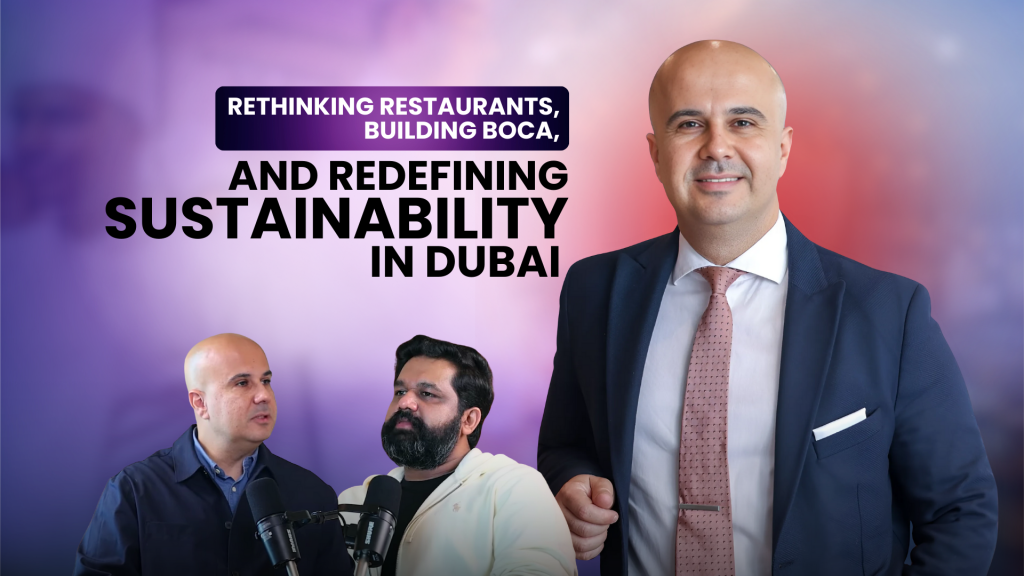

Dubai’s dining scene is often defined by glitz, rapid expansion, and imported restaurant concepts. Yet in the heart of DIFC, Omar Shihab has spent the last decade charting a different path with BOCA. His philosophy centers on integrity, people-first leadership, and a bold belief that sustainability isn’t just possible in a desert city, it can set new global benchmarks. In this conversation, Shihab reflects on his early shocks in hospitality, the values that shaped BOCA, and how staying small, intentional, and grounded eventually led to Michelin recognition.
When you first entered restaurants, what were the early shocks?
Omar Shihab: The restaurant business is an all-rounder’s game. You deal with contractors, mechanics, chefs, IT, media, and guests, all at once. And it’s high intensity, high urgency because the restaurant is always open. Things go wrong daily; Murphy’s law is your best friend. The biggest shock for me came from working with franchise partners. For example, Café Florian’s Italian owners insisted on replicating their model exactly even though in Dubai, a luxury space without hot food made no sense. We tried creating a localized version, but there were conflicting visions. That back-and-forth drained resources and eventually made us realize that building something original was the only way forward.
When you first started running restaurants, what aspects of operations challenged your expectations the most?
Omar Shihab: I’ve always been a people person. I like making collective decisions, gathering feedback from the ground up, and rethinking what’s taken for granted in restaurant operations. My mindset has always been: why should we follow rules just because someone said this is the only way to run a restaurant? We’re a young nation, evolving rapidly. People’s lifestyles change, so restaurants must adapt. At the core, restaurants are people serving people, guests and staff alike. I wanted to prioritize treating staff well while ensuring financial sustainability. That balance, human perspective versus profitability was my biggest challenge early on.
What traits from that first career helped shape the way you run BOCA today?
Omar Shihab: Integrity was the biggest one. I remember my first year, being thrown into a boardroom to defend numbers we had published in a report, numbers that affected executive bonuses. We had to justify everything down to the decimal point. That taught me to never make claims I couldn’t defend. Today, when we talk about sustainability at BOCA, those numbers must be real. Transparency and honesty are non-negotiable.
The second was people management. Leading teams across Africa and Europe required building trust remotely. That experience made me value mindset and attitude over just skill sets, something I still apply when hiring in hospitality. And third, public speaking. Leading conferences on emerging tech like cloud computing in my twenties gave me confidence to tell stories, something I now do for BOCA whether it’s about our ingredients or sustainability practices.
You touched on people management. In an industry known for high turnover, how does your leadership style impact your team?
Omar Shihab: Hospitality is notorious for attrition, especially in a transient city like Dubai. Skills can be taught, but mindset and loyalty matter more. We recruit for attitude, then support staff with fair pay, proper hours, flexibility, and, importantly, belonging. Life happens, people get sick, face family issues abroad, or go through struggles. How you show up for them in those moments builds loyalty.
At BOCA, we also invest in educating staff about sustainability, so they feel part of a bigger mission. Sometimes, though, the simplest thing is just listening. People often don’t want solutions; they just want to be heard. That’s leadership, too.
Let’s talk about BOCA itself. For someone who hasn’t dined there, what’s the concept?
Omar Shihab: BOCA has been evolving for over 10 years. From day one, it was about proving Dubai could create a homegrown, world-class concept. We’re based in the DIFC area, designed for people living and working nearby, business professionals, colleagues, friends, families. We’re not stiff fine dining, but we’re not casual fast food either. We sit in that middle ground: great food, excellent service, accessible pricing, and without unnecessary fluff. And because we’re homegrown, we always tie back to Dubai and the UAE, whether through ingredients, partnerships, or storytelling.
And how did sustainability become such a core pillar of BOCA?
Omar Shihab: It happened as Dubai’s gastronomy scene matured. Around the time homegrown restaurants began to rival international imports, voices like Samantha Wood started highlighting local culinary heroes. We wanted to amplify that show the world what a Dubai restaurant could look like.
We doubled down on sourcing locally where possible. With our chefs, we researched what fish, produce, and products grow here. We visited fish markets at different seasons, spoke with the Ministry of Fisheries and Climate Change, and studied food security initiatives. We saw local farms like Pure Harvest Smart Farms and Dibba Bay Oysters emerge. We built relationships not just with suppliers, but with their stories because restaurants are also storytellers.
Was sustainability also about economics and supply chain control?
Omar Shihab: Absolutely. Getting closer to the source meant better margins, unique products, and resilience against dependency on importers. For example, we learned that popular fish like hammour were overfished. Instead, we started experimenting with underutilized species that were abundant and delicious. That required time, research, trials, R&D but it gave us exclusive ingredients, stronger supplier relationships, and more predictable supply chains.
Most chefs here don’t have that time. They rely on purchasing departments and middlemen who naturally push high-margin imports. We took it upon ourselves to break that cycle, prove local can be world-class, and build an economic case for sustainability, not just a moral one.
Cloud kitchens are another example. I once spoke at a ghost kitchen conference in Texas, and when I broke down the economics, I told operators they couldn’t make money in 200 years running only cloud kitchens. The room laughed nervously but agreed. What’s your take?
Omar Shihab: I share your skepticism. At one point, we were bombarded with proposals to jump into cloud kitchens “get in now before it’s too late.” But the economics rarely make sense. I see cloud kitchens as a tool, not a replacement. They can help extend reach or test new markets, but they’re not a substitute for a real restaurant experience. The obsession with them felt like another tech-driven distraction rather than a sustainable model.
With such strong principles, why hasn’t BOCA expanded to multiple outlets in the last ten years?
Omar Shihab: Because we wanted to build on solid ground. For me, BOCA needed to be more than a profitable restaurant; it needed to embody a hospitality model rooted in sustainability and integrity. We bootstrapped, without access to massive funds, so we couldn’t afford to chase trends or quick wins. There were countless proposals: franchises, capital, partners but most looked unsustainable long-term.
We chose to focus on one location, refine it, and prove the ethos works. Now, after ten years, we’re ready. We’re upgrading our flagship in DIFC to reflect today’s evolved market, and we’re preparing to take BOCA’s heart and ethos to new locations in Dubai, Abu Dhabi, and beyond.
How did you resist the distractions like capital, partners, Saudi expansion over a decade?
Omar Shihab: It was about staying true to who we are. We didn’t want to chase every shiny opportunity. Hospitality is infrastructure-heavy; you can’t just depreciate restaurants overnight. If you open for short-term gains, you won’t last. We wanted longevity. So yes, it meant saying no many times to tempting offers. But it also meant building a legacy that will stand the test of time.
Let’s talk about Michelin. How did the Michelin Green Star happen, and how has it changed life at BOCA?
Omar Shihab: Post-pandemic, our team set a clear intention: we wanted to take ourselves seriously and move to the next level. That meant tightening everything professional execution of food, clarity in sourcing, transparent storytelling, service, communication everything.
We then amplified our story through the right people: chefs with the right mindset, opinion leaders, journalists, and industry colleagues who believed in what we were doing. These weren’t just PR stunts. It was consistent communication, from the way our menu is written to the tone of service to the details we share. Guests themselves became storytellers.
Eventually, Michelin, World’s 50 Best, and others took notice. They listen to the community, to the buzz, and to the voices that amplify genuine efforts. And in our case, they recognized something unusual serious sustainability efforts in Dubai, a city not exactly known for its sustainability efforts. That contrast drew attention.
You mentioned that sustainability in Dubai is being met with skepticism. How do you address that?
Omar Shihab: That’s true. Many visitors, especially from abroad, ask: “Sustainability in Dubai? Really?” They associate the UAE with oil wealth and consumption. But we show them that our sustainability is organic, built from the ground up.
We don’t claim to be 100% farm-to-table or 100% local because that’s not realistic. Instead, we focus on responsible sourcing, waste management, staff welfare, and community integration. Real impact isn’t just about food miles. It’s about how produce is grown, who’s behind it, and how resources are managed. That’s the broader spectrum of sustainability that we follow.
You also claim BOCA runs on 100% renewable energy. How is that possible in the heart of Dubai’s financial center?
Omar Shihab: We partnered with a carbon management consultancy called Element Six, which audited our entire footprint energy, water, gas, food sourcing, guest commutes, and waste. Since we couldn’t install solar panels on our building, they connected us with the Mohammed bin Rashid Solar Park.
There, solar panels generate the equivalent of the energy BOCA consumes annually. This power goes into the Dubai grid, and we receive internationally recognized certificates (IRECs) to validate our offset. It’s a marginal additional cost, but it supports the city’s renewable energy growth from below 5% today to a projected 15% in the next five years.
Conclusion
For Omar Shihab, BOCA has always been more than just a restaurant. It’s a living case study in how integrity, people-first leadership, and sustainability can coexist in one of the world’s most fast-paced dining markets. From resisting the lure of expansion to earning Michelin’s Green Star, his journey shows that growth doesn’t have to come at the expense of principles. In a city often defined by spectacle, BOCA’s story is proof that patience, authenticity, and responsibility can build a legacy that lasts.