
A cloud kitchen license cost in Dubai ranges from AED 17,000 to AED 27,500 for a mainland setup, covering the trade license, food license, and mandatory permits. Total setup costs run from AED 30,000 for a shared pod to AED 220,000 for a multi-brand hub, depending on your kitchen model, location, and staffing plan.
Understanding the key cloud kitchen license costs in Dubai before business setup will help you make informed choices about location, ownership structure, and operational model.
A cloud kitchen is a food preparation facility built exclusively for delivery orders, with no dine-in space or customer-facing storefront. Also called a ghost kitchen, dark kitchen, or virtual kitchen, this business model uses shared or standalone commercial kitchen space to prepare food for delivery platforms like Talabat and Deliveroo.
What You Will Learn
- How much a cloud kitchen license costs in Dubai in 2026, including mandatory permits and approvals.
- The total investment and monthly operating costs for shared kitchens, standalone setups, and multi-brand hubs.
- How mainland and free zone licenses differ in fees, ownership, and market access.
- The documents, inspections, and steps required to obtain and renew a cloud kitchen license.
- How to budget for hidden expenses, manage delivery commissions, and plan for profitability.
Why is Cloud Kitchen a Thriving Business in Dubai?
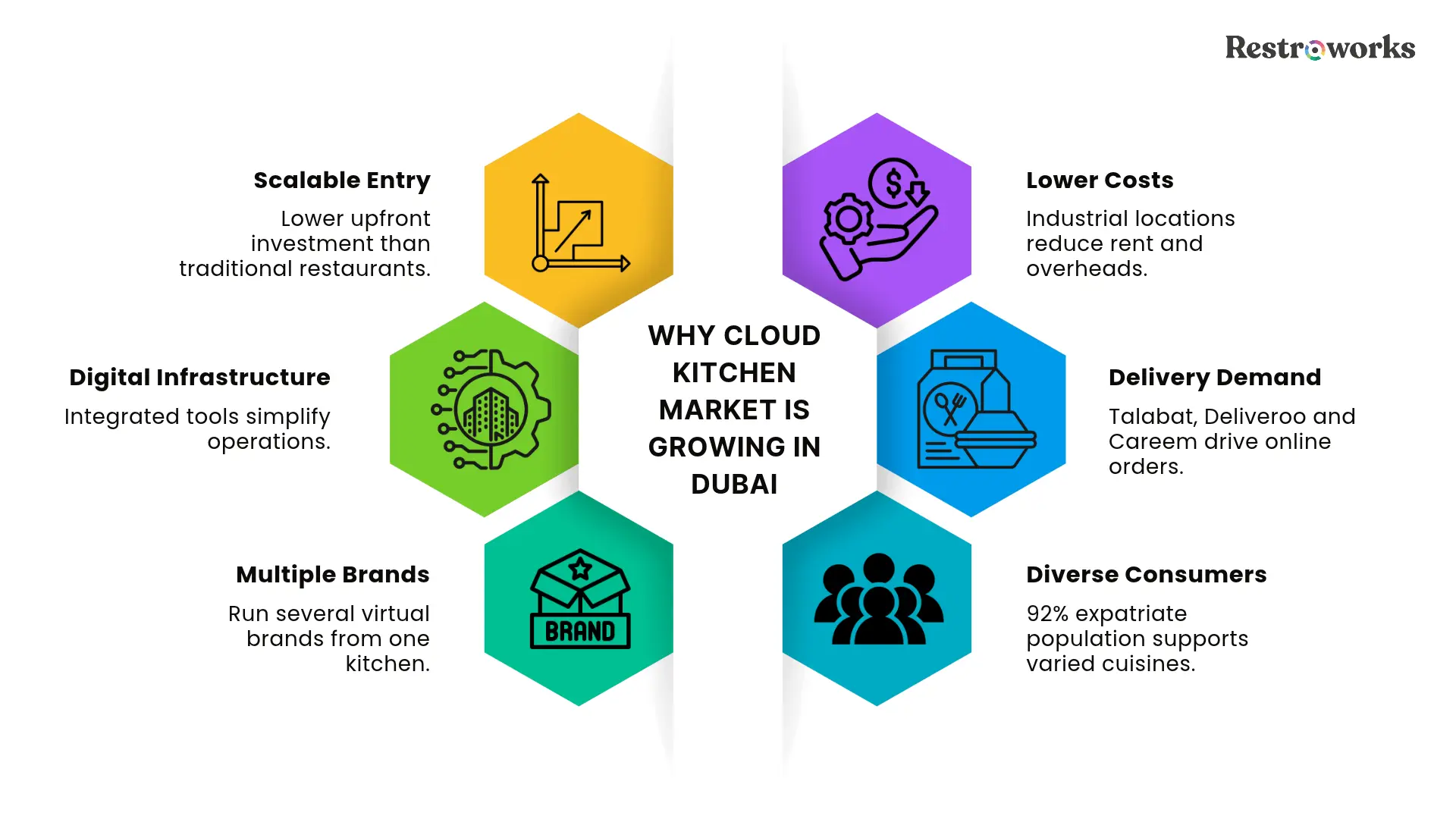
Dubai’s cloud kitchen sector is growing because traditional restaurants require premium real estate in high-footfall zones, while cloud kitchens operate in industrial or low-rent areas at a fraction of the cost. A delivery-first consumer culture led by Talabat, Deliveroo, and Careem creates steady demand. Diverse culinary needs from a population where 92.02% are expatriates allow operators to run multiple virtual brands from a single kitchen.
Strong digital infrastructure supports centralized restaurant management and integrated delivery operations. Combined with lower upfront investment than traditional restaurants, cloud kitchens offer a scalable entry into Dubai’s food and beverage industry. If you already operate in Dubai’s food service sector, skip ahead to the licensing breakdown below for costs and regulatory detail.
According to Coherent Market Insights’ 2025 UAE Dark Kitchens Market Report, the UAE cloud kitchen market was valued at USD 430 million in 2025 and is projected to reach USD 1082.6 million by 2032, growing at a 14.1% CAGR. As of 2021, over 400 cloud kitchen brands operated from approximately 80 locations across the city.
Globally, the market is valued at USD 82.5 billion in 2025 and projected to reach USD 263.3 billion by 2035 at a 12.3% CAGR, per Research Nester.
INDUSTRY INSIGHT
Shared kitchen rental in the UAE typically ranges from AED 5,000–15,000 per month depending on location and station size. This low-risk entry point makes shared kitchens the recommended starting cloud kitchen model.
Choosing Your Licensing Route: Mainland vs Free Zone
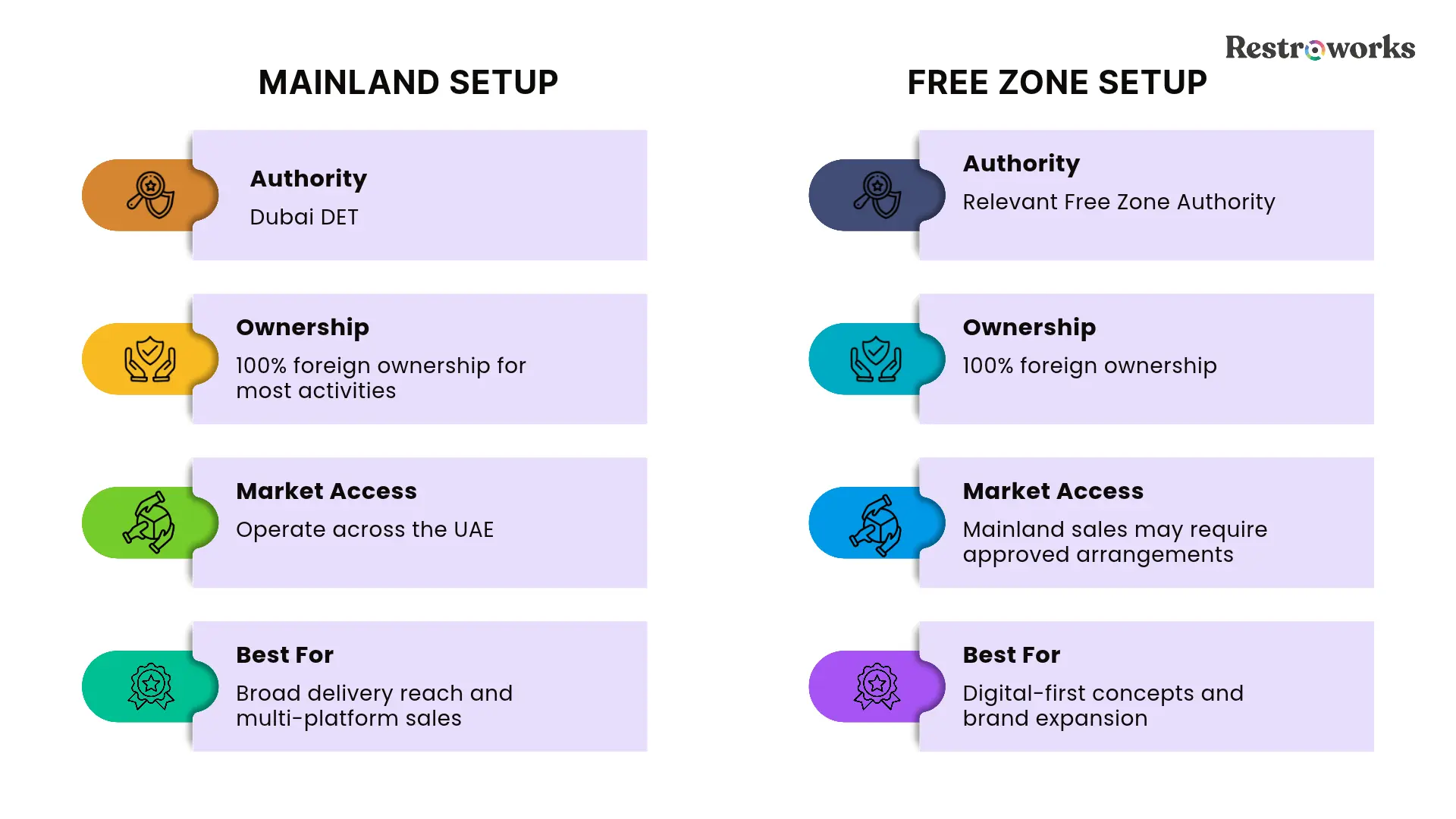
Choose the correct licensing route for your brand:
A. Mainland Setup
A mainland cloud kitchen is registered with the Dubai Department of Economy and Tourism (DET), formerly the Department of Economic Development. This business setup route allows you to operate anywhere in Dubai and across the UAE. DET classifies cloud kitchens under activities like “Food Preparation” or “Restaurant Without Seating,” mapped to ISIC Rev.4 Class 5610 (Restaurants and mobile food service activities).
Ownership: Most food-related activities now allow 100% foreign ownership, eliminating the need for a UAE national partner. Some may still require a UAE partner. Read source.
Market access: You can operate across the UAE without restrictions, including listing on delivery platforms like Talabat, Deliveroo, and Noon Food, or managing your own delivery fleet.
B. Free Zone Setup
Free zones like Dubai CommerCity, Dubai Multi Commodities Centre, Dubai South, and Meydan Free Zone offer streamlined business setup and 100% foreign ownership, suiting entrepreneurs focused on digital-first operations.
- Trade license: Issued by the relevant Free Zone Authority under activities like “Cloud Kitchen Operations” or “Food Services.”
- Ownership: No local sponsor required. You retain full control of your food business and intellectual property.
- Market access: Free zones restrict direct trading with mainland customers unless you appoint a local distributor or use third-party delivery services.
- Multi-brand potential: You can operate multiple brands from a single kitchen, ideal for testing niche cuisines or scaling delivery-only concepts with multiple virtual brands.
The two most common documentation errors that cause delays are submitting an unregistered lease (missing Ejari for mainland setups) and providing kitchen layout plans that do not match the physical space during inspection. A free consultation with a business setup advisor can help identify requirements specific to your jurisdiction.
How to Obtain a Cloud Kitchen License in Dubai?
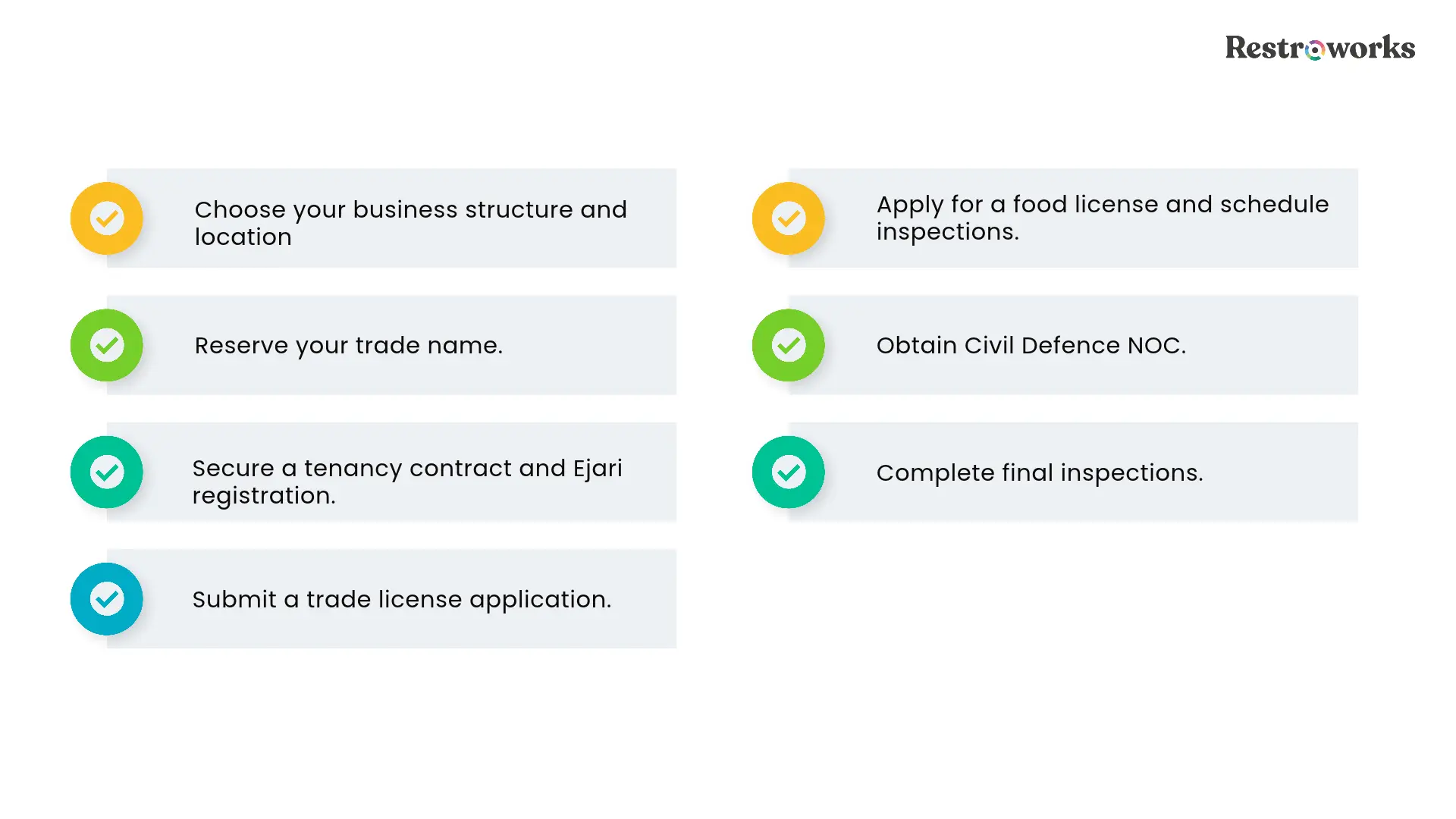
The licensing process typically takes four to seven weeks for standalone kitchens. Shared kitchen operators report two to four weeks, while standalone build-outs—where the food license and Civil Defence NOC run sequentially after trade license approval—extend to seven weeks. Trade name registration and tenancy contracts run in parallel, while the food license and Civil Defence NOC are sequential, and the food license application must precede the Civil Defence inspection. Working with a food safety consultant (AED 3,000–8,000) before submitting applications helps avoid failed inspections and resubmission delays.
- Choose your business structure and location. Decide between mainland (DET) or free zone licensing based on market access needs and budget. Secure a kitchen space, either a shared facility or a standalone unit.
- Reserve your trade name. Register via the DET portal or your chosen free zone portal. The name must comply with UAE naming conventions.
- Secure a tenancy contract and Ejari registration. Shared kitchen providers typically supply these. For standalone kitchens, ensure the space is zoned for food preparation.
- Submit a trade license application. Submit to DET or the relevant Free Zone Authority. Most trade licenses are issued within 5–7 working days.
- Apply for a food license and schedule inspections. Submit kitchen layout plans, food safety protocols, and food waste management contracts to Dubai Municipality.
- Obtain Civil Defence NOC. Dubai Civil Defence inspects fire suppression systems, emergency exits, and ventilation.
- Complete final inspections. Dubai Municipality conducts a final inspection covering food storage, hygiene stations, and waste disposal. Once approved, you can begin operating.
Cloud Kitchen License Renewal Costs and Timeline
Mainland license renewal ranges from 8,000 to 15,000, and Free Zone license renewal ranges from 5,750 to 20,000. Dubai Municipality food license renewal requires a fresh inspection; budget AED 800–1,500 for audit and re-inspection fees. [Flag: Inaccurate figure. Price ranges from 1,000 to 2,000. Renewals must be completed before expiry; late renewal incurs fines starting at AED 1,000. Start the renewal process at least 60 days before the license expiry date.
Dubai Municipality Inspection Requirements and Fees
Dubai Municipality inspections cover kitchen layout, food storage, hygiene stations, pest control, and waste disposal. Sources mention that price depends on a per-square-foot and per-visit basis. Inspectors typically visit within two to three working days of application. The most common reasons for failing the initial inspection are non-compliant ventilation specifications, incomplete pest control contracts, missing food waste management agreements, and expired food handler certifications. Each failed inspection adds two to three weeks to the licensing timeline.
Common Mistakes and Hidden Costs When Setting Up a Cloud Kitchen
First-time operators frequently encounter these avoidable setbacks during cloud kitchen setup:
- Wrong activity code: Selecting an incorrect DET activity code (e.g., “catering” instead of “Restaurant Without Seating”) delays approval by two to four weeks while the application is resubmitted.
- Missing pest control contract: Dubai Municipality requires a signed pest control contract before issuing a food license. Arranging one after the inspection delays approval.
- Incorrect ventilation specifications: Commercial kitchen ventilation must meet Dubai Municipality standards. Retrofitting a non-compliant kitchen after fit-out costs AED 5,000–15,000.
- MOHRE screening delays: Employment visa processing includes Ministry of Human Resources and Emiratisation screening, adding one to two weeks if documentation is incomplete.
Practical Tips for the Cloud Kitchen Licensing Process in Dubai
Choose the Right Jurisdiction: Mainland setups offer broader market access; free zones provide 100% foreign ownership and faster business setup. Consider setup costs, scalability, and scope, not only the legal structure.
Start with a Shared Kitchen: Shared kitchens offer fully equipped spaces with flexible lease terms. This low-risk cloud kitchen model reduces upfront investment and simplifies compliance, making it the recommended approach for a first cloud kitchen in Dubai.
Budget for Legal Support: Outsource initial business setup to consultants, then internalize renewals and aggregator onboarding. Include legal costs in your business plan.
Plan for Renewals and Hidden Costs: Annual renewals, inspection fees, and aggregator commissions add to operational costs. Budget 15–20% above initial setup costs. A centralized platform software helps track expenses, manage multiple virtual brands, and monitor delivery efficiency across platforms.
Case Study: Kitopi, Scaling a Cloud Kitchen in Dubai
Kitopi launched in Dubai in January 2018 as a managed cloud kitchen platform, operating more than 60 kitchens across the UAE, Saudi Arabia, Kuwait and Bahrain by 2021. In an interview with Entrepreneur Middle East, co-founder Mohamad Ballout described a model that helps restaurant brands expand without building and managing every kitchen themselves. Wamda’s analysis highlighted the company’s “democratised infrastructure,” which combines kitchen facilities, supply chains, technology, and trained staff to support brand expansion.
Kitopi raised US$ 415 million in a Series C round in July 2021, which was subsequently extended by another US300 million. In 2022, the company broadened its strategy beyond cloud kitchens to include investments in restaurant brands and dine-in experiences, while also streamlining its workforce. The broader lesson for cloud kitchen operators is to validate demand, establish repeatable operating processes, and assess location-level economics before expanding. Shared kitchens can reduce initial infrastructure costs, but operators should evaluate licensing requirements, operating expenses, and profitability for each proposed location.
Cloud Kitchen Profitability and ROI in Dubai
A cloud kitchen in Dubai typically nets 15–20% of revenue after all costs, with breakeven within 12–24 months. Multi-brand operators running three or more virtual brands report margins at the higher end.
Consider a multi-brand operation in a shared facility with monthly rent of AED 10,000. If three brands generate a combined monthly revenue of AED 90,000, the operation incurs AED 22,500 in platform commissions (25%), AED 27,000 in food costs (30%), AED 15,000 in staff costs, AED 5,000 in facility management fees, and AED 3,000 in packaging and marketing expenses. Including rent, total monthly costs amount to AED 82,500, leaving approximately AED 7,500 in operating profit—a margin of 8.3%, before any additional unaccounted expenses, taxes, or depreciation. In comparison, a single-brand operation generating AED 30,000 in monthly revenue may struggle to cover similar fixed and operating costs, potentially resulting in a loss.
Cloud kitchen customer acquisition cost in the UAE typically runs AED 25-60 for aggregator placement & promos to AED 5-20 for direct/organic. Using social media platforms, food bloggers, and platform-sponsored promotions typically reduces acquisition costs versus relying solely on organic placement.
However, the cloud kitchen concept does not guarantee profitability. Local Kitchens, a US operator, closed about half of its 13 locations despite USD 40 million in funding; high setup costs combined with thin delivery margins leave no room for error if order volumes fall short.
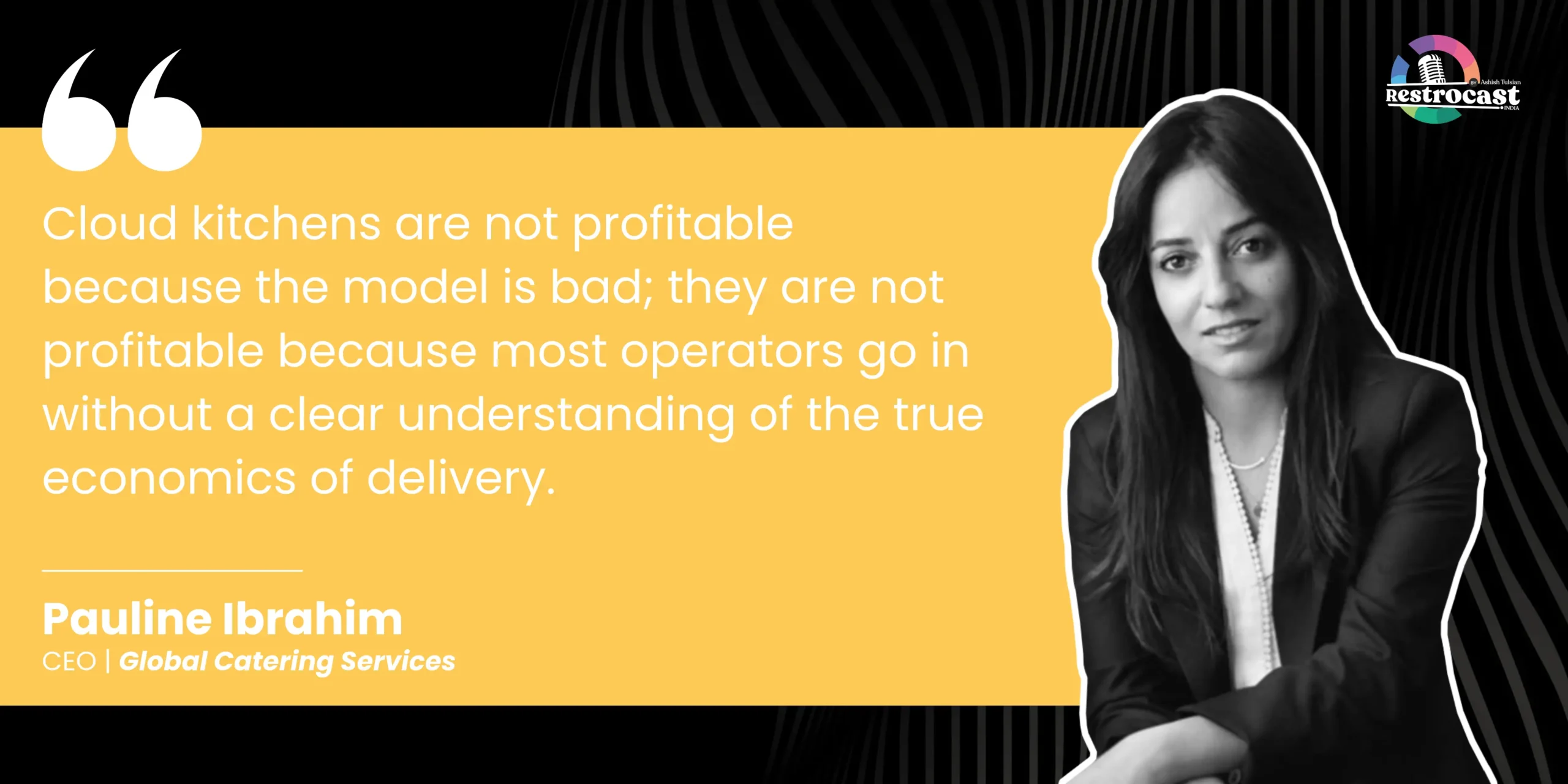
Pauline Imbrahim appeared on the Restrocast Podcast with Ashish Tulsian and explained the importance of understanding the economics of the cloud kitchen model to improve profitability.
Tax Obligations
Cloud kitchen operators in the UAE must register for VAT if their taxable supplies and imports exceed AED 375,000 over the previous 12 months, or if they expect to exceed this threshold within the next 30 days. The standard VAT rate is 5% on taxable supplies, which generally includes restaurant food sales. At 30 orders per day with an average order value of AED 40, monthly revenue reaches AED 36,000, or AED 432,000 annually. At this rate, the business would exceed the AED 375,000 threshold in approximately 10.4 months, assuming all sales count as taxable supplies and revenue remains consistent. Operators should monitor their rolling 12-month turnover and register when the legal criteria are met, rather than waiting until the threshold is crossed.
Separately, UAE corporate tax is charged at 0% on taxable income up to AED 375,000 and 9% on the portion exceeding AED 375,000, subject to the applicable rules. Eligible UAE resident businesses with revenue of AED 3 million or less in the relevant tax period and all previous tax periods may elect for Small Business Relief, subject to the qualifying conditions and exclusions. As of August 2026, the relief has been extended to tax periods ending on or before 31 December 2029. Businesses should confirm their eligibility and filing obligations with the Federal Tax Authority before relying on the relief.