

In 2025, the first digital impression defines the restaurant industry. Before a diner ever steps into a restaurant, they’ve likely already Googled it to check the ratings, analyze the menu, and maybe even decide based on a one-star review from three months ago.
In fact, nearly 94% of diners use online resources, including Google, social media, and media sites, to discover new restaurants through effective restaurant marketing. From “best Thai lunch near me” to “affordable Instaworthy cafes,” restaurant Google searches have become more hyper-intentional and definitive than ever.
As a result, what people search on Google reveals a lot about what they value, what they’re looking for, and how they make decisions when picking a restaurant. This blog dives into the latest Google restaurant search statistics to see how it impacts the restaurant business.
Key Google Restaurant Search Statistics
Google remains the dominant platform for restaurant discovery. 62% of consumers find restaurants through Google, surpassing other platforms like Yelp or social media.
Understanding how consumers use Google to find and choose restaurants offers valuable insights into their preferences and decision-making processes.
Here are some key statistics to know about when analyzing Google restaurant search trends-
- 40% of consumers use Google Search to find new restaurants, while 38% rely on food delivery apps.
- Consumers are increasingly seeking immediate dining options, leading to an increase in “near me” searches on Google. Interestingly, searches for “food near me” increased by 99% year-over-year, while “food near me open now” surged by 875%.
- Over 60% of restaurant searches originate from mobile devices.
- Online reviews significantly impact consumer choices, as 92% read restaurant reviews before deciding where to eat.
- 88% of diners trust online reviews as much as personal recommendations.
- 87% of customers engage with businesses with a 3-4 star rating on Google.
- On average, restaurants get 7x higher views on their Google Business Profile than on their website.
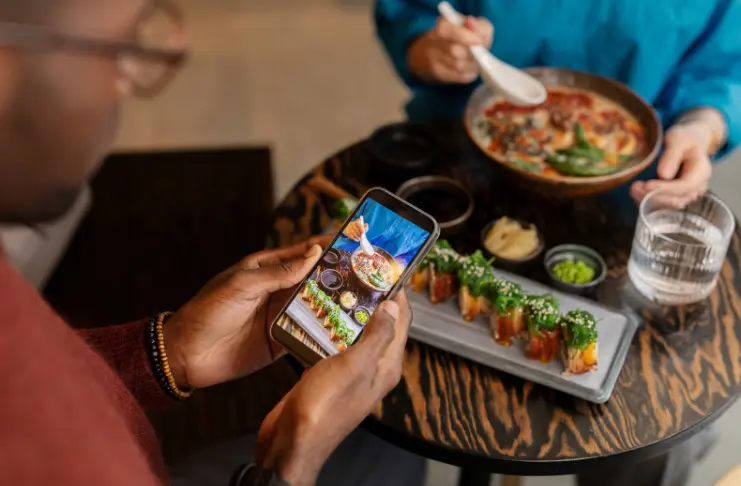
- High-quality visuals are crucial to online restaurant presence, as 40% of people visit a restaurant after checking out the food pictures.
Top Google Restaurant Search Trends in 2025
Diners are getting far more specific in their Google searches, signaling a shift toward highly personalized and convenience-driven dining decisions. Here’s a closer look at what’s trending in restaurant-related searches this year, aiming to attract more diners.
1. Niche Search Queries
Gone are the days when users discovered new places to eat with simple searches like “restaurants near me.” Now, searches like “late-night vegan tacos” or “kid-friendly sushi bar” are becoming common. This trend reflects how diners seek experiences that meet particular eating preferences. For instance, the query “hot honey pizza” has increased by a staggering 232% year-on-year in 2025.
2. Hyper-Local Search
Hyperlocal searches—those including precise locations or followed by “near me” or “close by” have increased by 900% in the last two years.
This significant rise indicates a growing consumer reliance on immediate, location-based searches. Diners are seeking quick solutions, emphasizing the importance of maintaining accurate and up-to-date online information for restaurants.
3. Multilingual Searches
Another way consumers have localized Google restaurant search is by using other languages in their search queries to reach new audiences.
For perspective, there’s been a growing demand for businesses to cater to Spanish-speaking customers in the U.S., with a surge in Spanish search terms like “restaurants cerca de mí”, meaning “restaurants near me” in Spanish.
Given the trend, restaurants that focus on translating their menus or ads into Spanish or other languages can cast a wider net to attract more customers, while keeping the advertising costs low.
INDUSTRY INSIGHT
Local SEO Strategies to Improve Restaurant Search Visibility
1. Optimizing Google Business Profile
Beyond just basic business information, an optimized Google Business Profile with up-to-date hours, high-quality photos, and detailed attributes like “wheelchair accessible” or “outdoor seating” can boost your profile’s online visibility. At the same time, visuals and specifics help potential diners feel confident choosing you.
2. Using “Menu” and “Order” Features Directly on Google
Integrating your menu and online ordering right into your Google listing removes friction for customers in the ordering process.
3. Focusing on User-Generated Content (UGC)
Encourage guests to post photos and answer questions on your listing. Fresh user content signals activity to Google’s algorithm and builds trust with prospective customers, establishing the restaurant’s credibility.
4. Location Pages for Multi-Location Restaurants
For restaurants with multiple outlets, dedicated location pages tailored to neighborhood keywords can improve relevance and capture the local foot traffic that the Google listings alone can’t fully reach.
5. Optimizing Google Map Listing
It’s a simple step with a massive impact: claiming and verifying your Google Maps listing ensures your restaurant appears accurately when diners search nearby.
Conclusion
Today’s restaurant discovery journey begins long before a customer walks through the door; it starts with a search. For operators, this shift demands continuous attention to evolving search behavior, platform updates, and user preferences.
Understanding these key Google restaurant search statistics will give restaurants a competitive edge in adapting to changing market dynamics, ultimately attracting more customers and emerging as customers’ first choice.