


In 1960, Edmund Jerome McCarthy coined the theory of marketing mix. Later, Jerome McCarthy developed the concept into a model using the 4Ps: Product, Price, Promotion, and Place.
Fast forward to 2024, these 4Ps are still the fundamental benchmark for marketers to meet their marketing objectives. However, there have been changes in implementing these 4 p of marketing for a restaurant after 60 years. As for restaurant marketing, the relevance of the 4Ps lies in their ability to provide a robust framework for strategic brand positioning. A key advantage is their adaptability to market changes.
As consumer behaviors and market dynamics shift, restaurants can swiftly adjust their strategies. For instance, the rise of food delivery apps necessitates evolution in the place element, while digital marketing facilitates broader online audience reach.
This adaptability ensures the continued effectiveness of the 4 P of marketing for a restaurant.
By understanding these essential marketing mix elements, you can develop targeted strategies to enhance your restaurant’s visibility and attract more customers.
Whether it’s optimizing your menu to highlight more than just the food, implementing a strategic direct mail campaign to reach potential diners, or refining your pricing strategy to maximize profitability, this guide will provide valuable insights to help you elevate your restaurant’s marketing efforts. By incorporating effective marketing strategies such as inbound marketing and collaborating with local businesses to expand your reach, you can effectively allocate your marketing budget and develop a targeted promotional strategy tailored to the unique needs of your food business.
We have also discussed the strategy-in-action of a famous fast food chain, after reading it you might just say “I’m lovin’ it”!
What Are the 4 Ps of Marketing for a Restaurant?
1. Product:
In restaurant marketing, products can be tangible items, like the food prepared with intangible services offered during dining. Factors like quality, design, usability, packaging, color, branding, size, consumer expectations, market demand, product lifecycle, and competition are crucial to enhancing consumer attractiveness. Analyzing these factors ensures the product meets and exceeds customer desires, standing out as a leader in a competitive market.
2. Price:
In restaurant marketing, setting the price involves balancing costs with the value customers see. This decision is vital for achieving the restaurant’s goals, whether attracting more customers with lower prices or setting a premium with a well-known brand. Strategies like penetration or skimming adjust to production costs, customer value perception, and discounts. Thus, restaurants carefully choose prices to attract a wide customer base, ensuring market presence and profitability.

3. Promotion:
In Restaurant marketing, the target audience makes decisions based on the popularity of the restaurant and its unique features, such as cuisine, dining experience, and venue ambiance.
For a robust restaurant marketing plan, marketers do traditional advertising, branding, public relations, personal selling, direct marketing, online marketing, and special promotions for events and days such as Christmas Day. It is the marketer’s onus to decide the promotion approach based on his findings about the target audience.

4. Place:
“Place” refers to strategically considering a restaurant’s location and methods to distribute its services and products. It includes the establishment’s physical location, aimed at being accessible and attractive to its target market; the distribution channels, which may encompass dine-in, takeout, delivery, or online ordering systems; and efforts to ensure that the restaurant and its offerings are readily available to the intended customers, precisely where and when they desire. As a crucial element of the marketing mix, “Place” significantly influences a customer’s access to the restaurant’s services, affecting their overall dining experience.
A restaurant can stay ahead of its competitors by using the 4Ps. For a successful marketing plan, analyze your competitors and target audience to integrate each component thoroughly. A detailed marketing analysis through the lens of the 4Ps can build the swot analysis related to the product’s nature, price, the chosen place for distribution, or promotional tactics. Promotional techniques can include utilizing digital marketing, influencer marketing, and eye-catching promotion, using social media.
Incorporating social media integration and maintaining an engaging business page can ensure consistent branding and messaging across platforms. By offering unique promotions while maintaining the same price point, restaurants can attract more customers and achieve their business objectives. Additionally, fostering social media interaction with customers can enhance engagement and build brand loyalty over time.

Product: The Heart of Your Restaurant
1. Importance of a Well-Defined Menu:
A well-defined menu is pivotal as it communicates the restaurant’s identity and influences consumer choices. It should be an effective marketing tool highlighting the restaurant’s best offerings and a cost-control mechanism. A strategically designed menu can guide customers toward more profitable items and enhance their dining.
2. Strategies for Menu Innovation:
Approximately 60% of diners use a restaurant QR code menu or promotional offers. It means that innovation keeps a menu fresh and appealing. Restaurants can introduce VR views to balance the ideal with real-world simulations.
Moreover, there should be a provision to update the menu, even with small changes. This practice keeps customers engaged and interested. The restaurants can integrate global flavors and consider customer feedback.

Quality and Presentation of Food Items:
The quality of food is a trust builder, and it directly impacts customer satisfaction and return visits.
Moreover, Food presentation, or ‘Plating,’ is crucial in enhancing the dining experience by engaging the senses beyond taste, such as sight. An appealing plate can make food more delicious, highlighting the importance of color, texture, and arrangement. Historical practices, evolving from elaborate feasts to modern minimalist designs, reflect its significance in culinary arts. Chefs leverage presentation to create first impressions, engage multiple senses, and differentiate their dishes. Thoughtful plating shows effort, injects personality, and encourages mindful eating, underlining its role in a meal’s enjoyment and the establishment’s reputation.
Tips on Additional Product Offerings:
- Diversify revenue through branded merchandise like unique sauces, or gift vouchers, many companies started selling merch during the pandemic to help recover lost revenue. Moreover, it is a great way to advertise.
- Expand reach with catering services and meal kits for at-home use.
Price: Striking the Right Balance
Striking the right balance with pricing is necessary. A well-thought-out pricing strategy ensures survival and propels a restaurant to new heights of success. Let’s dive into the critical aspects of pricing.
1. Importance of Setting Competitive Prices
Competitive pricing is crucial in attracting customers and making them revisit your venue. Restaurants should mark prices that align with what customers expect and are willing to pay while also considering the prices set by competitors.
Since 46% of diners consider menu price a vital factor in choosing a restaurant, your restaurant must meet the need for prices that resonate with market standards and customer expectations.
2. Utilizing Pricing Strategies
Pricing your restaurant menu requires considering your restaurant’s type, including all costs (raw materials, labor, décor, maintenance) plus a projected profit to calculate the Gross Margin Value (GMV), aiming for 60-65% depending on the restaurant type (75% for fine dining, 55% for casual dining, 45% for QSR). Exotic cuisine can command premium prices due to perceived value.
Pricing must also consider the right quantity, avoiding common pitfalls of over or undercharging. Featuring a “Chef’s Special” in each menu section attracts customers looking for exclusive options, and subtle pricing strategies like omitting currency signs or placing prices at the end of descriptions can psychologically influence spending. Complimentary item pricing boosts sales of related items. Markup pricing covers costs and ensures profit margin. Offers and experiences can offset the perception of high-priced items.

3. Menus
Effective menu design boosts restaurant profits by emphasizing profitable items, facilitating upselling, and reflecting the brand consistently across all platforms. The design process involves:
- Organizing items and strategic pricing.
- Writing enticing descriptions.
- Selecting brand-aligned colors.
- Careful layout planning.
- Proper use of high-quality dish photos can further attract customers. Overall, a well-designed menu guides customer choices, enhances sales, and strengthens the restaurant’s brand identity.
Pro Tip: To create a menu that everyone loves and stays ahead of trends, consider these points:
- Know Your Customers: Do your homework. Use surveys, interviews, or look at what sells best and what your customers say to understand what food they like or can’t eat.
- Mix in World Flavors: America loves a mix. Bring in dishes from around the world to catch the interest of those eager for new and different flavors.
- Keep It Varied: Make sure your menu has something for everyone. Have options for different diets like vegan, gluten-free, or low-calorie.
- Go Seasonal and Local: Use ingredients that are in season and nearby. This keeps your dishes fresh and in line with what’s currently popular.
- Let Customers Personalize: Offer dishes they can customize, like salads or pizzas they can build themselves, to fit their exact wants and needs.
- Reimagine Favorites: Give classic dishes a new twist to make them exciting again and give diners a reason to choose you.
- Think Health: More people want to eat healthily. Include options that are good for them but still taste great.
4. Combos
Implement combo offers in your restaurant’s menu to attract groups and individual diners alike. Offer big meal bundles for 3-4 people, fixed discounts on selected meal combinations, and enticing deals like “buy one, get one free” to double the value.
Highlight a free dessert option with specific combos to make them irresistible. For customization, introduce meal bundles that allow for variations in sides or additions for an extra charge, catering to diverse customer preferences and enhancing the dining experience.

5. Loyalty Programs
To increase loyalty program sign-ups, use customer-facing devices for easy opt-in, promote benefits through email newsletters, and capture sign-ups with digital receipts.
Link rewards to credit cards for automatic points and offer a mobile app for tracking rewards. Effective incentives include welcome drinks, free appetizers, meal discounts, and free delivery, balancing attractiveness with cost-effectiveness to boost customer loyalty and retention.
6. Dynamic pricing
Implement dynamic pricing in your restaurant by integrating sophisticated POS software, focusing on enhancing sales without compromising service speed or customer experience. Key steps include defining your business objective (e.g., boosting sales or profits), deciding on a competitive pricing strategy, establishing consistent pricing rules, and monitoring the strategy’s impact for adjustments. Notable examples include Alinea’s discounted rates during off-peak times and Bob Bob Ricard’s varied pricing for different times of the day, demonstrating the effectiveness of dynamic pricing in attracting customers and managing demand.

Place: Convenience is Key
The right location is critical for your restaurant’s success. It directly impacts its ability to attract and retain customers. Key factors to consider include:
- Target Audience: Choose a location where your potential customers live or frequently visit, based on a clear understanding of their demographics and preferences.
- Accessibility: Opt for a spot that’s easy to reach by public transportation, has plenty of parking, and is convenient for pedestrians and drivers.
- Visibility: A location easily seen by passersby can attract more walk-in customers, reducing the need for heavy advertising.
- Competition: Balance the benefits of being near other restaurants for increased foot traffic against the risk of too much competition.
- Safety: A safe neighborhood is more inviting to customers, enhancing their dining experience.
- Regulations: Familiarize yourself with local zoning, health regulations, and permit processes that could affect your operation.
- Cost: Consider the location’s affordability versus its potential for drawing in business. Prime spots cost more but can lead to higher sales.
- Space and Expansion: Ensure the space meets your current needs and allows for future growth.
A strategic location can turn a restaurant into a thriving business by maximizing visibility and customer base in a competitive market.

How can you create a welcoming and memorable dining experience?
Creating a welcoming and memorable dining experience extends beyond the restaurant’s physical location, including streamlined online ordering and swift delivery.
Starting with a simplified reservation process, utilizing technology like POS systems for easy table bookings, and ensuring exceptional hospitality from guests arriving enhances the experience.
A warm ambiance, influenced by cleanliness, lighting, and music, sets the stage. Quick ordering, facilitated by technology, ensures efficiency, while consistency in food quality remains paramount. Easy payment options and actively seeking customer feedback are crucial steps in crafting a memorable dining journey, making every visit unforgettable.
As the customers tend to compare the dining experience, a good dining experience is their natural choice including the benefit of word-of-mouth publicity.

Promotion: Getting Your Message Out
A well-thought promotion strategy is vital for the following reasons:
- To position a restaurant among competitors.
- To attract new clients and promote loyalty.
- To create awareness of the restaurant’s unique offerings
- To cultivate interest and demand, compelling customers to take action.
From ensuring your restaurant stands out with a strong brand identity to engaging potential customers with enticing calls to action, the essence of marketing lies in its continuous nature, constantly adapting to achieve the best investment-to-results ratio.
his involves implementing effective promotional activities both online and offline, fostering a cohesive corporate brand presence across all touchpoints, and participating in local events to connect with the community. Don’t forget to prominently display your website address in all marketing materials to drive traffic and encourage online engagement with your brand.
Various Marketing Channels of Promotion
Leveraging a mix of promotional channels is crucial for a comprehensive marketing approach:
- Online Ordering System: An internal system increases convenience for customers, allowing orders directly from their couch or table, enhancing the dining and ordering experience.
- Website and Search Engine Optimization: A well-designed restaurant website boosts online visibility, attracting more customers through search engines. Incorporating SEO & focusing on increasing local search optimization practices ensures your restaurant ranks high in relevant searches.
- Google Business Profile: A complete profile on Google increases your restaurant’s online presence, making it easier for customers to find and choose your establishment based on reviews, images, and critical information.

- Email Marketing: Targeted email marketing campaigns can encourage repeat business and higher-value orders, utilizing tools like automated marketing modules for direct mail campaigns will help to enhance efficiency.
- Social Media: Active engagement on platforms where your target audience spends their time can significantly increase your restaurant’s reach to drive online traffic for higher customer engagement.
- Digital Promotions: Technology allows for real-time updates to promotions on your menu, appealing directly to customers with offers that are hard to refuse.
[Case Study] Extended Restaurant Marketing Mix in McDonald’s Strategy
The 4Ps mentioned above have now evolved into 7Ps. To help give you a practical understanding of these 7Ps we have explained how McDonald’s uses these 7Ps in their marketing strategy:
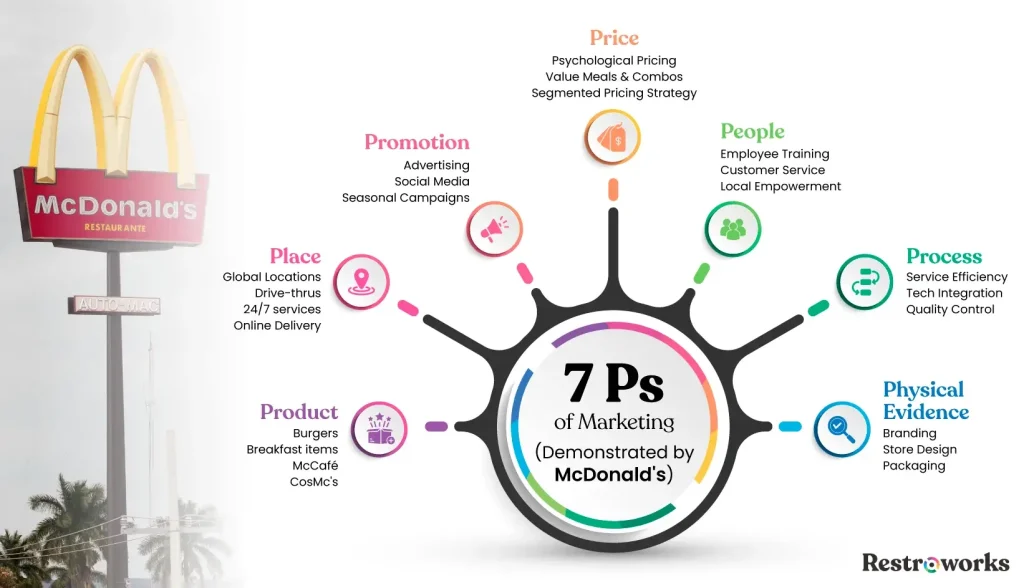
1. Product:
McDonald’s product mix includes multiple food items like ice cream, fries, burgers, meals, coffees, shakes, McCafe, and desserts, with burgers being the most iconic. By diversifying its offerings to include chicken, fish, and breakfast items, and adding kid’s meals with toys, its newest venture CosMc’s, a chain of restaurants focusing on coffee and other drinks is another great example of expansion to compete with competitors.
2. Price:
McDonald’s uses psychological pricing to trick customers into thinking that they can order more items. Their pricing strategy is usually set to appeal to middle class or lower middle sections especially young teens and adults who are brand savvy and want to spend less money.
3. Promotion:
McDonald’s exemplifies a globally recognized brand with its iconic “I’m Lovin’ it” slogan and logo. Their strategic, culturally diverse menus ensure global relevance and appeal. Moreover, they keep the brand relevant with their innovative advertising and social media presence.
4. Place:
McDonald’s has many locations spread across malls, airports, and other food courts that make them accessible. Some of their outlets have a drive-thru or are open 24 hours a day to ensure convenience.
5. People
The ‘People’ component is critical, with McDonald’s employing over two million globally. The franchise model empowers local business owners, while crew members are essential in delivering the customer service that McDonald’s is known for.
6. Process
McDonald’s excels in ‘Process,’ implementing systems for fast and efficient service. From the assembly line approach in the kitchen to streamlined ordering through McDelivery, McDonald’s focuses on customer convenience and speed.
7. Physical Evidence
The ‘Physical Evidence’ of McDonald’s success is visible in its universally recognized logo and the consistent design elements across its global restaurants. Even in unique locations, McDonald’s maintains its brand identity, reinforcing its market position.
Conclusion: 4 P of Marketing for a Restaurant
The grasp of the foundational 4Ps and the expanded 7Ps of marketing by restaurant owners marks a critical step toward strategic adaptation and growth. The thoughtful application of these frameworks allows for an effective response to evolving consumer behaviors and competitive market dynamics. This effective strategy positions restaurants for sustained success, navigating through the complexities of the industry with a well-rounded perspective on product offerings, pricing, promotional strategies, and place considerations, alongside the added dimensions of people, processes, and physical evidence.
By understanding their target customers and effectively leveraging content marketing strategies, restaurant owners can enhance their brand image and appeal to specific market segments. Implementing strategic print media campaigns and optimizing profit margins further contribute to brand strengthening and long-term success in the competitive restaurant industry.